Address
304 North Cardinal
St. Dorchester Center, MA 02124
Work Hours
Monday to Friday: 7AM - 7PM
Weekend: 10AM - 5PM
Address
304 North Cardinal
St. Dorchester Center, MA 02124
Work Hours
Monday to Friday: 7AM - 7PM
Weekend: 10AM - 5PM
A hydroponic tower lets beginners grow fresh food without soil or a yard: water and nutrients circulate from a base reservoir to the top and trickle down past the roots on a timer. Start with easy crops like lettuce, basil, and parsley, keep pH between 5.5 and 6.5, and most towers largely run themselves after a 15-minute setup.
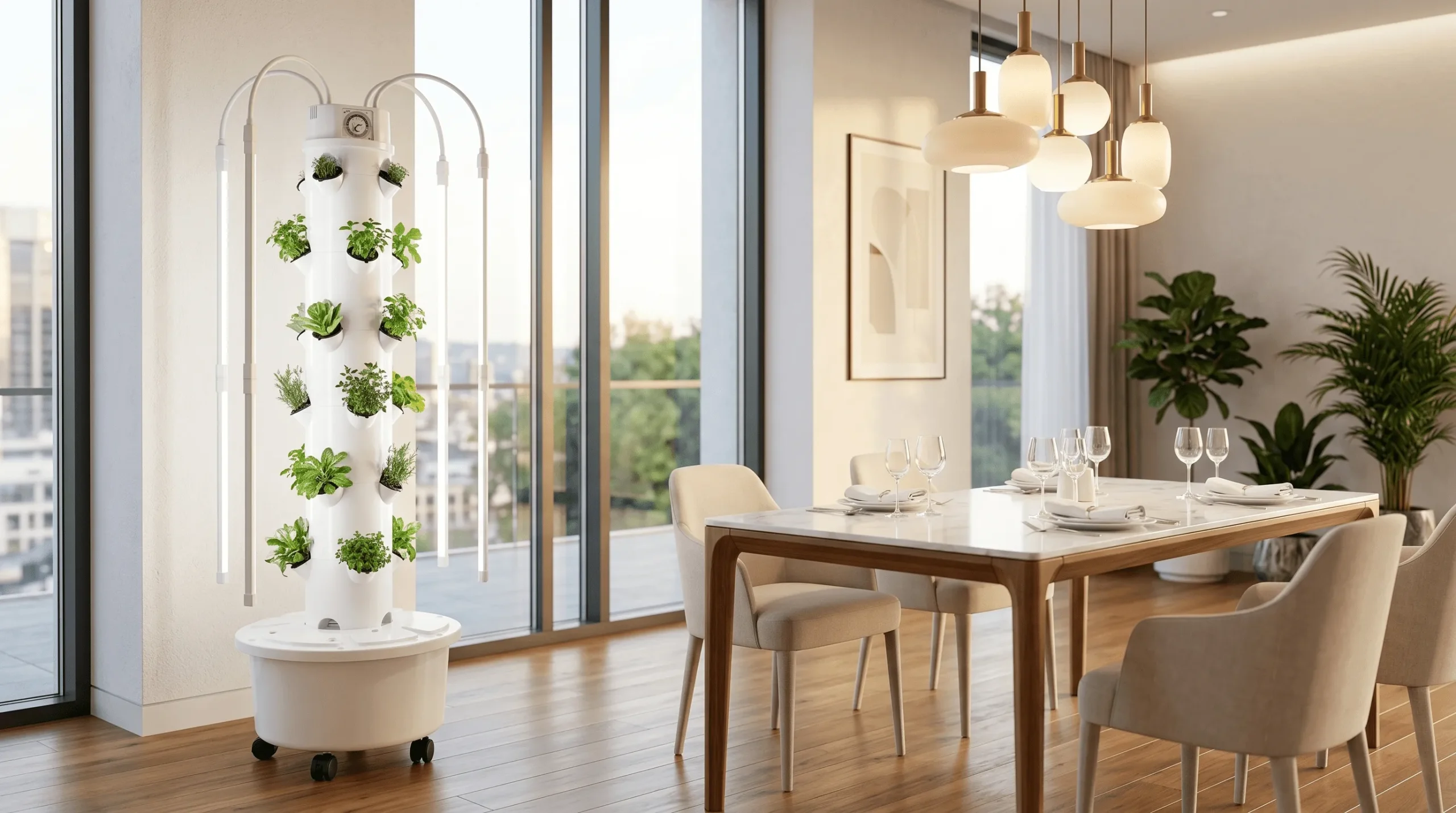
A hydroponic tower is a vertical, soil-free growing system that feeds plants with recirculating nutrient-rich water. For beginners, it’s one of the easiest ways to grow fresh herbs and greens indoors: setup takes about 15 minutes, daily care is mostly checking the water level, and you can harvest your first lettuce in about a month.
You don’t need a backyard, perfect weather, or a “green thumb.” If you live in an apartment or a compact home and you’ve ever wished for fresher herbs than the sad plastic clamshells at the grocery store, a tower is honestly the most practical place to start. Here’s what it actually involves — no hype, no jargon.
A hydroponic tower is a vertical growing structure that holds plants in stacked layers instead of soil. The roots sit in or near a stream of water enriched with dissolved mineral nutrients. A small pump lifts water from a reservoir at the base to the top, and gravity carries it back down past every plant’s roots on the way.
The key idea is simple: plants don’t need soil itself. They need what soil provides — water, nutrients, and physical support. Hydroponics just delivers those three things more directly. NASA has been researching exactly this approach for growing food in space since the 1990s, which tells you something about how well the underlying science is understood.
Because the design goes up instead of out, one tower can hold 24 to 96 plants in under 3 square feet of floor space. That’s the harvest footprint of a much larger soil garden, standing in the corner of your kitchen.
Every tower runs on the same four ingredients: water, nutrients, light, and oxygen. Here’s the daily cycle in plain terms:
Your actual job in all of this: keep the reservoir filled, keep the pH between 5.5 and 6.5 (the standard availability window cited by Missouri Extension’s hydroponic nutrient guide), and harvest. That’s the whole routine.
Start with herbs and leafy greens. They’re fast, forgiving, and — this matters more than people admit — they’re the things you’ll actually cook with. Nothing kills a new hobby like nursing a plant for two months that you don’t even like eating.
| Crop | Days to first harvest | Difficulty | Why beginners like it |
|---|---|---|---|
| Leaf lettuce | 30–45 | Easy | Cut-and-come-again; harvest outer leaves for weeks |
| Basil | 25–40 | Easy | Grows fast, smells great, endless kitchen use |
| Arugula | 25–35 | Easy | One of the fastest crops you can grow |
| Mint | 30–40 | Very easy | Nearly indestructible; contained by the tower (it invades soil gardens) |
| Spinach | 35–45 | Easy | Loves the cool, consistent indoor conditions |
| Cilantro | 30–45 | Easy | Bolts outdoors in heat; stays happy longer indoors |
| Kale | 40–55 | Medium | Slower but harvests for months once established |
My honest recommendation for a first planting: fill half the tower with lettuce and basil, and use the rest to experiment. You’ll learn more from one fast, successful cycle than from any guide — including this one.
Once you’re comfortable, fruiting crops like cherry tomatoes, peppers, and strawberries are absolutely possible in a tower, though they want stronger light and a bloom-stage nutrient formula. Root vegetables like carrots and potatoes, on the other hand, are a poor fit — they need depth a tower can’t give them. For the full rundown, see what you can grow in a hydroponic tower and the best herbs for beginners.
Less than you’d think. The honest starter list:
That’s it. No soil, no bags of fertilizer, no trowels, no weeding tools. The whole kit fits in one box.
Let’s talk real numbers, because this is where most guides go vague.
Time: about 15 minutes for initial setup, then roughly 5 minutes a day — glance at the water level, check that the pump is running. Once a week, spend 10 minutes testing pH and topping up the reservoir. Every 1–2 weeks, mix a fresh batch of nutrients. That’s the entire workload. Compare that to a soil garden’s watering, weeding, and pest patrol, and it’s not close.
Electricity: less than you’d expect. A typical LED grow light draws around 50 watts; run it 14 hours a day and that’s 0.7 kWh daily, or about 21 kWh a month. At the U.S. residential average of roughly $0.17 per kWh (EIA, 2024 — it varies by state), you’re looking at around $3–4 a month, plus a small pump that sips power intermittently. Our full breakdown is here: how much electricity a hydroponic tower uses.
Water: because the system recirculates instead of losing water to soil and evaporation, published comparisons commonly report up to 90% less water use than conventional field growing for the same harvest. Your water bill won’t notice the tower.
Almost everyone makes the same three, so you can skip them:
A fourth, quieter mistake: letting the reservoir run dry. Pumps burn out fast when they run without water, and roots dry out even faster. A weekly water check prevents nearly all of it.
For most people, yes — with one caveat. A tower won’t make you self-sufficient, and it won’t replace the grocery store. What it does remarkably well is turn “I should eat more fresh greens” from an aspiration into something growing three feet from your stove. The harvest is real: cut basil minutes before dinner, at peak freshness, in January.
The people who love tower growing tend to share one trait: they’d rather spend five focused minutes a day on one tidy system than a whole Saturday wrestling a soil garden. If that sounds like you, start small, grow what you eat, and give it one full growing cycle before you judge it. For the complete walkthrough, our hydroponic tower gardening guide picks up where this article leaves off.
No. If you can fill a container with water and follow a mixing label, you can run a tower. The system automates watering; your job is monitoring, not technique.
Typically a few dollars a month — roughly $3–4 for the LED lights at average U.S. rates, plus a small pump. See our full electricity breakdown for the math.
A complete hydroponic fertilizer supplying nitrogen, phosphorus, potassium, calcium, magnesium, sulfur, and micronutrients. Keep pH between 5.5 and 6.5 and EC between 0.8 and 2.0 mS/cm for leafy greens. Details: EC, pH & PPM cheat sheet.
Glance at the level daily (5 seconds), top up weekly, and do a full nutrient refresh every 1–2 weeks. In hot conditions or with thirsty mature plants, check more often.
Yes — that’s exactly what full-spectrum LED grow lights are for. Give leafy greens 12–16 hours of light a day on a timer, and a windowless room works fine.
Fast crops like arugula and basil can be ready in under a month from transplant; most lettuce takes 30–45 days. “Cut-and-come-again” harvesting then keeps you supplied for weeks.
Yes. The nutrients are purified mineral salts — the same elements plants absorb from soil — and indoor growing avoids soil-borne contaminants. Buy fertilizers labeled for hydroponic or food-crop use and mix at label rates.
Research describes general methods; it does not verify any specific model, product claim or customer outcome.
Related reading: how hydroponic towers work, what you can grow in a hydroponic tower, complete gardening guide
We reviewed source material on 2026-10-04.

