Address
304 North Cardinal
St. Dorchester Center, MA 02124
Work Hours
Monday to Friday: 7AM - 7PM
Weekend: 10AM - 5PM
Address
304 North Cardinal
St. Dorchester Center, MA 02124
Work Hours
Monday to Friday: 7AM - 7PM
Weekend: 10AM - 5PM
Two numbers decide hydroponic tower success: pH (5.5-6.5) and EC (0.8-2.0 mS/cm). This guide explains nutrients, target ranges by crop, mixing steps, and beginner mistakes - with a cheat-sheet table.
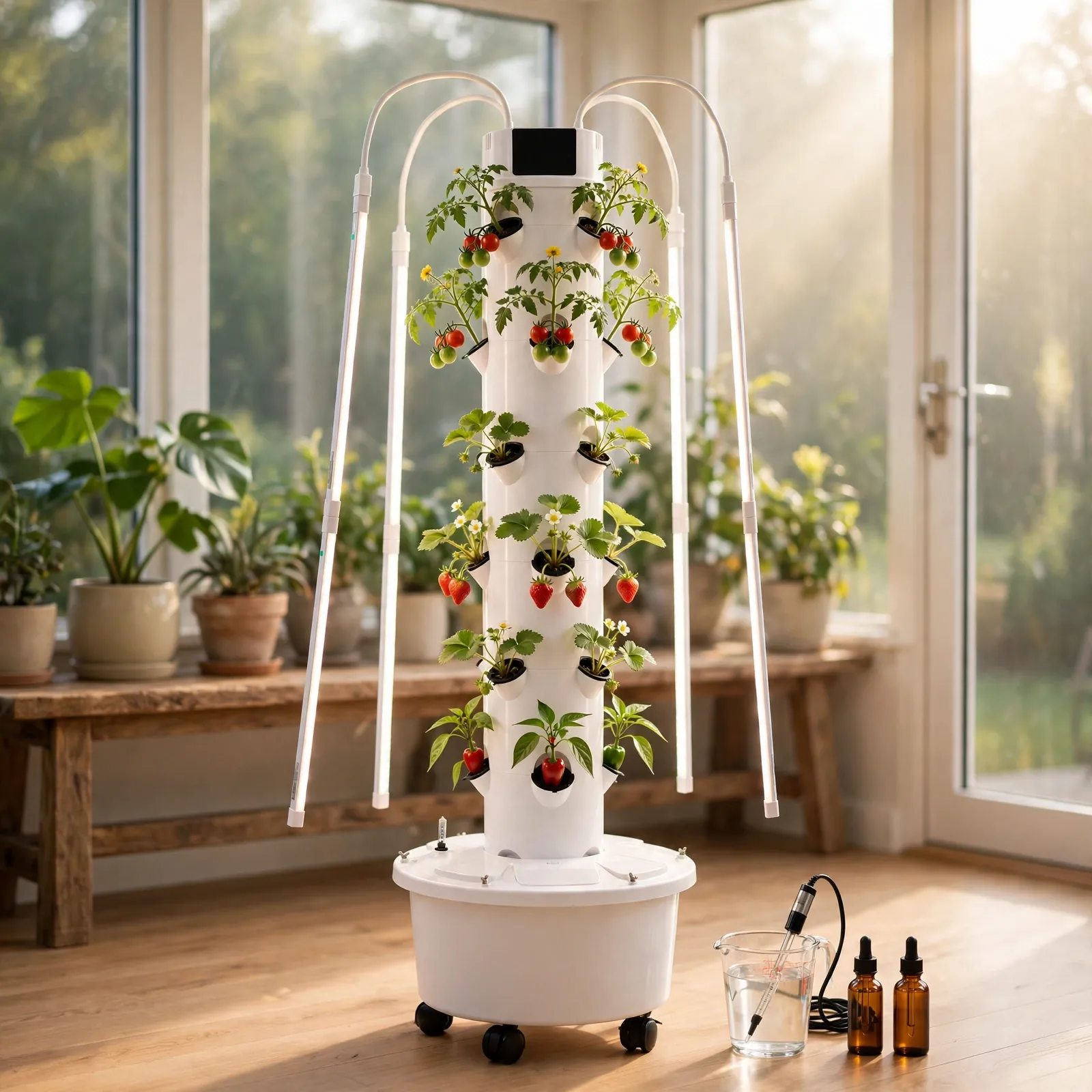
Short answer: Hydroponic tower nutrients are mineral salts dissolved in water that do the job soil normally does. Two numbers decide almost everything: pH between 5.5 and 6.5 for most crops — the standard availability window cited by Missouri Extension’s hydroponic nutrient guide (G6984) — and EC between 0.8 and 2.0 mS/cm depending on crop and growth stage. Measure both with inexpensive meters, adjust in small steps, and refresh the reservoir every one to two weeks. Everything below is the detail behind those two numbers.
If you are new to how the system itself works, read how hydroponic towers work first — this guide picks up where that one leaves off, at the reservoir.

Plants need the same elements whether they grow in soil or water. A complete hydroponic fertilizer supplies macronutrients — nitrogen (N), phosphorus (P), potassium (K), calcium (Ca), magnesium (Mg), and sulfur (S) — plus micronutrients such as iron, manganese, zinc, copper, boron, and molybdenum.
Most quality formulas come in two or three parts for a chemical reason: calcium reacts with sulfates and phosphates to form an insoluble precipitate (the white sludge at the bottom of a badly mixed tank). Keeping the parts separate until they are diluted prevents this — it is the same reason Penn State Extension’s nutrient-mixing guidance stresses correct concentrate handling. That is also why mixing order matters — always add each part to water separately, never pour concentrates directly into each other.
| Metric | What it measures | Healthy range in a tower | Measured with |
|---|---|---|---|
| pH | How acidic or alkaline the solution is | 5.5–6.5 for most crops | pH meter or pen |
| EC | Total dissolved salts (nutrient strength) | 0.8–2.0 mS/cm | EC meter |
| PPM / TDS | Same thing as EC, expressed differently | 400–1000 (500 scale) | TDS meter |
Watch out for the PPM scale trap. PPM is EC multiplied by a conversion factor, and there are two common factors: 500 (NaCl scale, common in the US) and 700 (KCl scale, common in Europe and Australia). The same solution reads 1000 PPM on one meter and 1400 on another — you can see both scales side by side on Current Culture H2O’s nutrient calculator. Whenever you follow a feeding chart, check which scale it uses. This single confusion causes more beginner problems than any other.
pH controls availability: outside the right range, nutrients can be sitting in the reservoir while the plant starves. EC controls strength: too low and growth stalls; too high and roots get burned. You need both numbers; neither one substitutes for the other.
Use these as starting points, then watch your plants — they will tell you if an adjustment is needed. Values are EC in mS/cm. Ranges below are cross-checked against IGWorks’ hydroponic nutrient and pH chart, Missouri Extension’s tomato EC guidance (2.0–3.5 mS/cm for fruiting tomatoes), and the e-Gro lettuce nutrition alert.
| Crop | Seedling EC | Vegetative EC | Fruiting EC | pH |
|---|---|---|---|---|
| Lettuce | 0.6–0.8 | 0.8–1.2 | — | 5.8–6.2 |
| Basil | 0.8–1.0 | 1.0–1.6 | — | 5.5–6.5 |
| Arugula | 0.6–0.8 | 0.8–1.4 | — | 6.0–6.5 |
| Kale | 0.8–1.0 | 1.2–1.8 | — | 5.5–6.5 |
| Cilantro | 0.6–0.8 | 1.0–1.4 | — | 5.8–6.5 |
| Swiss chard | 0.8–1.0 | 1.2–1.8 | — | 5.8–6.2 |
| Strawberry | 0.6–0.8 | 0.8–1.2 | 1.2–1.8 | 5.8–6.2 |
| Cherry tomato | 0.8–1.0 | 1.2–1.6 | 1.8–2.4 | 5.8–6.3 |
| Pepper | 0.8–1.0 | 1.2–1.8 | 1.8–2.2 | 5.8–6.2 |
| Compact cucumber | 0.8–1.0 | 1.2–1.6 | 1.6–2.0 | 5.8–6.0 |
Two data points worth knowing: the e-Gro Alert on lettuce nutrition puts hydroponic lettuce at 150–200 ppm nitrogen (roughly 1.0–2.0 mS/cm) with solution pH held between 5.5 and 6.0, optimal 5.8. And a peer-reviewed vertical-farming study notes extension services recommend EC 0.5–1.6 for lettuce and basil, with growth dropping off measurably below about 0.9 — so don’t starve young plants in the name of caution.
Leafy greens and herbs are forgiving; fruiting crops are not. If you are choosing what to grow in your hydroponic tower, start with lettuce or basil while you learn to read these numbers.
For most home towers, a full reservoir change every 7–14 days works well. Between changes, top up with plain, pH-balanced water — not more nutrient solution — because plants drink water faster than they absorb minerals, and topping up with nutrients steadily drives EC upward.
Change the solution sooner if the EC drifts far from target, the pH swings wildly day to day, the water smells off, or you are switching crops. A full change is also the natural moment for the cleaning routine described in our complete tower guide.
Usually yes, with two checks: measure its EC (above ~0.5 mS/cm, consider filtering) and let chlorinated water sit uncovered for 24 hours or use a dechlorinator, since chlorine can harm beneficial root-zone biology.
Yes — they answer different questions, and guessing either one is the most common reason beginners struggle. Inexpensive pen-style meters are fine to start; calibrate the pH pen monthly.
A slow upward drift is normal: plants absorb negatively charged ions faster than positive ones, and aeration drives off dissolved CO₂. If it rockets up daily, check for algae, decomposing root matter, or a reservoir that is too small for the plant load.
A general vegetative formula works across leafy greens and herbs. Fruiting crops (tomatoes, peppers, strawberries) do noticeably better on a bloom/fruit formula with relatively more potassium and phosphorus once flowering starts.
The minerals themselves are the same ones plants take up from soil, in purified form. Buy fertilizers labeled for hydroponic or food-crop use, mix at label rates, and avoid “bloom boosters” with undisclosed ingredients.
In a cool, dark, sealed container for up to about a week. Light grows algae, warmth breeds microbes, and pH drifts over time — always re-test EC and pH before using stored solution.
We reviewed source material on 2026-10-04.
Research describes general methods; it does not verify any specific model, product claim or customer outcome.
Next in the series: how much electricity a tower really uses, and how to keep it quiet enough for an apartment. Browse all growing guides.

