Address
304 North Cardinal
St. Dorchester Center, MA 02124
Work Hours
Monday to Friday: 7AM - 7PM
Weekend: 10AM - 5PM
Address
304 North Cardinal
St. Dorchester Center, MA 02124
Work Hours
Monday to Friday: 7AM - 7PM
Weekend: 10AM - 5PM
Keep your hydroponic tower's reservoir between 65–75°F — ideally 68–72°F — to hold dissolved oxygen high and root-rot pathogens down. This guide covers how to measure, cool, and warm your tank, and when a chiller is worth it.
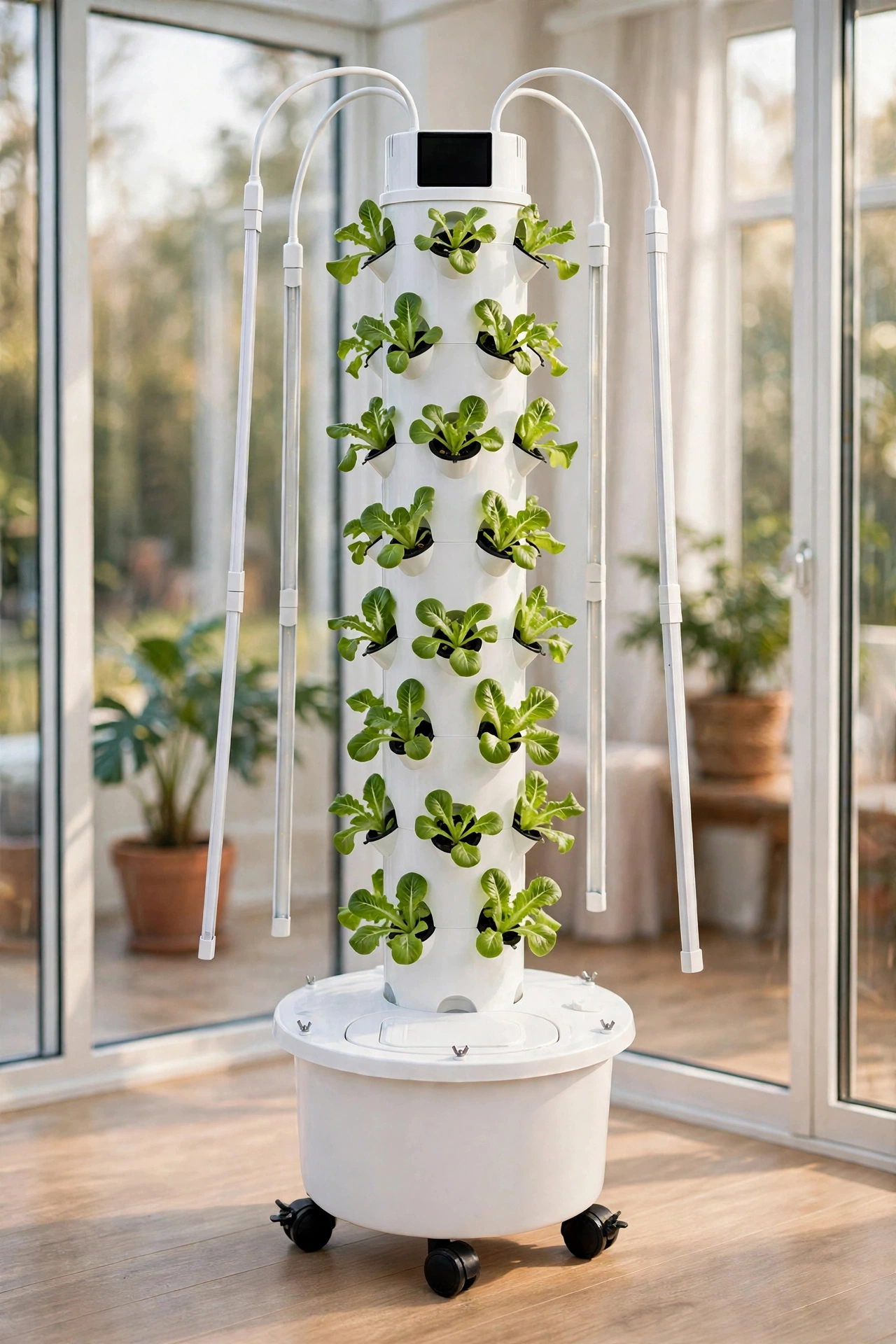

Most hydroponic tower owners obsess over pH and nutrients and never check the one variable that quietly decides whether roots stay healthy: reservoir temperature. The short answer — hydroponic tower water temperature should stay between 65°F and 75°F (18–24°C), with 68–72°F (20–22°C) as the sweet spot — is easy to remember, but holding a tank there through a summer heatwave or a cold garage takes more than a thermometer. Below: why temperature matters for dissolved oxygen and root rot, what to do when the tank runs hot or cold, and when a chiller actually earns its money.
For most leafy greens and herbs grown in a tower, the widely accepted safe range is 65–75°F (18–24°C), and the tighter sweet spot that commercial research keeps returning to is 68–72°F (20–22°C). In that window, nutrient uptake is at its best and dissolved oxygen stays high enough to support vigorous roots while the conditions that favor root-rot pathogens stay suppressed.
Those numbers aren’t arbitrary. They come from greenhouse research on leafy crops, not from anyone’s backyard diary — and the same research is clear about the boundaries.
Two reasons, and they compound each other.
First: oxygen. Water holds less dissolved oxygen as it warms — there is no opinion in that, just physics. At 68°F (20°C), fully aerated water holds about 9.1 mg/L of dissolved oxygen; at 86°F (30°C), that ceiling drops to about 7.5 mg/L (Atlas Scientific). And those are saturation ceilings — in a real tank with a pump running, measured levels often sit below them. Roots need oxygen to respire. When the tank can’t carry enough of it, roots suffocate even while sitting in water.
Second: pathogens. Warm, oxygen-poor nutrient solution is the preferred habitat of Pythium species, the water-borne oomycetes behind most hydroponic root rot. Cornell research on hydroponic spinach found that cooling pond water to about 68°F measurably reduced Pythium aphanidermatum, while low dissolved oxygen and warmer root-zone temperatures reliably increased infection. Cool water doesn’t just feed roots better — it slows the enemy down.
One honest caveat before we go further: a perfect temperature reading is not a harvest guarantee. Temperature is a contributing factor, not a promise — keeping the tank at 70°F won’t save a crop from dirty equipment or bad sanitation. Think of it as necessary but not sufficient.
| Reservoir temperature | What typically happens | What to do | What this table can’t tell you |
|---|---|---|---|
| Below 60°F (16°C) | Nutrient uptake slows; root development can stall. Plants look sluggish even under good light. | Warm the tank gently — see the winter section below. | These are rules of thumb synthesized from greenhouse studies on leafy crops. Your tower’s actual oxygen level depends on aeration and system design, not just the thermometer — a warm, well-aerated tank can hold more oxygen than a cool, stagnant one. Treat ranges as zones, not walls. |
| 60–65°F (16–18°C) | Tolerable but below ideal; growth may be a step slower than at the sweet spot. | Usually fine as-is; warm slightly if you want to optimize. | |
| 68–72°F (20–22°C) | The sweet spot: peak nutrient uptake, high dissolved oxygen, Pythium survival slowed. | Hold it here if you can. | |
| 73–78°F (23–26°C) | Oxygen capacity declining; pathogen risk climbing. Still manageable with good aeration and hygiene. | Cool with passive methods; watch roots closely. | |
| Above 80°F (27°C) | The danger zone. Dissolved oxygen drops sharply and the tank favors Pythium and Phytophthora. Roots can effectively dry out at the cellular level while submerged, because they can’t draw in enough oxygen to function. | Act now: cool the reservoir and consider a chiller if this is routine. |
Slightly. Leafy crops like lettuce, spinach, kale, and herbs are comfortable in the standard 68–72°F window — that’s the range the commercial research measured. Fruiting crops such as cherry tomatoes and peppers tolerate (and in some growers’ experience slightly prefer) the upper end of the range, around 70–75°F (21–24°C), because warmer solution matches their higher metabolic rate. But nothing about fruiting plants changes the ceiling: above 80°F, everyone loses.
If you grow a mixed tower, aim for 68–72°F and don’t overthink it. Splitting hairs between crop types matters far less than staying out of the danger zone. For crop-specific feeding numbers, see our nutrient EC and pH guide — temperature and nutrient management work as a pair.
Don’t guess from the room thermometer — tank water can run several degrees warmer than room air, especially when the pump adds heat and the LED bars radiate down onto the column. Three practical notes:
This is the summer problem, and it’s the one most tower owners meet first. The chain reaction: warmer water holds less oxygen → roots struggle → Pythium finds its ideal habitat → brown, slimy roots and wilted plants that look thirsty while sitting in water. If you see those symptoms, our cleaning and sanitation guide pairs with this one — temperature control prevents recurrence, but it doesn’t sterilize an already-infected system.
No-chiller cooling methods that actually work:
Maybe — but it’s the last resort, not the first step. Try the passive methods above first; many indoor growers never need anything more. A chiller earns its place when:
Sized for a tower’s modest 35L tank, a small 1/10 HP chiller handles the load — this is aquarium-grade equipment, not industrial. The commercial evidence favors it: Cornell researchers found chilling hydroponic ponds to ~68°F to be an effective way to reduce Pythium aphanidermatum in baby-leaf spinach. It doesn’t eliminate pathogens entirely — sanitation still matters — but it takes away their favorite conditions.
The winter problem is the quieter one. Below about 60°F (16°C), root metabolism slows: plants take up nutrients sluggishly, new growth looks pale and stalled, and below ~55°F many plants effectively stop growing. A tower in an unheated garage or a cold sunroom in January can sit in this zone for months.
Warming methods that work:
One warning: never chase temperature swings by cycling a heater hard. Stability beats precision — a steady 66°F serves plants better than bouncing between 60°F and 74°F. Gradual changes; no shocks.
Temperature doesn’t act alone. Warm water increases evaporation from the tank, which concentrates the nutrient solution and nudges EC upward — so a heatwave often shows up as both a temperature problem and an EC problem. Warm water also feeds algae growth on surfaces, and algae competes with plants while fouling equipment. If your temperature correction didn’t fix the symptoms, check EC and pH next: temperature, pH, and EC are a triangle, and diagnosing only one side misleads. Our nutrient guide covers the other two corners, and the cleaning schedule keeps the tank side healthy.
For a full year-round plan — including the cold-month setup this article’s warming section summarizes — see how we keep leafy crops running through winter and browse the Growing Guides archive.
We reviewed source material on 2026-10-22.
Research describes general methods; it does not verify any specific model, product claim or customer outcome.

