Address
304 North Cardinal
St. Dorchester Center, MA 02124
Work Hours
Monday to Friday: 7AM - 7PM
Weekend: 10AM - 5PM
Address
304 North Cardinal
St. Dorchester Center, MA 02124
Work Hours
Monday to Friday: 7AM - 7PM
Weekend: 10AM - 5PM
Kale and Swiss chard are made for hydroponic towers: cool-season leafy greens that reward outer-leaf harvesting. Here's the EC, pH, light, and cut-and-come-again routine that keeps one planting productive for months.
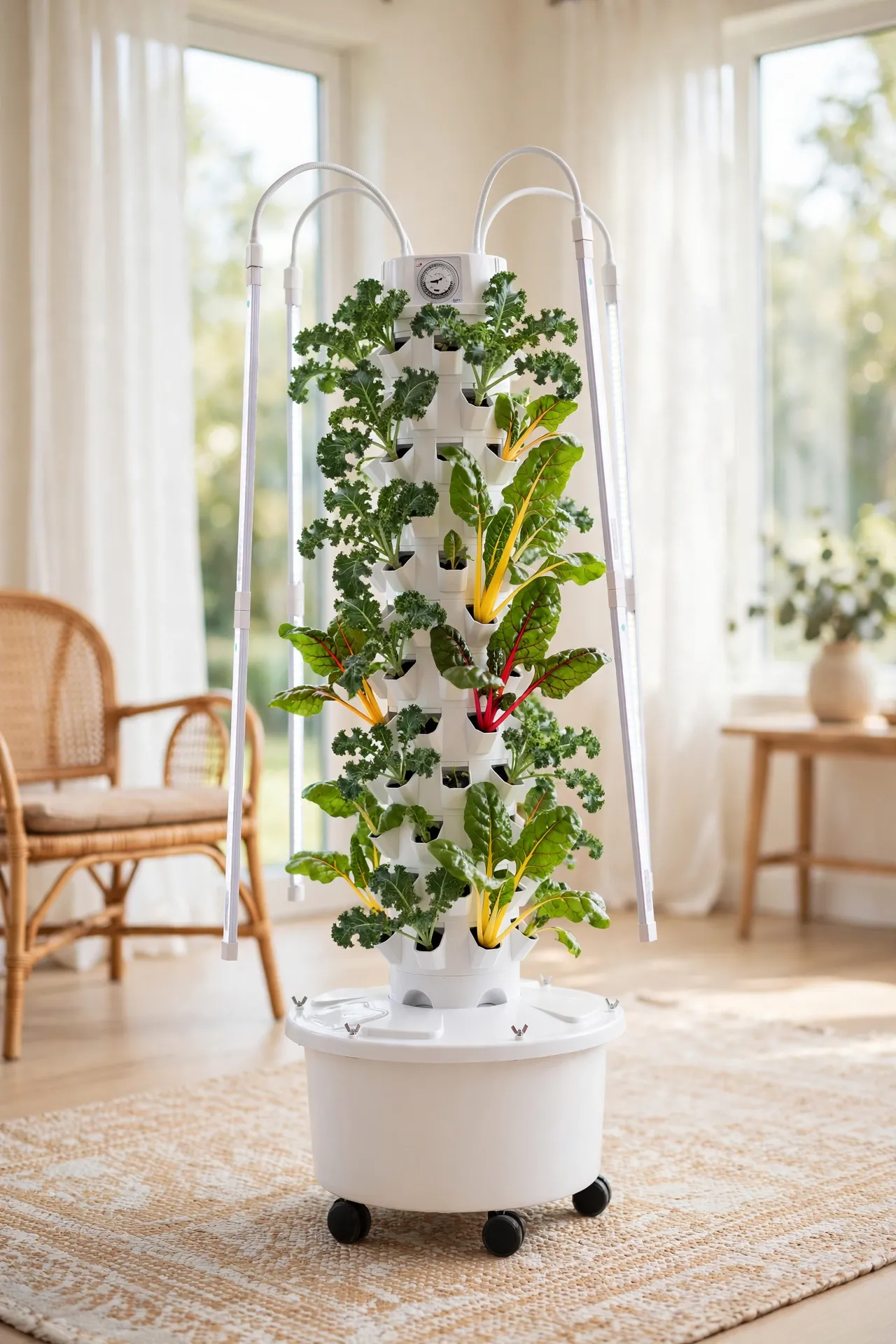
Growing kale in a hydroponic tower is one of the easiest wins in indoor gardening. Run EC 1.6–2.5 mS/cm, pH 5.5–6.5, 14–16 hours of light, and harvest only the outer leaves — the cut-and-come-again method. One planting of kale or Swiss chard can keep feeding you for months.
Kale is also quietly one of the most expensive leafy greens at the grocery store — a small organic bunch routinely costs several dollars. A tower turns that math upside down: a few net cups of kale and Swiss chard, harvested leaf by leaf, can out-produce their footprint for an entire season. No soil, no flea beetles, no weeding. Just weekly handfuls of greens, cut minutes before dinner.

Three things make kale and Swiss chard unusually well suited to a vertical tower — and they all come down to how the plants grow.
First, they’re cut-and-come-again crops. Unlike head lettuce, which gives you one harvest and then it’s over, kale and chard are harvested leaf by leaf from the outside of the plant. Each plant becomes a little greens factory: take the outer leaves, leave the crown, and the center keeps pushing new growth. With weekly harvesting, a single kale plant can stay productive for two to four months before it gets leggy and needs replacing.
Second, they’re cool-season plants that don’t need much light. Fruiting crops like tomatoes demand enormous light and pollination; kale just wants steady light and cool air. A tower’s built-in LED bars plus a decent window spot is genuinely enough — no supplemental rig required for leafy greens.
Third, the indoor environment removes their worst enemies. Outdoors, kale fights flea beetles, cabbage worms, and heat waves. Indoors, those problems mostly don’t exist. What you get instead are manageable indoor issues (aphids, tipburn, leggy growth) that are easier to fix than a caterpillar infestation.
A note on expectations: planting-slot counts are not a harvest guarantee. A tower with 40 slots won’t give you 40 mature kale plants — big varieties need breathing room, and overcrowding is the most common beginner mistake. Plan on one kale plant per net cup, and don’t fill every adjacent cup.
Kale and Swiss chard are medium feeders — hungrier than lettuce, far lighter than tomatoes or peppers. The good news: their targets overlap almost completely, so they share a reservoir happily.
| Parameter | Kale & Swiss chard target | What this number can’t tell you |
|---|---|---|
| pH | 5.5–6.5 | Stability matters more than a magic number. Wild pH swings stress roots more than a steady 6.7 does. |
| EC | 1.6–2.5 mS/cm (800–1250 ppm) | Higher EC does not mean faster growth. Leafy greens plateau, and overfeeding invites tipburn and bitter leaves. |
| Water temperature | 65–72°F (18–22°C) | Warm reservoir water holds less oxygen and invites root problems. Cool water matters more than a perfect EC reading. |
| Air temperature | 55–75°F (kale); chard tolerates up to ~80°F | These are comfort zones, not germination guarantees — your seed packet still rules for sprouting temperatures. |
| Light schedule | 14–16 hours/day; DLI 12–16 mol/m²/day | Total daily light matters more than hours. A bright 14-hour day beats a dim 18-hour one. |
If you want to share the tower with lettuce, run a compromise EC around 1.6–1.8 — both crops stay happy there. Don’t share a reservoir with fruiting crops like cherry tomatoes or peppers: they want stronger nutrients, warmer air, and longer days — the opposite of what keeps leafy greens sweet and tender. For the full nutrient breakdown, see our guide to what grows well in a hydroponic tower.
Variety choice matters more for kale than for most tower crops, because some kales get big. A full-size curly kale can spread two feet wide outdoors. In a tower, compact or upright varieties earn their keep:
For Swiss chard, the main decision is ornamental versus productive:
Whatever you choose, sow one plant per net cup. Kale and chard both develop substantial root systems and broad canopies. For the largest varieties, consider leaving every other cup empty around them — airflow between plants is your best defense against aphids and mildew.
Leafy greens are the least demanding thing you can grow under lights, but “undemanding” still means a real target: aim for a daily light integral (DLI) of roughly 12–16 mol/m²/day, which in practice means running the tower’s LED bars 14–16 hours a day and parking the tower near your brightest window.
A few placement notes that matter more than people expect:
This is the whole technique, and it’s simple — but the details are what separate a plant that produces for a month from one that produces for four:
Think of each plant as a 2–4 month subscription to fresh greens, not a permanent resident. The rotation is the system — and net cups make swapping plants a thirty-second job.
Indoor leafy greens have a short list of usual suspects. Diagnose before you treat:
Kale and chard ask for less attention than almost any other tower crop. A workable rhythm:
That’s genuinely it. Leafy greens don’t need pollination help, pruning schedules, or support stakes — which is exactly why they’re the best first crop for a new tower owner. If you’re still choosing what to plant first, our hydroponic tower gardening guide walks through the full beginner setup.
Yes — indoors you control temperature and light, so cool-season greens grow in any month. Keep the room under 75°F, run lights 14–16 hours a day, and summer heat becomes irrelevant. Sow fresh cups every month and the supply never stops.
Seeds sprout in 5–10 days, and the first outer-leaf harvest comes at 8–10 inches tall, roughly 4–6 weeks from seed. With weekly cut-and-come-again harvesting, one plant can keep producing for 2–4 months before it gets leggy and needs replacing.
Yes, with a compromise: kale wants EC 1.6–2.5 while lettuce prefers 1.2–1.8, so run the reservoir around 1.6–1.8 and both stay happy. Don’t mix either with fruiting crops like tomatoes or peppers, which want much stronger feed and warmer air.
Usually heat stress or an old, under-harvested plant. Keep air below 75°F, harvest outer leaves weekly so no leaf sits too long, and replace plants that have grown a long bare stem. Young, regularly picked leaves are the mildest.
No — their targets overlap almost completely (EC 1.6–2.5, pH 5.5–6.5), so they share a reservoir happily. The main difference is temperature: Swiss chard tolerates a bit more heat before bolting than kale does.
If you only take outer leaves and leave the crown plus a few center leaves, yes — that’s the cut-and-come-again method, and the center keeps pushing new growth. What won’t regrow is a plant cut down to a bare stump; always leave the growing point intact.
Almost always low light. Chard stretches toward weak light and the stems can’t support the leaves. Give it 14–16 hours of strong light, keep it in one of the tower’s brightest tiers, and thin out any neighbors shading it.
We reviewed source material on 2026-10-12.
Research describes general methods; it does not verify any specific model, product claim or customer outcome. Planting-slot counts are not a harvest guarantee.

