How to Clean a Hydroponic Tower: The Algae-Free Maintenance Schedule

Algae loves light, water, and nutrients — exactly what a hydroponic tower provides. This guide gives you a realistic cleaning schedule, a safe step-by-step deep clean, and honest notes on vinegar, hydrogen peroxide, and bleach.
The short answer: A hydroponic tower stays nearly algae-free with a light weekly routine: wipe exposed surfaces, top off the tank, and change the nutrient solution every 1–2 weeks. Deep-clean the tank, pump, and lines every 4–8 weeks. Deny light to the water, and algae loses its main food source.

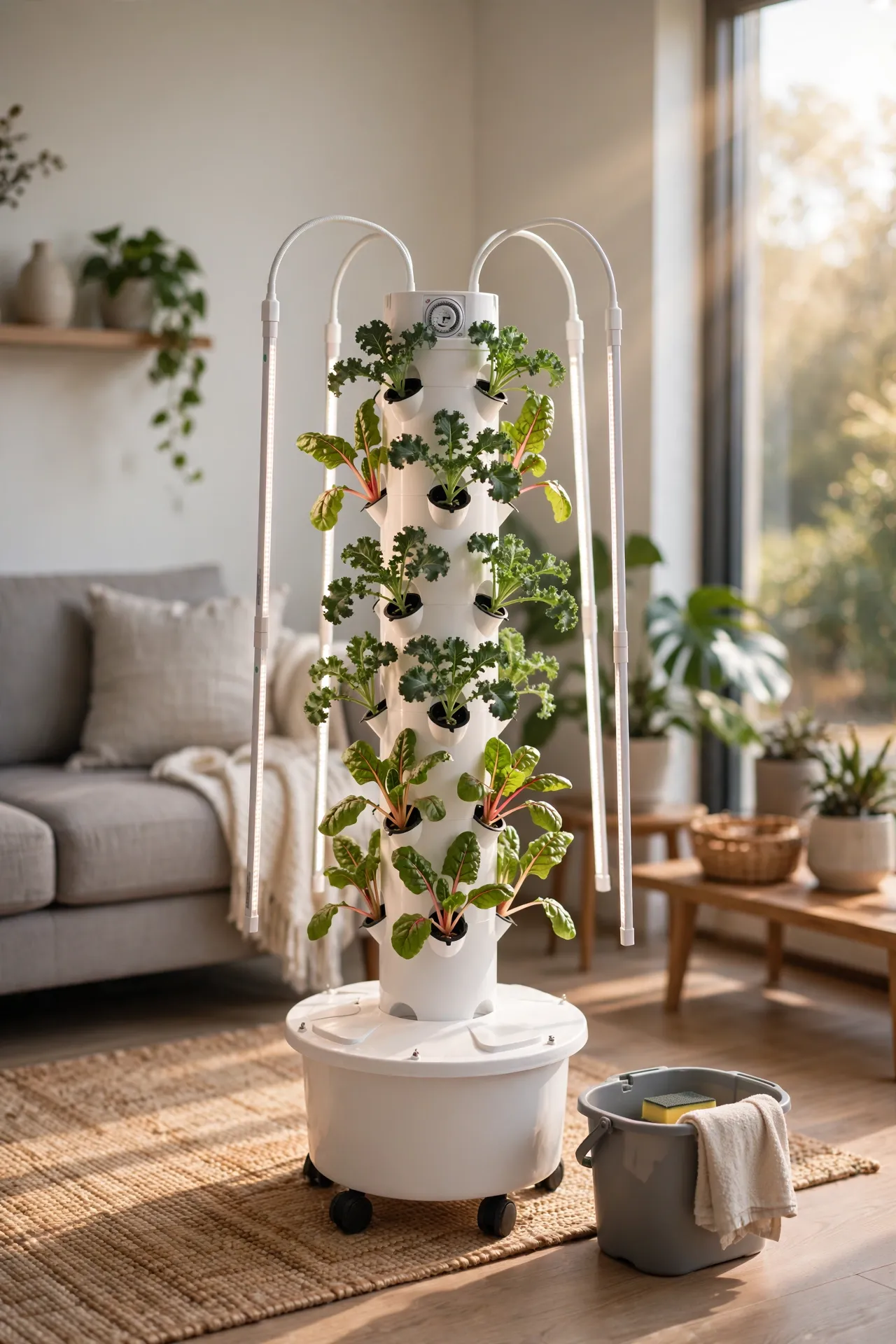
how to clean hydroponic tower — white tower with kale and chard in a living room

Why Does Algae Grow in a Hydroponic Tower?

Algae is not complicated. It needs three things: light, water, and nutrients. A hydroponic tower hands it all three on a silver platter — water and nutrients recirculating around the clock, grow lights on for most of the day.

That is why the first sign of trouble is almost always a green film on the tank wall, the net pots, or anywhere water meets light. Left alone, a thin film turns into slimy mats that can clog drip emitters and the pump intake, and heavy growth competes with your plants for dissolved nutrients. Algae also tends to travel with company: growers frequently report that fungus gnats show up wherever algae is thriving, because the gnats feed on it too.

A useful mental shift: you are not trying to sterilize a laboratory. You are trying to make your tower a bad neighborhood for algae. Algae cannot grow without light, so light control does most of the heavy lifting. Cleaning handles the rest.

What Supplies Do You Need to Clean a Hydroponic Tower?

You already own most of this. A dedicated cleaning kit for the tower keeps things simple:

  • Soft sponge or non-scratch scrub pads (nothing abrasive — scratched plastic gives algae more grip)
  • Bottle brush or pipe cleaners for the water lines and drip emitters
  • An old toothbrush for net pots, the pump impeller, and tight corners
  • 3% hydrogen peroxide from the pharmacy
  • Plain white distilled vinegar for mineral deposits
  • A measuring cup and a spare bucket
  • Gloves and eye protection when handling cleaners
  • Clean towels and a dry spot to lay out parts

Skip anything abrasive or scented. Scrub pads that feel rough enough to clean a grill are rough enough to scuff your tower’s plastic, and scuffs become algae condos.

How Often Should You Clean Your Hydroponic Tower?

Here is a schedule that works for most home towers. It is deliberately boring: algae loses to routine, not to heroic once-a-year scrubs.

TaskFrequencyTimeWhat it doesWhat it doesn’t prove
Visual check + wipe any green film on exposed surfacesWeekly~5 minCatches growth before it matsA wipe-down is not a deep clean; biofilm still builds in hidden spots
Top off the tank, check EC and pHWeekly~5 minKeeps nutrients in rangeBalanced numbers don’t mean the tank is clean
Full nutrient solution changeEvery 1–2 weeks~20 minResets salt buildup and stale nutrientsThe “right” interval varies with crop stage and tank size — heavy fruiters drift faster
Deep clean: tank, pump, lines, emittersEvery 4–8 weeks, or between crops~45 minRemoves biofilm and scaleOne deep clean doesn’t make a tower permanently algae-proof
Inspect pump impeller and intake filterMonthly~10 minPrevents most clogsA clean impeller can’t compensate for a filthy tank

The last column matters. Schedules like this one are condensed wisdom from growers and extension guides — they describe what usually works, not what is guaranteed for your tower, your crops, and your water. If your tank is small or you grow heavy feeders, shorten the intervals rather than debating them.

How Do You Deep-Clean a Hydroponic Tower? Step by Step

Do this between crop cycles if you can. If the tower is mid-harvest, it still works — just keep the plants’ roots in plain water while you work and move quickly.

  1. Unplug everything. Pump, lights, timers. Working around a live pump is how impellers meet fingers and how spills meet outlets.
  2. Move the plants aside. Lift each net pot and set it in a tray or bucket of plain room-temperature water, roots submerged. They are fine for an hour or two out of the tower.
  3. Drain the tank completely. Siphon or pour it out. This is also when you notice whether the last solution had that stale, swampy smell — a sign you waited too long.
  4. Scrub the tank and tower sections. Warm water and a soft sponge take care of loose film. For the white crusty deposits around the waterline (dried nutrient salts), soak a cloth in white vinegar and let it sit on the crust for 10–15 minutes before scrubbing. Vinegar dissolves mineral scale well; it is not a strong disinfectant, so treat it as step one, not the whole job.
  5. Disinfect with diluted hydrogen peroxide. A widely used home approach: wipe or soak the empty tank and small parts with 3% pharmacy hydrogen peroxide diluted roughly 1:5 to 1:10 with water, let it sit 10–15 minutes, then rinse thoroughly. Peroxide’s appeal is that it breaks down into water and oxygen — there is no residue to chase, just rinse well and let parts air-dry. Keep plants and any beneficial microbes out of this step; peroxide does not distinguish between algae and roots.
  6. Clean the pump and flush the lines. Open the pump housing, wipe the impeller and intake, and clear any stringy debris. Run warm water through the lines and drip emitters, using a pipe cleaner on stubborn spots. Most mystery clogs live here, not in the tank.
  7. Rinse twice, then air-dry. Refill with plain water, swish, and drain — twice. Then let the tank and parts air-dry if you have time. Drying is underrated: many microbes, algae included, hate a fully dry surface.
  8. Refill and rebalance. Add fresh water, mix in nutrients at the right strength, and check pH and EC before the plants go back in. If you need a refresher on targets, our nutrients, EC, and pH guide has the cheat sheet.
  9. Cover every empty port. Any planting hole without a plant is a skylight into the nutrient water. Cap it, cover it, or fill it — this single habit prevents more algae than any cleaner.

Vinegar, Hydrogen Peroxide, or Bleach: Which Cleaner Should You Use?

All three show up in grower forums and guides. They do different jobs, and mixing them up is where people get into trouble.

CleanerBest forStrengthCatch
White distilled vinegar (5%)Mineral scale and salt crustCheap, food-safe, no toxic residueNot a real disinfectant; the smell lingers briefly
3% hydrogen peroxideAlgae film and general sanitizingBreaks down to water and oxygenCan damage roots at high doses — plants stay out during cleaning; degrades in light
Diluted household bleachHeavy-duty disinfectionStrong and cheapDemands very thorough rinsing and full air-drying; many home growers skip it over residue worries — use plain unscented bleach only, never near plants

The evidence leans toward peroxide for home towers. In a published student-journal experiment testing four common disinfectants against algae in nutrient solution, 3% hydrogen peroxide was the most effective at inhibiting algae growth — though that was a small beaker study over four days, not a real tower over a season, so read it as a signal, not a verdict. Meanwhile, experienced growers’ sterilization guides consistently warn that bleach can leave residue and is not their first pick for systems, and commercial sanitation walkthroughs reach for peroxide or dedicated algaecides for the routine work.

Bottom line for most people: vinegar for scale, peroxide for sanitizing, bleach only if you know exactly why you need it and are willing to rinse like you mean it.

How Do You Keep Algae From Coming Back Between Cleans?

Cleaning removes algae. Prevention starves it. Remember the formula: no light on the water, no algae in the water.

  • Seal the light leaks. Most home towers already use an opaque tank — keep it that way, lid fully closed. Then hunt the small leaks: uncovered net pots, gaps around the tower sections, any port without a plant. Growers who stay algae-free tend to be obsessive about covering every opening, because algae simply cannot grow without light.
  • Aim the lights at plants, not water. If your grow lights wash over exposed wet surfaces, reposition them or add simple covers. Light that never touches water never feeds algae.
  • Don’t overfeed. Extra nutrients don’t make plants grow faster — they mostly make the water more hospitable to everything, algae included. Keep EC in the range your crops actually want (see our nutrients guide).
  • Wipe drips and spills promptly. A puddle of nutrient water under a bright grow light is an algae starter kit.
  • Know what your tower actually is. Most home “hydroponic towers” — including Ovelium’s — are closed-loop trickle systems: a pump lifts water to the top and gravity carries it back down. That means one pump, one tank, and one set of lines to maintain, which is why the monthly pump check matters so much. (More on the mechanics in our aeroponic vs. hydroponic tower breakdown and how hydroponic towers work.)

One more honest note: if you see fungus gnats hovering around the tower, cleaning up the algae often shrinks the gnat problem too, since the gnats feed on it. Fix the algae and you frequently fix the gnats for free.

Sources

We reviewed source material on 2026-10-03.

  1. Hydroponic Xpress (Aquaponics WA) — “How to Clean Your Hydroponic System: A Step-by-Step Guide.” Practical home-system cleaning walkthrough; describes soaking parts and media in diluted hydrogen peroxide and rinsing before reuse. Scope: a retailer’s how-to for general home systems; describes common methods, does not prove results for any specific tower model. https://www.aquaponicswa.com.au/how-to-clean-your-hydroponic-system-a-step-by-step-guide/
  2. American Journal of Student Research — disinfectant comparison for algae control in hydroponic nutrient solution; of four tested disinfectants, 3% hydrogen peroxide was the most effective at inhibiting algae growth. Scope: a small beaker study run over four days; it signals that peroxide works on algae in solution, it does not prove long-term prevention in a real tower. https://ajosr.org/wp-content/uploads/journal/published_paper/volume-3/issue-6/ajsr2025_ysfEZRIN.pdf
  3. Cannabis Business Times — “Create a Sterile Hydroponic Environment: 18 Tips” (commercial growers on post-harvest deep cleans, acid flushes near pH 3 for salt buildup with a warning not to go lower, UV sterilizers, and algaecides such as Physan 20). Scope: written for commercial-scale operations; equipment, scale, and chemistry differ from a home tower — useful for principles, not for copying doses. https://www.cannabisbusinesstimes.com/containers-growing-media/hydroponic-cannabis-cultivation/article/15695633/create-a-sterile-hydroponic-environment-18-tips
  4. Cornell Produce Safety Alliance (2014) — “On-Farm Decision Tree: Postharvest Water”; includes a tank-cleaning protocol: drain, detergent scrub, rinse, sanitizer at label rate with protective gear, and log the date. Scope: written for postharvest wash-water tanks, not growing systems; the sanitation steps transfer, the context doesn’t. https://stg-mda.maryland.gov/farm_to_school/School Gardens/Cornell-Postharvest Water.pdf
  5. Grower community guides (Rollitup) — long-running threads on system sterilization and algae control: daily/weekly habits (wipe probes and tools, keep lids closed and ports covered), plus the oft-repeated warning that bleach leaves residue and isn’t the community’s first choice. Scope: anecdotal grower experience, not peer-reviewed; illustrative of common practice, not evidence of efficacy. https://www.rollitup.org/t/how-to-sterilize-and-disinfect-your-system.8620/, https://www.rollitup.org/t/algae-problem.253914/
  6. Hydroponic Grow Guide — DWC reservoir maintenance overview recommending a complete nutrient solution change roughly every 14 days. Scope: written for deep-water-culture systems; the interval is general guidance and varies with tank volume and crop load. https://hydroponicgrowguide.com/blog/dwc-hydroponic-system-with-reservoir-setup-maintenance/

Research describes general methods; it does not verify any specific model, product claim or customer outcome.

Want the next maintenance topic? See more step-by-step guides in Growing Guides.

Can I clean my hydroponic tower while plants are still in it?

Light weekly maintenance — wiping surfaces and topping off the tank — is fine with plants in place. A full deep clean with disinfectants is different: take the plants out, keep their roots in plain water, and rinse everything thoroughly before they go back in.

Is algae harmful to my hydroponic plants?

A thin green film is mostly cosmetic. Heavy mats are the problem: they can clog drip emitters and the pump intake, compete with plants for nutrients, and give pests like fungus gnats a place to feed. Worth removing, not worth panicking over.

Can I use bleach to clean my hydroponic tower?

Some growers do, but bleach demands very thorough rinsing and complete air-drying afterward, and many home growers avoid it over residue concerns. Hydrogen peroxide or white vinegar cover most home-tower cleaning with less risk — use plain unscented bleach only, and never near plants.

How often should I change the water in my hydroponic tower?

Every 1–2 weeks is the common guidance. Smaller tanks and heavy-feeding crops drift out of balance faster, so treat the interval as a starting point and adjust to your EC and pH readings.

What is the white crust forming on my tower?

Usually dried nutrient salts — mineral scale, not mold. White distilled vinegar dissolves it well; soak a cloth, let it sit on the crust for 10–15 minutes, then scrub.

Do I really need to clean the pump too?

Yes — the impeller and intake are where gunk collects first, and a clogged pump starves the whole tower. A quick monthly check prevents most of the “my tower stopped watering” emergencies.

Can algae grow if my tank is opaque and the lid is closed?

It can still grow wherever light reaches a wet surface — open planting ports, uncovered net pots, or gaps in the tower sections. Covering every opening is what actually starves it.

Newsletter Updates

Enter your email address below and subscribe to our newsletter

Leave a Reply

Your email address will not be published. Required fields are marked *