Address
304 North Cardinal
St. Dorchester Center, MA 02124
Work Hours
Monday to Friday: 7AM - 7PM
Weekend: 10AM - 5PM
Address
304 North Cardinal
St. Dorchester Center, MA 02124
Work Hours
Monday to Friday: 7AM - 7PM
Weekend: 10AM - 5PM
An aeroponic tower mists roots suspended in air; a hydroponic tower trickles nutrient water down past them — and most home "aeroponic towers" are actually the trickle kind. True aeroponics grows fastest but needs high-pressure pumps and clog-free nozzles; trickle towers are cheaper, simpler, and more forgiving. Shop the watering mechanism, not the label.
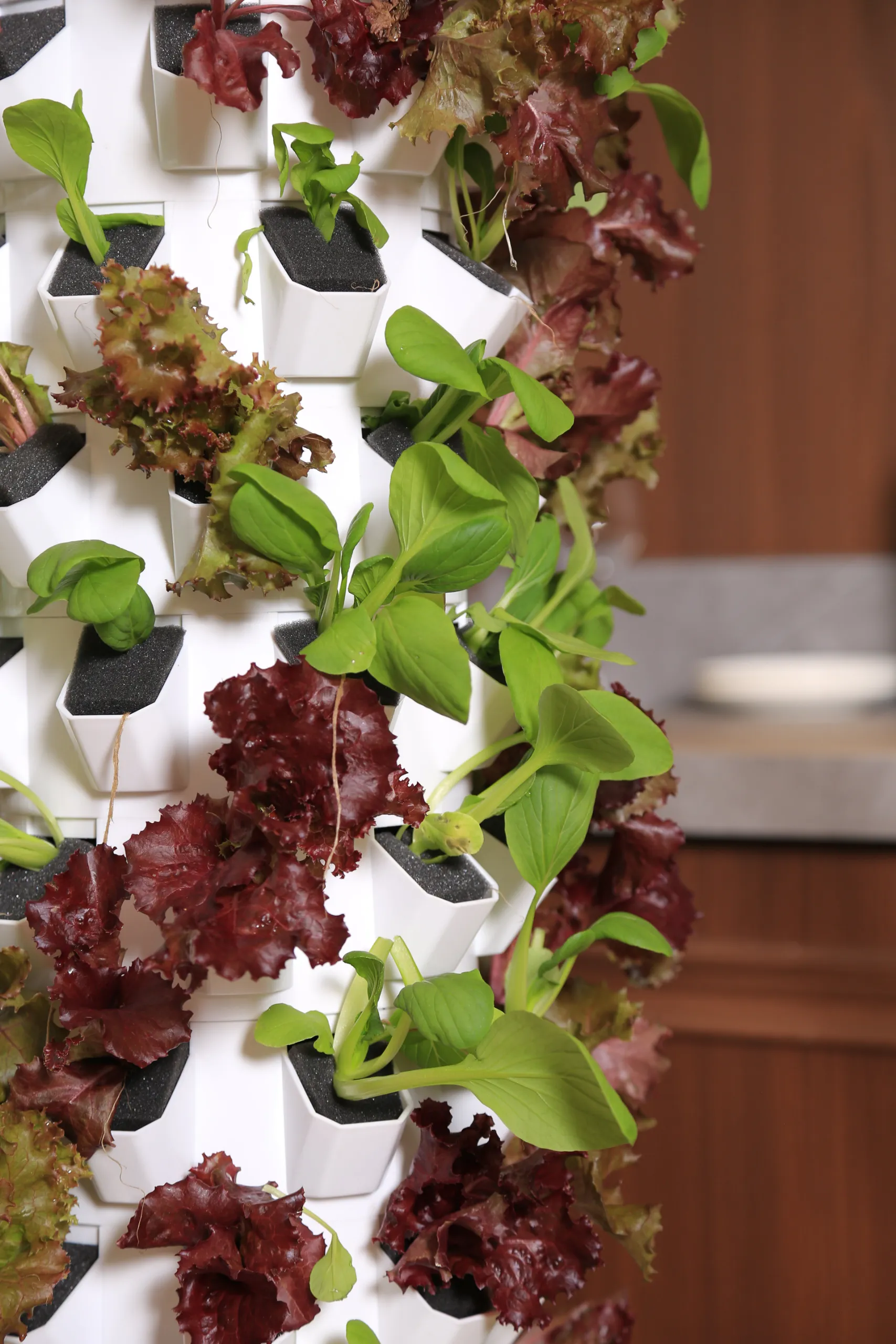
An aeroponic tower grows plants with their roots hanging in air, misted with nutrient water on a timer — no soil, no standing water. Most towers marketed for homes as “aeroponic” are actually hybrids: a pump lifts water to the top and it trickles down past the roots. Either way, what drives fast growth is the same thing: roots getting water, nutrients, and plenty of oxygen.

Aeroponics is a subset of hydroponics — both grow plants without soil. The difference is how the roots get fed. In true aeroponics, plant roots hang suspended in air inside a dark chamber, and a pump sprays them with a fine nutrient mist every few minutes. Between mistings, the roots sit in open air, which gives them more oxygen than any other growing method. That oxygen surplus is the whole point: roots need to breathe, and aeroponic roots breathe better than roots buried in soil or submerged in water.
The idea isn’t new. A Russian botanist, V.M. Artsikhovski, showed in 1911 that plants could absorb nutrients sprayed into the air. In 1957, Dutch biologist F.W. Went — working at Caltech — grew coffee plants and tomatoes with their roots suspended in air and coined the term “aeroponics.” NASA later picked it up for space agriculture research at Kennedy Space Center, because a system that grows food with almost no water and no soil is exactly what you’d want on a spacecraft.
Strip away the marketing and a true aeroponic tower is five parts doing one job:
That cycle — mist, breathe, mist, breathe — is why aeroponics has a reputation for explosive growth. But notice the weak links: it depends on a high-pressure pump and tiny nozzles that clog. If the pump fails, exposed roots can dry out in under an hour. True aeroponics is powerful but fussy, which is why it thrives in labs and commercial greenhouses more than living rooms.
Quick comparison:
Root environment: True aeroponic — suspended in air, misted. Trickle hydroponic — water trickles down past the roots.
Pump: True aeroponic — high-pressure, fine mist nozzles. Trickle hydroponic — standard low-wattage pump.
Oxygen to roots: True aeroponic — maximum. Trickle hydroponic — high, roots get air between watering cycles.
Maintenance: True aeroponic — nozzles clog; needs filtered water and frequent checks. Trickle hydroponic — simpler; a timer runs the schedule.
If the pump fails: True aeroponic — roots dry out fast. Trickle hydroponic — roots stay moist much longer.
Typical cost: True aeroponic — higher. Trickle hydroponic — lower.
Growth speed: True aeroponic — very fast when dialed in. Trickle hydroponic — fast; tower makers commonly claim up to 3x vs soil.
Here’s the honest answer most product pages won’t give you: usually not. The majority of towers sold for home use under the “aeroponic” label don’t use high-pressure mist at all. They pump water to the top of the tower and let it trickle down through each planting tier — that’s drip hydroponics, and it’s the more sensible design for a home. Cheaper pumps, no clogged nozzles, and your plants survive a missed watering cycle.
We’ll say it plainly about our own products: Ovelium towers are hydroponic trickle towers, not true aeroponic systems. A quiet pump in the base reservoir sends water and nutrients to the top; it trickles down past every plant’s roots and collects back in the reservoir, recycling like a fountain. A typical schedule is 15 minutes on, 45 minutes off during the day, handled automatically by the timer. Because roots get water, nutrients, and air in cycles rather than sitting in soggy soil, our towers are rated at up to 3x faster growth than soil growing — the same benefit people are actually shopping for when they search “aeroponic tower.”
So our advice: don’t shop the label, shop the mechanism. Ask how water reaches the roots, how often, and what happens when the pump pauses. The answers to those three questions tell you more than the word “aeroponic” on the box ever will.
Whatever the marketing calls it, a good tower garden comes down to six things:
Towers shine with leafy greens and herbs: lettuce, kale, spinach, basil, parsley, cilantro. Strawberries and compact peppers do well too. What doesn’t belong: root vegetables (carrots, potatoes) with nowhere to form, and large vining plants like full-size tomatoes or cucumbers unless you add a trellis. If you want the full avoid-list with reasons, we wrote a dedicated guide on what not to grow in a hydroponic tower.
True aeroponics delivers the most oxygen to roots, but most home “aeroponic” towers are actually trickle hydroponic systems — which is good news, because they’re cheaper, simpler, and more forgiving. For home growing, a well-designed hydroponic tower gives you nearly all the benefit with far less fuss.
Yes, dramatically. Both aeroponic and hydroponic towers recirculate water in a closed loop instead of losing it to runoff and evaporation. Tower makers commonly claim up to 95% less water than traditional soil gardening.
You don’t water it by hand — the timer does. A common schedule for trickle towers is 15 minutes on, 45 minutes off during the day. True aeroponic systems mist for a few minutes each hour. Your job is keeping the reservoir filled and the pH in range.
Cherry and compact determinate varieties, yes — with support. Full-size vining tomatoes outgrow tower slots and shade everything below them. Strawberries and peppers are safer fruiting choices for most towers.
Unless the tower sits beside a big south-facing window, yes. Full-spectrum LED grow lights on a timer (about 14 hours on, 10 off) are what make year-round indoor growing possible.
Aeroponics is a subset of hydroponics. All hydroponics grows plants without soil using nutrient water; aeroponics specifically suspends roots in air and mists them. Deep water culture, nutrient film technique, and drip/trickle towers are the other members of the hydroponic family.
If you want fresh herbs and greens steps from your kitchen with minimal space and water, yes — just buy based on the actual watering mechanism, reservoir size, lights, and materials rather than the “aeroponic” label. A trickle hydroponic tower from a reputable maker delivers the results most home growers are after.
We reviewed source material on 2026-10-04.
Related reading: how hydroponic towers work · the complete tower gardening guide · what you can grow in a tower
Research describes general methods; it does not verify any specific model, product claim or customer outcome.

