Address
304 North Cardinal
St. Dorchester Center, MA 02124
Work Hours
Monday to Friday: 7AM - 7PM
Weekend: 10AM - 5PM
Address
304 North Cardinal
St. Dorchester Center, MA 02124
Work Hours
Monday to Friday: 7AM - 7PM
Weekend: 10AM - 5PM
Indoor growing belongs in the modern home because it turns unused space into fresh food: a 3-square-foot tower supplies cut-and-come-again herbs and greens steps from the kitchen, with no soil, no mess, and automated watering handling the daily work. It's quieter than a dishwasher and makes healthy cooking the easy default, not a weekend project.
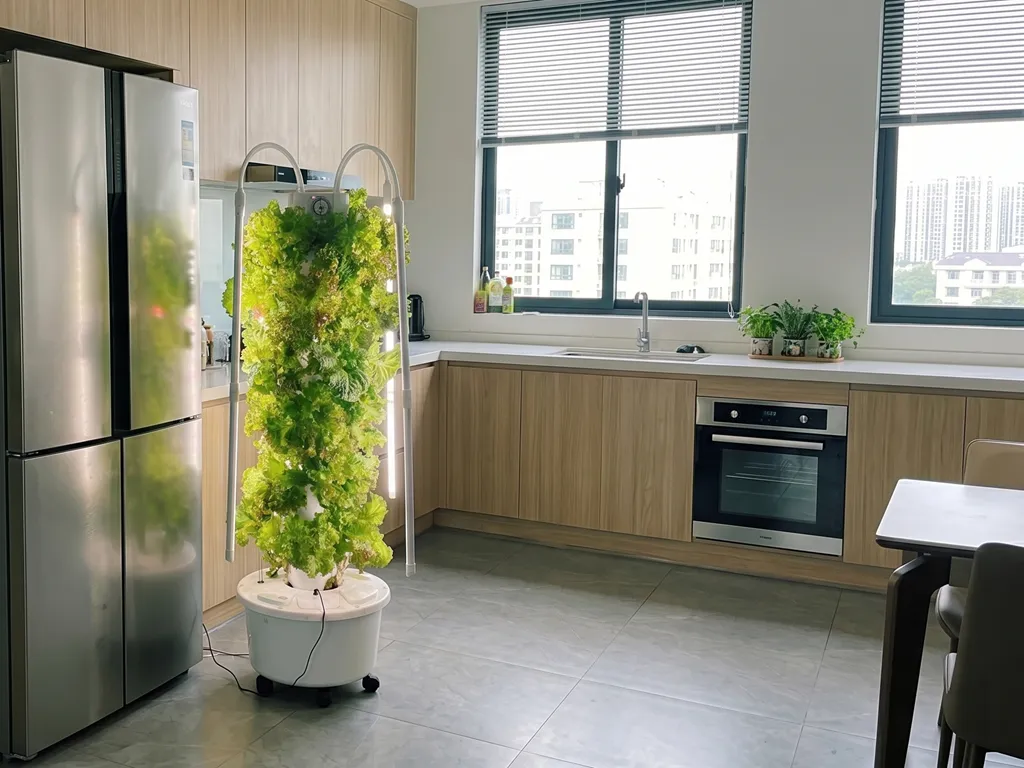
Indoor growing belongs in the modern home because it solves real problems of modern life: small spaces, packed schedules, and the wish for fresher food. A hydroponic tower grows dozens of plants in a few square feet, uses up to 95% less water than soil gardening, and turns a kitchen corner into a year-round source of fresh herbs and greens.
It is not a fad. It is a response to how we actually live now.
More of us rent. More of us live in apartments without yards. Work eats the daylight hours that a traditional garden demands. And the grocery store, for all its convenience, is a compromise: herbs that wilt in three days, lettuce shipped 1,500 miles, prices that keep climbing.
The USDA’s Economic Research Service has estimated that roughly a third of the U.S. food supply goes uneaten at the retail and consumer level. A lot of that waste is fresh produce — the stuff that looked great at the store and died in the crisper drawer. Growing a little of your own does not fix the food system. But it fixes the most annoying part of it: paying for freshness and not getting it.
Indoor growing fits the gap between “I wish I ate fresher” and “I do not have time for a garden.” That gap is where most of us live.
Honest answer: not self-sufficiency. You will not feed a family of four from a tower in the living room, and anyone who tells you otherwise is selling something.
What you do get is the stuff you use every day, at the moment it is best. Basil cut seconds before it hits the pasta. Mint that is still fragrant when the tea steeps. Lettuce that was alive ten minutes before lunch. Herbs and leafy greens are the highest-value thing a home grower can produce, because they are the foods where freshness matters most and store-bought quality drops fastest.
There is a rhythm to it, too. Checking the plants becomes a two-minute pause in the day — water level, new growth, a leaf to taste. People underestimate how much they like having something alive and productive in the house until they have it.
Soil gardening is. That is exactly why hydroponic towers changed the equation.
No soil means no bags of dirt in the hallway, no drainage trays staining the floor, no fungus gnats breeding in damp potting mix. A tower is a closed loop: water and nutrients circulate from a reservoir, up through the column, past the roots, and back down. You top up the reservoir, check the pH now and then, and harvest.
The weekly time commitment is genuinely small — about 15 to 30 minutes total, mostly harvesting (the fun part) and a quick reservoir check. Compare that to a soil garden’s weeding, watering, pest patrol, and seasonal soil work, and it is not close. If you want the full mechanical picture, read how hydroponic towers work.
Less than you think. This is the part that surprises people:
| Setup | Footprint | What it can hold | Grows year-round? |
|---|---|---|---|
| Raised bed garden | 32+ sq ft | One season of vegetables | No |
| Windowsill pots | 2–3 sq ft | A few struggling herbs | Barely |
| Hydroponic tower (24–96 sites) | Under 3 sq ft | Dozens of herbs and greens at once | Yes, with grow lights |
A vertical tower stacks planting sites the way a bookshelf stacks books. The same floor space that holds one sad basil pot on a sill can hold a whole salad garden going upward. For apartments and small kitchens, vertical is the only geometry that makes sense.
This is where I get careful, because the internet loves to overclaim. Houseplants will not cure anything. But the research on active gardening — not just owning plants, but tending them — is genuinely interesting.
A meta-analysis by Soga, Gaston, and Yamaura (2017) in Preventive Medicine Reports pooled data across multiple studies and found gardening was associated with reductions in depression and anxiety symptoms, along with increases in life satisfaction. And in a small but widely cited experiment, van den Berg and Custers (2011) found that 30 minutes of gardening lowered the stress hormone cortisol more effectively than 30 minutes of reading (Journal of Health Psychology).
My take: the mechanism is probably simple. Tending plants forces a slower pace, gives you a small visible win every week, and gets your hands off your phone. You do not need a study to notice that feels good — but it is nice that the studies agree.
Less than the takeout you will skip because dinner got more interesting. The two running costs are electricity (LED grow lights plus a small water pump) and nutrients.
U.S. households pay about 17 cents per kWh on average (U.S. Energy Information Administration), though it varies a lot by state — Hawaii pays more than triple the national average, while parts of the South and Northwest pay far less. A typical tower setup lands in the range of a few dollars a month in electricity. We break the math down properly in how much electricity a hydroponic tower uses.
Nutrients cost a few dollars a month for a home-sized reservoir. Seeds are nearly free. The real investment is the tower itself — and unlike a gym membership, it pays you back in groceries.
People stall here because they treat it like a project. It is not a project. It is an appliance that grows food. Here is the whole plan:
That is genuinely it. If you want the deep version, our complete hydroponic tower gardening guide covers nutrients, pH, and troubleshooting in detail.
No. A hydroponic tower automates the two things beginners get wrong: watering and light schedules. If you can fill a container and follow a timer, you can do this. Start with lettuce and basil — they practically grow themselves.
Leafy greens (lettuce, spinach, kale, arugula), herbs (basil, mint, parsley, cilantro), and compact fruiting crops like cherry tomatoes and peppers. Root vegetables and large vining plants are not a good fit for towers.
About 15–30 minutes, mostly harvesting and a quick reservoir check. There is no weeding, no daily watering runs, and no seasonal soil prep.
Electricity typically costs a few dollars a month at average U.S. rates, plus a few dollars for nutrients. The tower itself is the main upfront cost.
A single tower adds negligible humidity to a normal room. And because there is no soil, you skip the most common indoor pest — fungus gnats — entirely. Keep the reservoir covered and wipe up spills, and pests are rarely an issue.
Anywhere with an outlet and a few square feet of floor. Kitchens win because proximity drives harvesting: the closer the greens, the more you eat them. Living rooms work fine too — modern towers are designed to look like furniture, not lab equipment.
Research describes general methods; it does not verify any specific model, product claim or customer outcome.
Related reading: indoor hydroponics vs traditional gardening, fresh herbs and everyday living, hydroponic tower nutrients guide
We reviewed source material on 2026-10-04.


At Ovelium, we believe in thoughtful design, timeless aesthetics, and creating experiences that feel both elegant and meaningful.