Address
304 North Cardinal
St. Dorchester Center, MA 02124
Work Hours
Monday to Friday: 7AM - 7PM
Weekend: 10AM - 5PM
Address
304 North Cardinal
St. Dorchester Center, MA 02124
Work Hours
Monday to Friday: 7AM - 7PM
Weekend: 10AM - 5PM
Your tower's plastic holds your water, your roots, and your dinner. Here's how to tell whether that plastic is food-safe — and what to check before you buy.
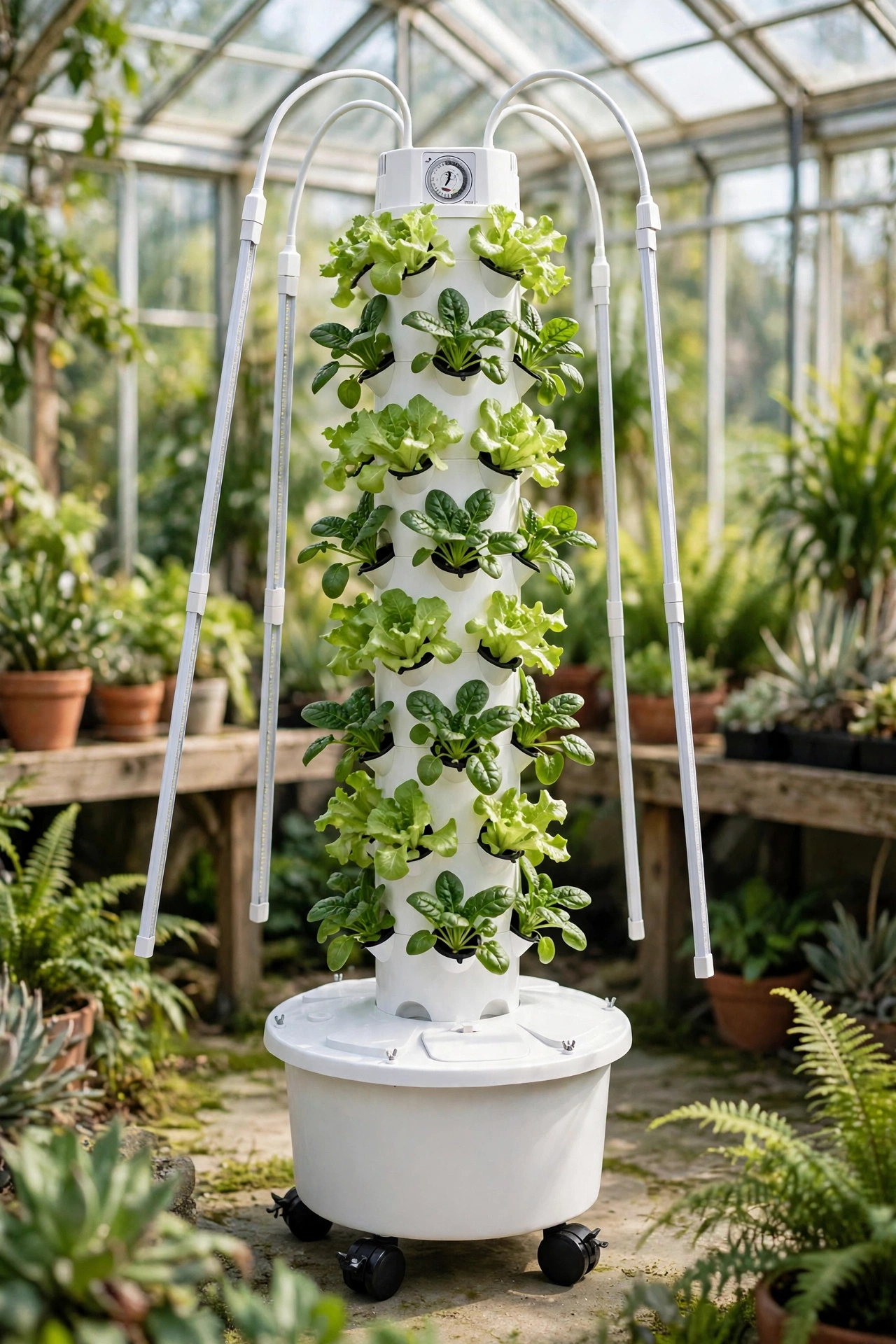
Short answer: Asking “is my hydroponic tower food safe?” Start here: it generally is when the parts that touch your water and roots are made from stable, food-contact-grade plastics — usually polypropylene (PP) or HDPE — and the seller states that in writing. Be cautious with towers that use PVC water paths or make vague “food-grade” claims you can’t verify. The seven checks below take about ten minutes.
You eat what grows in your tower, so it’s fair to ask what the tower itself is made of. A hydroponic system recirculates the same nutrient solution past your plants’ roots for weeks — through the tank, up the column, and back down again. Here’s how to judge whether the plastic is a safe one, without a chemistry degree.

In a hydroponic tower, water and nutrients loop continuously through the same plastic parts. Unlike a tomato grown in soil and rinsed once, your lettuce sits with its roots in tower-circulated water for its entire life. So the material question is reasonable: could anything migrate from the plastic into the water, and from the water into the plant?
Two things drive that question. First, plastics aren’t single substances — they’re polymers plus additives (plasticizers, stabilizers, colorants) that make them flexible, UV-resistant, or cheap to mold. Second, migration increases with heat, agitation, and time. A tower ticks two of those three boxes by design: constant water movement and weeks of contact. Heat is the one you can control — more on that later.
That said, don’t default to panic. Most reputable tower manufacturers use the same families of plastic that food containers are made from. The goal of this guide is to help you tell a well-made tower from a corner-cutting one before you buy.
“Food-grade” is a claim, not a magic property. In the United States, plastics intended for food contact are regulated by the FDA as food contact substances — a material is “food-grade” when its composition complies with the relevant FDA regulations for its intended use. In the EU, the equivalent framework is Commission Regulation (EU) No 10/2011, which sets migration limits for plastic food contact materials.
Here’s the catch for tower shoppers: hydroponic towers are not regulated as food contact articles. Nobody certifies a whole tower the way a baby bottle gets certified. So when a listing says “food-grade plastic,” that claim is only as good as the seller behind it. What you want is specificity — the actual resin (PP, HDPE), ideally molded into the part itself as a resin code, plus a written statement from the manufacturer. A one-word “food-grade” in a product title, with no material named anywhere, tells you almost nothing.
Two chemical families dominate this conversation: bisphenol A (BPA) and phthalates. Here’s the honest, cited version of where things stand.
BPA is a building block of polycarbonate plastic and some epoxy resins. In 2012, the FDA amended its food additive regulations to no longer provide for polycarbonate resins in baby bottles and sippy cups — notably, the agency’s stated basis was that manufacturers had already abandoned the use, not a new safety finding about those products. BPA remains authorized for many other food-contact uses in the US. In April 2023, the European Food Safety Authority (EFSA) re-evaluated BPA and set a new tolerable daily intake of 0.2 nanograms per kilogram of body weight per day — 20,000 times lower than its 2015 value — concluding there is a health concern from dietary BPA exposure. That conclusion is contested: the European Medicines Agency and Germany’s Federal Institute for Risk Assessment both disagreed with EFSA’s methodology. The science here is genuinely unsettled, which is exactly why “BPA-free” has become a selling point rather than a settled answer.
Phthalates are plasticizers used to make rigid PVC flexible — the reason cheap vinyl tubing bends. They are a separate concern from BPA and, unlike BPA, they aren’t chemically bound into the plastic, which means they can migrate out more readily, especially with warmth and agitation. This is the main reason buyers are advised to look closely at what a tower’s tubing and fittings are made of.
One more honest note: “BPA-free” does not mean “chemical-free.” Some BPA-free plastics use substitute bisphenols (like BPS) with similar structures. A BPA-free label answers one question about one chemical — it doesn’t certify the whole product. That’s why the checklists in this article focus on materials and documentation, not labels.
Flip the tank and the column over and look for the resin identification code — the number inside the chasing-arrows triangle molded into the plastic. Then use this cheat sheet:
| Code | Plastic | Where it shows up in towers | Buyer’s read | What this table can’t tell you |
|---|---|---|---|---|
| #2 | HDPE (high-density polyethylene) | Reservoir tanks on some brands | Commonly used for milk jugs and food containers; a good sign when labeled for food contact | A resin code identifies the polymer family — it is not a safety certificate. Two “PP” parts from different factories can use very different additive packages, and the code says nothing about manufacturing hygiene or recycled content. Treat the code as a starting point, then confirm with the seller in writing. |
| #5 | PP (polypropylene) | Tower columns, lids, net cups/net pots | The most common food-contact plastic in towers; heat-resistant and widely used for food containers — look for confirmation it’s food-contact grade | |
| #4 | LDPE (low-density polyethylene) | Some flexible tubing, gaskets | Generally considered suitable for food contact; tubing formulations vary, so confirm food-contact labeling | |
| #3 | PVC (polyvinyl chloride) | Cheap tubing, some fittings | Deserves a second look — flexible PVC can contain phthalate plasticizers that migrate more readily; prefer phthalate-free or food-grade silicone tubing | |
| #6 | PS (polystyrene) | Rarely in the tower itself; sometimes in product packaging | Avoid for food contact — styrene migration is the concern; irrelevant if it’s only the shipping foam | |
| #7 | Other (incl. polycarbonate) | Occasionally control-head housings or sight gauges | Ask the seller directly — #7 is a catch-all, and polycarbonate is the BPA-relevant one |
The pattern: #2, #4, and #5 are the plastics you want to see in water-contact parts. #3 in the water path and unmarked #7 parts are where you ask questions. And no code at all — on a tank that holds 30+ liters of your plants’ water — is itself an answer: the manufacturer didn’t think the material was worth declaring.
Not every plastic part matters equally. Rank them by contact time with your nutrient solution:
Already own a tower and now wondering about it? A few habits cover most of the risk:
None of this requires lab equipment. It’s the same logic as a kitchen: use the right materials, don’t cook them, and retire them when they wear out.
Once the material question is settled, the fun part starts. Leafy greens are the most forgiving first crops for a new tower — if you haven’t picked yet, see what you can grow in a hydroponic tower, and the hydroponic tower gardening guide walks through setup basics step by step.
We reviewed source material on 2026-10-20.
Research describes general methods; it does not verify any specific model, product claim or customer outcome.
Generally, yes — provided the water-contact parts (tank, column, net cups, tubing) are made from stable food-contact plastics like polypropylene or HDPE and the manufacturer states the material. No regulator certifies whole towers as food-contact articles, so “food safe” is really a question about materials and documentation, not a stamp.
It means the plastic was made without bisphenol A — one specific chemical. It doesn’t mean chemical-free: some BPA-free plastics use substitute bisphenols, and the label says nothing about phthalates or other additives. Treat “BPA-free” as one answered question, then still check the resin type and food-contact rating.
Rigid PVC is one thing; the flexible vinyl tubing in cheap towers is the concern, because flexible PVC typically needs phthalate plasticizers that can migrate, especially with warmth and constant water flow. If your tower came with vinyl tubing and the seller can’t confirm it’s phthalate-free, replacing it with food-grade silicone tubing is a cheap upgrade.
Not reliably — many migrating chemicals are odorless. But a strong chemical smell from the tank that survives washing and airing is a legitimate red flag and a reasonable basis for a return. The smell test catches the worst offenders; it doesn’t certify the rest.
pH extremes can accelerate degradation of some materials, which is one more reason to keep your nutrient solution in the normal growing range (roughly pH 5.5–6.5 for most crops) rather than letting it swing wildly. Normal, well-managed nutrient solution isn’t a special leaching risk beyond the heat and time factors covered above.
Most are polypropylene, which is a standard food-contact plastic — fine as far as the material goes. The practical rule is condition, not color: replace net cups once they turn brittle, crack, or go permanently cloudy, since degraded plastic is harder to sanitize.
The plastic parts are the main event in this article, but it’s fair to glance at metal bits too — cheap brass fittings can contain lead, and unknown pump internals are unknowable. Buying from a seller that names its materials, and avoiding mystery hardware in the water path, covers most of this concern without needing a lab test.

