Address
304 North Cardinal
St. Dorchester Center, MA 02124
Work Hours
Monday to Friday: 7AM - 7PM
Weekend: 10AM - 5PM
Address
304 North Cardinal
St. Dorchester Center, MA 02124
Work Hours
Monday to Friday: 7AM - 7PM
Weekend: 10AM - 5PM
Day-neutral varieties like Albion and Seascape fruit for months in a tower — if you keep EC low (1.0–1.8 mS/cm) and don't skip pollination. This guide covers varieties, nutrient targets, and the hand-pollination step indoor growers miss.
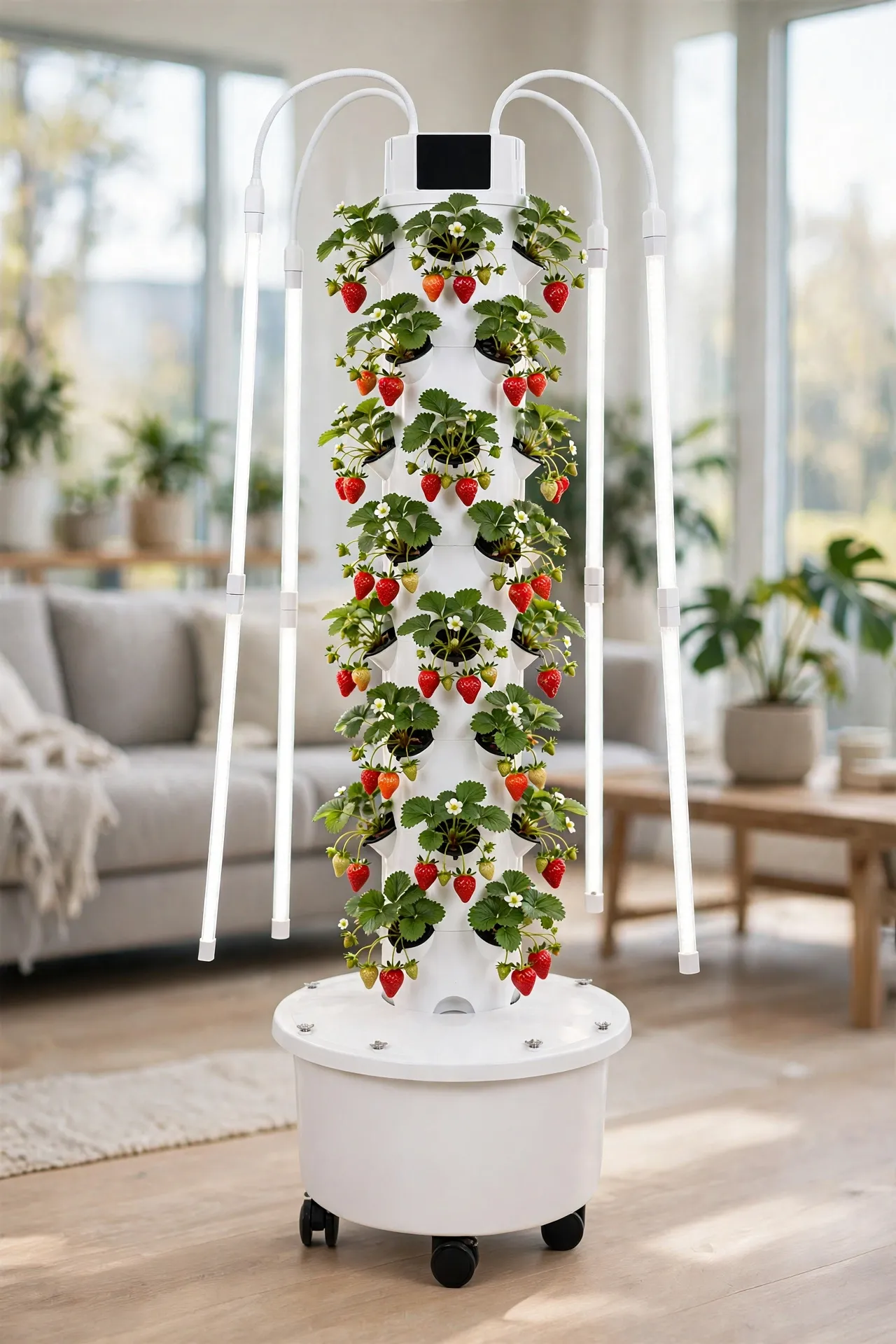
Short answer: Strawberries thrive in a hydroponic tower if you pick day-neutral varieties like Albion or Seascape, keep the nutrient solution weaker than you’d expect (EC roughly 1.0–1.8 mS/cm, pH 5.8–6.2), and give the flowers airflow or a gentle hand so they set into well-shaped fruit. Expect the first ripe berries about 60–90 days after transplanting a healthy crown.
Of all the fruiting crops you can grow in a hydroponic tower, strawberries are the most rewarding — and the most misunderstood. They look delicate, and they are picky about two things: salt levels and pollination. But they don’t need a greenhouse, they fruit continuously with the right variety, and a tower full of red berries in February is a genuine flex.
This guide covers exactly what differs from growing leafy greens: variety selection, EC/pH targets tuned for salt-sensitive berries, the pollination step everyone skips indoors, and the maintenance habits that keep plants fruiting for months.

Lettuce and basil just need to make leaves. Strawberries need to flower, get pollinated, and ripen fruit — three extra steps that all have opinions about your setup. The differences that actually matter:
This is the single highest-leverage decision you’ll make. Strawberry types differ in when they flower, and that changes everything indoors.
| Type | How it flowers | Tower verdict |
|---|---|---|
| Day-neutral (Albion, Seascape, Evie-2, Tristar) | Flowers whenever conditions are right, regardless of day length | Best choice — continuous harvests, made for controlled environments |
| Everbearing (Quinault, Ozark Beauty) | Two or three flushes per season | Workable, but harvest comes in waves with quiet gaps |
| June-bearing (Chandler, Cabot) | One big flush, triggered by short days | Skip for towers — one harvest doesn’t justify the reservoir space |
For a first tower, Albion and Seascape are the safe picks: compact plants, firm berries, widely available as certified disease-free crowns, and extensively grown in hydroponic research — which means the nutrient numbers below were worked out on varieties like these.
Buy certified bare-root crowns from a reputable nursery, not seeds from a garden center and definitely not plants started from a grocery-store berry. Store fruit can carry pathogens into your reservoir, and the variety is a mystery — you might wait months to discover it fruits poorly in your setup. A crown 10–12 mm across is a good, vigorous size to start with.
Here are starting targets, then watch the plants — they’ll tell you if an adjustment is needed. These cross-check against the OSU berry program’s root-zone guidance and peer-reviewed hydroponic strawberry studies run at EC 1.2, pH 5.8.
| Stage | EC (mS/cm) | pH | Limitation of this table |
|---|---|---|---|
| Young transplants (first 2–3 weeks) | 0.6–0.8 | 5.8–6.2 | These are starting points from research and extension guidance, not results measured on any home tower. Your tap water’s baseline EC counts toward the target, and each variety tolerates the range slightly differently. |
| Vegetative growth | 0.8–1.2 | 5.8–6.2 | |
| Flowering & fruiting | 1.2–1.8 | 5.8–6.2 |
A few things that catch tower growers out:
Yes — or more precisely, they need help with pollination. Strawberry flowers are self-fertile: a single flower can pollinate itself without another plant. The catch is mechanical. Each berry is covered in tiny seed-like achenes, and every achene needs a pollen grain for the flesh beneath it to swell. In still indoor air, pollen doesn’t move well, and you get berries that set on one side only — small, lopsided, and slow to ripen. Misshapen fruit is the telltale sign of incomplete pollination.
Three indoor-friendly methods, in order of effort:
The fan alone is enough for most home towers. Reserve the brush for a variety that keeps producing lopsided fruit despite airflow.
Think mild spring, not greenhouse summer. Strawberries fruit best in moderate temperatures — roughly 60–75°F (15–24°C) days, a touch cooler at night. Sustained heat above about 80°F degrades fruit quality fast: softer berries, weaker flavor, more disease pressure. If your tower sits in a warm room, strawberries belong near a window or in the coolest bright spot you have.
Humidity is a balancing act. Very dry night air can brown leaf edges and the little green caps (calyxes) on the berries, which hurts both photosynthesis and appearance. Very humid air invites gray mold on ripening fruit. Gentle airflow — the same fan helping with pollination — is doing triple duty here: pollen movement, disease prevention, and stronger stems.
| Symptom | Likely cause | Fix |
|---|---|---|
| Lopsided, half-grown berries | Incomplete pollination | Add airflow; brush open flowers at midday |
| Young leaves yellowing | pH too high (iron lockout) | Bring pH back to 5.8–6.2; don’t add more fertilizer |
| Brown, scorched leaf tips | EC too high | Dilute the reservoir; check root-zone buildup |
| Gray fuzzy mold on ripe fruit | Botrytis from humidity + poor airflow | Remove affected fruit immediately; space plants; run the fan |
| Lots of leaves, few flowers | Too much nitrogen; too little light | Switch to a fruit formula; move to the brightest level |
| Crown mushy or black | Crown sitting in water | Reposition higher in the net pot; replace the plant if rotted |
One more honest note: a tower site count is not a harvest guarantee. Eight strawberry crowns in a tower will not out-produce a garden bed of fifty. What a tower gives you is freshness — berries harvested minutes before eating, at peak ripeness, in months when the store has nothing local. That’s the real win.
New to towers entirely? Start with our complete beginner guide to hydroponic tower gardening before you buy crowns — the reservoir routine in there applies to every crop on this page.
We reviewed source material on 2026-10-08.
Research describes general methods; it does not verify any specific model, product claim or customer outcome.
Yes, with day-neutral varieties like Albion or Seascape and enough light. Day-neutral types flower whenever conditions suit them rather than waiting for a season, so under 12–16 hours of strong light they can fruit through winter. June-bearing varieties won’t cooperate — they give one flush and stop.
Usually a small fan is enough. Strawberry flowers are self-fertile, but pollen has to reach every part of the flower — still indoor air often leaves berries lopsided and half-grown. Gentle airflow fixes most cases; a soft brush dabbed on open flowers around midday is the backup.
Strawberries are salt-sensitive. Research guidance from the Ohio State berry program keeps the root zone at or below about 1.2 dS/m — far under what fruiting tomatoes tolerate. Running tomato-strength nutrients on strawberries causes tip burn and stunted plants.
Not recommended. Store fruit can carry pathogens into your reservoir, and the variety is unknown — you may wait months to discover it fruits poorly in your setup. Buy certified disease-free crowns from a nursery instead.
Check pH first. Above pH 7.0, strawberries develop iron deficiency (yellow-green young leaves) even with plenty of fertilizer in the reservoir. Bring pH back to 5.8–6.2 before adding more nutrients.
Yes, for fruit production. Runners divert the plant’s energy into making new plants instead of berries. Snip them as they appear; root one or two separately only if you want new crowns.

