Address
304 North Cardinal
St. Dorchester Center, MA 02124
Work Hours
Monday to Friday: 7AM - 7PM
Weekend: 10AM - 5PM
Address
304 North Cardinal
St. Dorchester Center, MA 02124
Work Hours
Monday to Friday: 7AM - 7PM
Weekend: 10AM - 5PM
Mint is the easiest herb to grow — and the hardest to contain. Here's how to grow it in a hydroponic tower with one pod, weekly runner checks, and harvest-as-pruning, so it stays a tidy supply of fresh leaves.
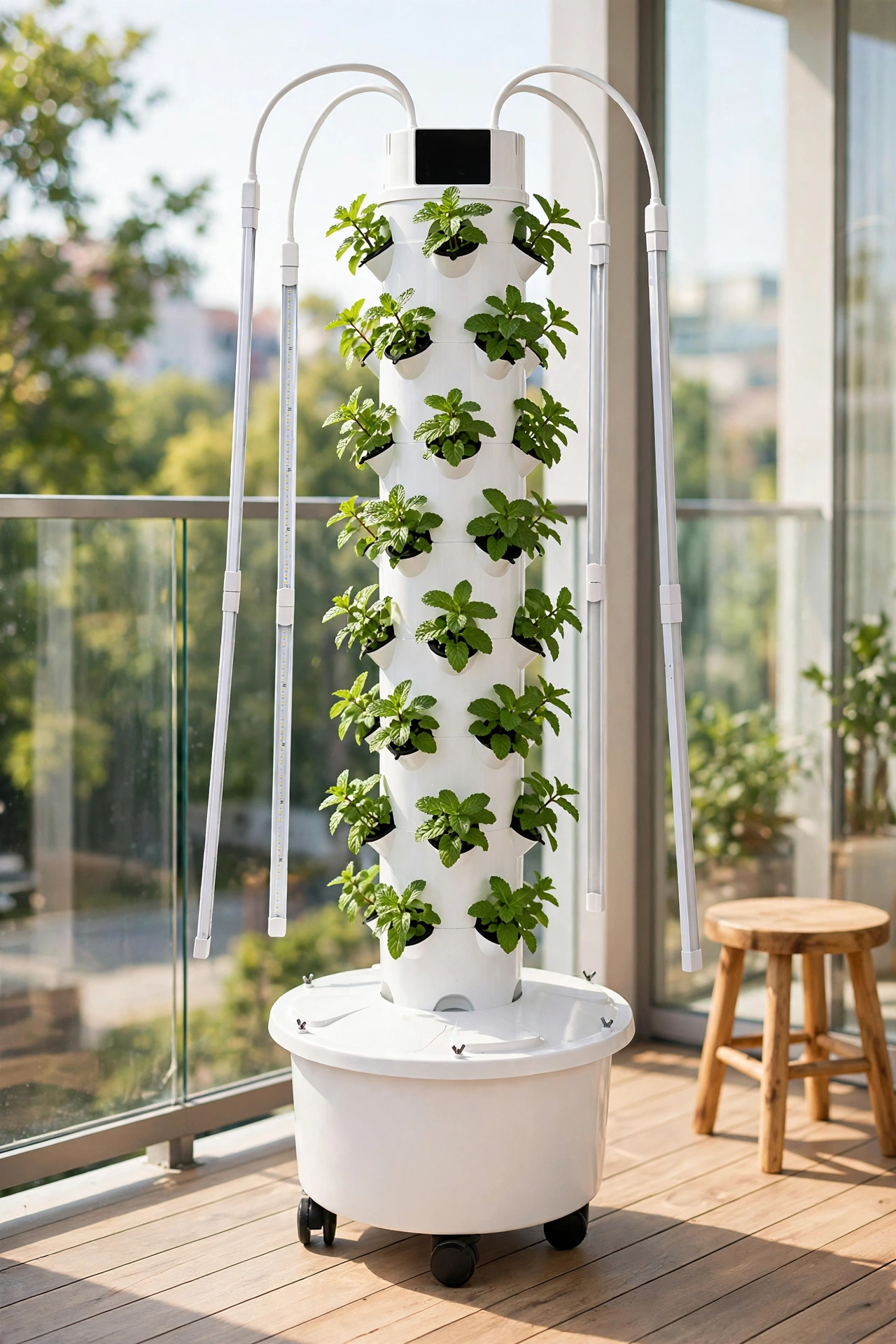
Growing mint in a hydroponic tower works best when you give mint exactly one pod, keep it away from slow herbs, and harvest often. Start from a cutting, hold pH near 5.8–6.5 and EC near 1.2–1.8 mS/cm, run lights 12–16 hours a day, and trim runners weekly. Do that, and mint stays a tidy harvest instead of a takeover.

Mint has earned its reputation. In a garden bed, one plant can turn into a patch, then a problem, then a multi-year removal project. A hydroponic tower changes the game: there is no soil for rhizomes to run through, every plant sits in its own pod, and trouble is visible early. But the tower does not make mint polite on its own. Mint still sends out runners, still shades its neighbors, and still tries to flower when it gets warm or stressed. Containment in a tower is a weekly habit, not a one-time setup.
Mint spreads through more than one channel at once. Underground, it sends out rhizomes — horizontal stems that grow sideways, put down roots, and pop up as new plants at each node. Above ground, it sends out stolons, long shoots that creep outward and root where they touch moisture. If it flowers and sets seed, that is a third channel. University of Illinois Extension describes peppermint as aggressive for exactly this reason, notes that it spreads via rhizomes, and recommends growing it in a container to help control that spread.
In a hydroponic tower, the soil channel is gone, and that is a real advantage. Rhizomes cannot travel through open air between pods. But the other two channels survive: stolons can arc out of a pod and root into a neighbor’s moist medium, and roots can grow long and dense inside a shared column, crowding the plants above or below. Seeds can also drop into nearby pods if mint is allowed to flower. All three are visible and fixable if you check weekly.
Start with the variety, because mint is not one plant. Spearmint (Mentha spicata) is the all-rounder for tea, salads, and drinks. Peppermint (Mentha × piperita) is a hybrid with a sharper, cooler flavor, and it does not grow true from seed — cuttings are the reliable route. Pick one you will actually use, because you will have a lot of it.
For a tower, start from a cutting rather than seed. Cuttings root fast, stay true to the parent variety, and skip the slow, uneven germination that mint seed is known for:
If you are new to towers, read how hydroponic towers work first — the pump cycle, the shared reservoir, and the root zone inside the column all shape how mint behaves once it settles in.
Mint is a light feeder. A full-strength mix meant for heavy fruiting plants is more than mint needs, and excess salts can stress roots without adding flavor. Start low, watch the plant, and adjust in small steps.
| Setting | Target for home towers | If it drifts off | What this number does not prove |
|---|---|---|---|
| EC (nutrient strength) | 1.2–1.8 mS/cm | Too high: leaf edges brown, growth stalls. Too low: pale, slow growth. | A home starting range, not a verified Ovelium recipe. |
| pH | 5.8–6.5 | Above ~6.8: micronutrients get harder to absorb, leaves can yellow. Below ~5.5: roots can suffer. | Published guidance spans 5.5–6.8; this is a practical middle. |
| Light | 12–16 hours a day; moderate intensity | Too little: leggy stems, sparse leaves. Too much heat: flowering, bitter leaves. | Hours alone do not guarantee intensity. |
| Air temperature | 60–70°F (16–21°C), cooler is fine | Warm and dry: flowering comes sooner, flavor turns sharper. | A comfort range, not a hard limit. |
| Reservoir temperature | 65–75°F (18–24°C) | Warm water holds less oxygen and favors root problems. | General guideline, not a per-model measurement. |
| Solution change | Top up with pH-adjusted water; full change every 1–2 weeks | Skipping changes: salt buildup, drifting pH, stale solution. | A rhythm, not a substitute for meter checks. |
Sources disagree on the numbers. One commercial soilless trial kept EC near 2.0–2.5 and pH near 5.5, while home-growing guides put EC closer to 1.0–2.0 and pH between 5.5 and 6.5, and a leafy-vegetable study lists mint’s pH optimum nearer 6.0–6.8. Those are different setups, not contradictions. The targets above sit in the overlap, and your plant’s leaves are the final check.
Five rules. They only work if all five stay in force.
Mint does not need company. A second pod doubles the runner output and halves the time until you have a problem. If you want two varieties, grow one at a time, or keep the second in a separate small pot, not in the same tower.
Leave the pods immediately around the mint empty, or fill them with fast, sturdy plants that finish quickly. Do not put slow, delicate herbs — cilantro is the classic victim — right next to mint. If you want a mint-plus-herbs tower, put mint on the lowest level and herbs above it, with at least one empty pod between them.
Once a week, lift the mint’s canopy and look for horizontal shoots escaping the pod. Snip them off at the base with clean scissors. Do not tuck them back in, and do not let one root into a neighbor pod “just this once.” A stolon that roots is a second mint plant with a head start.
When you change the nutrient solution, lift the mint net cup and look at the root mass. Healthy mint roots are pale and firm. If the root ball is a dense, circling mat, trim back the longest roots by about one-third with clean scissors and rinse the cup. Do not rip roots out by hand — the goal is airflow and space, not punishment.
Flowering shifts the plant’s energy from leaves to seed, and the leaves turn less flavorful afterward. Pinch off any flower buds the moment they appear, and cut back any stem that starts to stretch upward and form a flower spike. Regular harvesting does most of this work for you.
Harvest is the containment plan. Every time you cut mint back, you remove growth that would have become a runner or a flower spike, and you push the plant to branch into bushier, leafier growth.
Expect the first real harvest about 3–4 weeks after transplanting a rooted cutting, then a small harvest every week or two. If growth slows in winter, ease off; a tower under grow lights can keep producing, but not at full speed every week.
Most mint problems in a tower are water, nutrient, or light problems wearing a leaf costume. Check pH and EC with a meter first, then temperature, then pests.
| Symptom | Most likely cause | What to try first | What this table does not prove |
|---|---|---|---|
| Lower leaves yellow | pH drift locking out nutrients, or old leaves aging out | Test and correct pH; remove yellow leaves; check EC. | Several causes look identical. |
| Leggy stems, small pale leaves | Too little light | Move the tower closer to light or lengthen the light period within the 12–16 hour range. | Intensity matters too. |
| Brown, slimy roots; wilting | Warm reservoir, low oxygen, or stale solution | Change the solution, cool the reservoir, check the pump is circulating. | Does not identify a pathogen. |
| Bitter, less fragrant leaves | Flowering, heat, or stress | Pinch buds, cut back flowering stems, cool the growing area. | Flavor varies by variety. |
| Tiny webs or speckled leaves | Spider mites or aphids | Rinse leaves with water, remove badly affected stems. | Suggests pests; does not confirm species. |
If more than one symptom shows up at once, fix water and pH before reaching for any additive. In a shared reservoir, anything you add affects every plant in the tower.
Yes, with conditions. Mint plays well with herbs that are equally vigorous and fast to harvest. It bullies slow or delicate ones. The deciding factor is growth speed and root competition inside a shared column.
| Neighbor | Verdict | Why | Limitation |
|---|---|---|---|
| Basil | Workable, with a buffer pod | Fast, sturdy, harvest-heavy; can hold its own if it gets light. | Shared reservoir means compromise for both. |
| Parsley | Workable, with distance | Slower but sturdy once established; tolerates a shared leafy-green mix. | Mint can shade it early; give parsley a head start. |
| Cilantro | Risky | Fast to bolt, shallow-rooted, easily shaded by mint’s canopy. | Risk is the pairing, not cilantro itself. |
| Lettuce | Risky | Wants cool, steady conditions and clean root space; mint roots can crowd it. | Variety and temperature matter more. |
| A second mint variety | Skip it | Two mints double the runners and can cross-flavor the harvest. | Real cost is doubled maintenance. |
When in doubt, give mint its own tower section or its own tower. A tower full of mint is not a failure — it is a mojito, tea, and salad station that asks for one weekly trim. For more pairings, see best herbs for a hydroponic tower and what you can grow in a hydroponic tower.
Growing mint in a hydroponic tower is one of the easiest wins in indoor gardening, as long as you respect the plant’s nature. One pod, one plant, a buffer zone, a weekly stolon check, and harvest-as-pruning will keep mint productive and contained. The tower removes the soil channel that makes mint a garden nightmare; your weekly five minutes removes the rest. For the broader routine — cleaning, solution changes, and seasonal care — follow the hydroponic tower gardening guide.
We reviewed source material on 2026-10-13.
Research describes general methods; it does not verify any specific model, product claim or customer outcome.
Yes. Mint grows well in a hydroponic tower because it is a vigorous, light-feeding herb. Give it one pod, keep pH near 5.8–6.5 and EC near 1.2–1.8 mS/cm, and trim runners weekly so it does not crowd neighboring plants.
Use one pod for one mint plant, leave a buffer pod around it, snip every stolon you see each week, check roots at each solution change, and pinch off flower buds. Harvesting often doubles as pruning and keeps the plant leafy.
Aim for EC around 1.2–1.8 mS/cm and pH around 5.8–6.5. Published guidance varies by setup, so treat these as starting targets and confirm with a meter — pale or stalled growth usually means checking pH and EC before adding anything.
It can, with a buffer pod and fast, sturdy neighbors like basil or parsley. Avoid putting delicate, slow herbs such as cilantro right next to mint, and never grow two mint varieties in the same tower.
Start about 3–4 weeks after transplanting a rooted cutting, then harvest a little every week or two. Pinch stems just above a leaf node and take at most one-third of the plant at once.
Bitterness often follows flowering, heat, or stress. Pinch off flower buds, cut back flowering stems, and keep the growing area cool and bright. Leaves harvested before flowering tend to taste fresher.

