Address
304 North Cardinal
St. Dorchester Center, MA 02124
Work Hours
Monday to Friday: 7AM - 7PM
Weekend: 10AM - 5PM
Address
304 North Cardinal
St. Dorchester Center, MA 02124
Work Hours
Monday to Friday: 7AM - 7PM
Weekend: 10AM - 5PM
Crisp, sweet lettuce from a hydroponic tower comes down to cool temperatures and gentle nutrition — not luck. Here's the EC, pH, light, and harvest routine that keeps heads tender and bitterness away.
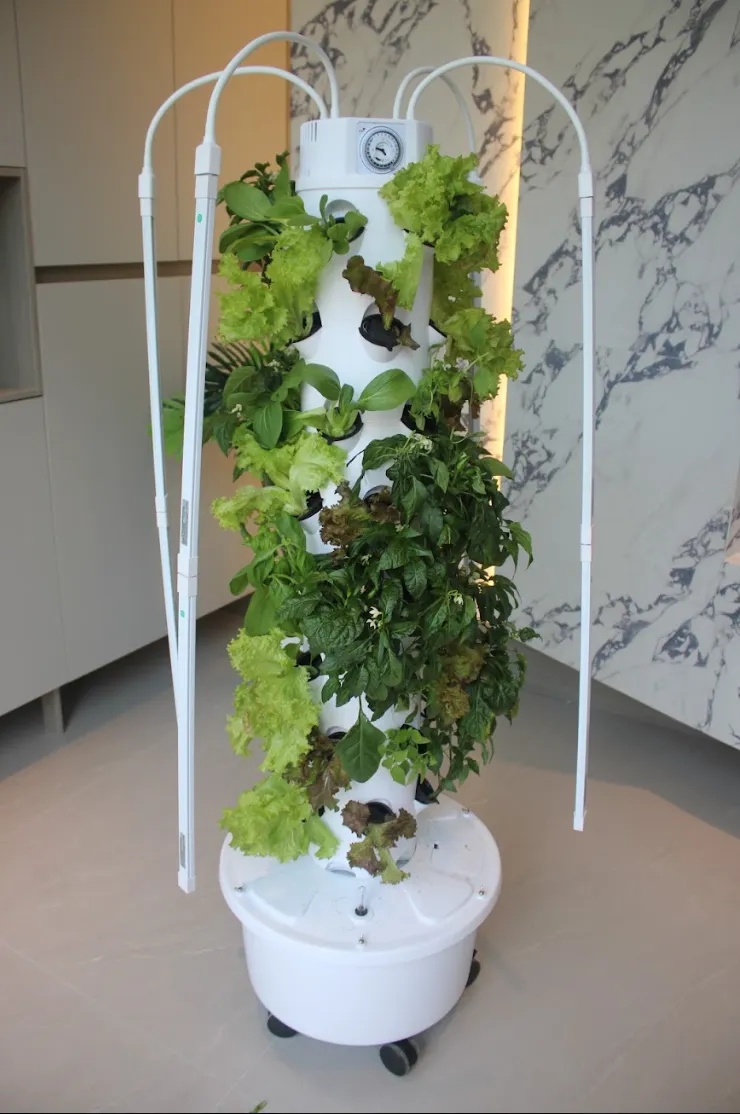
Lettuce is the easiest crop for a hydroponic tower — and the one most punished by heat. Keep your nutrient solution at an EC of 0.8–1.2 mS/cm and a pH of 5.5–6.5, hold air temperatures between 60–70°F, and give the plants 12–17 mol/m²/day of light over 14–16 hours. Harvest outer leaves starting 4–5 weeks after transplant, and you’ll get crisp, mild heads instead of bitter ones.

Lettuce is a light feeder — it wants far less nutrition than fruiting crops like tomatoes or peppers, and overfeeding is one of the most common beginner mistakes. The ranges below are the consensus starting points from crop reference tables and published hydroponic research.
| Parameter | Recommended range for lettuce | Notes |
|---|---|---|
| EC | 0.8–1.2 mS/cm | Start at ~0.6–0.8 for seedlings; raise to 1.0–1.2 once established. Some commercial programs run higher — resist copying them for a home tower |
| pH | 5.5–6.5 | Aim for 5.8–6.2. Research shows lettuce growth drops significantly when pH climbs to 7.0 |
| Water temperature | 65–75°F (18–24°C) | Cooler is fine for lettuce; warm reservoirs invite root-zone problems faster |
| Air temperature | 60–70°F (15–21°C) day, 55–60°F night | Lettuce stalls and turns bitter above ~75°F — temperature matters more than nutrients for flavor |
| Relative humidity | 40–60% | High humidity with still air invites tip burn and leaf diseases |
What this table can’t tell you: these ranges describe general hydroponic lettuce, not your tower, your water, or your nutrient brand. Tap water with high alkalinity drags pH upward no matter what the table says, and a reservoir shared with basil or herbs will drift differently than a lettuce-only system. Published commercial targets (for example, EC 1.4–1.8 cited from Bugbee 2004 in a 2026 HortScience paper) describe greenhouse DWC production — not a home tower with leafy greens. Measure with your own meter; the numbers above are a starting point, not a recipe.
For the mechanics — how to measure EC and pH, how often to check, and what drift patterns mean — see our nutrient guide (EC, pH & PPM cheat sheet).
Lettuce is happy with moderate light. Aim for a daily light integral (DLI) of roughly 12–17 mol/m²/day, delivered over a 14–16 hour photoperiod. With most tower LED setups, that means running the lights about 14–16 hours a day — lettuce doesn’t need the long days that basil tolerates.
More light is not always better, and here’s a specific reason: Cornell University’s Controlled Environment Agriculture group has shown that high DLI combined with poor airflow triggers tip burn — browned, dead edges on the young inner leaves — in lettuce. The disorder appears above roughly 12 mol/m²/day when airflow is poor, and even with good vertical airflow it can show up past ~17 mol/m²/day. If your lettuce looks great but the heart leaves have scorched edges, your lights are probably fine — your air is just too still. A small fan aimed to move air vertically through the canopy is the cheapest fix.
Pale, stretched leaves with long stems mean too little light; bleached or crispy outer leaves mean the lights are too close. Lettuce responds to corrections within days, so adjust and watch.
Our lighting guide (PPFD, DLI & schedules) explains how to translate “hours of light” into a timer setting that works for your tower.
If there’s one thing to get right with lettuce, it’s temperature. University of Illinois Extension puts it plainly: lettuce likes cool conditions, and high temperatures can stunt growth, make leaves bitter, or trigger bolting. This matters more than getting EC exactly right — warm, bitter lettuce is the single most common complaint from indoor growers, and it’s almost never a nutrient problem.
| Stage | Target temperature | Why it matters |
|---|---|---|
| Germination | 60–70°F | Lettuce seed goes dormant in real heat; sow cool for even sprouting in 3–7 days |
| Seedling growth | 60–70°F day, 55–60°F night | Cool nights keep growth compact instead of leggy |
| Mature heads | 60–70°F | The sweet-crisp window; harvest quality is best here |
| Danger zone | Sustained above 75–80°F | Growth stalls, leaves turn bitter, plants bolt (send up a flower stalk) |
The tower advantage: indoors, you control this. If your home runs warm in summer, run the lights at night when the house is cooler, or place the tower in the coolest room — a north-facing corner beats a sunny one for lettuce. Don’t assume a warm room is “fine because the lights are on”; lettuce genuinely prefers your house at sweater weather.
Not all lettuce suits a vertical tower. The winners are compact types that tolerate close spacing and recover fast from outer-leaf harvests. Start with these:
Skip full-size head lettuce (iceberg types) and giant romaines — they need more space than tower pods allow, shade their neighbors, and trap humid air that invites tip burn. If you’re still deciding what to plant first, our “what NOT to grow” guide covers the space hogs to avoid.
Lettuce is the original cut-and-come-again crop. Follow this routine and one planting feeds you salads for a month or more:
One practical tip for towers: stagger your planting. Put new seedlings in a few empty pods every two weeks and you’ll always have plants at peak harvest instead of a tower full of aging lettuce all at once.
Bitterness in lettuce comes from sesquiterpene lactones — compounds like lactucin glycoside that are present at very low levels in young leaves but increase sharply when the plant flowers. Research summarized by Fine Gardening confirms the mechanism: before bolting, bitter compounds are minimal; during flowering, they surge. University of Minnesota Extension adds that heat, drought, and general plant stress are all associated with bitterness even before any flower stalk appears. So bitterness is a symptom with several possible causes — diagnose before you act.
| Symptom pattern | Likely cause | Fix |
|---|---|---|
| Bitter + central stalk shooting up | Bolting from heat or age | Harvest immediately; replace the plant. Bolting can’t be reversed |
| Bitter but no stalk yet | Heat stress (above ~75°F sustained) | Cool the growing area; run lights at night; switch to heat-tolerant varieties |
| Bitter + tough, leathery leaves | Over-mature plants, harvested too late | Pick younger leaves; restart the planting on a staggered schedule |
| Bitter + wilted despite wet roots | Water stress / inconsistent reservoir levels | Keep the reservoir topped up; check the pump schedule (water-change guide) |
| Brown dead edges on inner leaves | Tip burn (localized calcium deficiency), not bitterness — but often confused with it | Improve vertical airflow with a small fan; don’t just add calcium — Cornell’s CEA group notes it occurs even when solution calcium is sufficient |
Limitation of this chart: these causes overlap in real towers. A warm room causes heat stress and faster reservoir evaporation and earlier bolting — so one bitter plant can honestly match three rows. Start with the cheapest, most reversible fix (cooling the area and refreshing the reservoir), re-observe for a few days, and only then consider replacing the planting.
Yes — lettuce (EC 0.8–1.2, pH 5.5–6.5) overlaps well with basil and most culinary herbs on both EC and pH, so a mixed leafy tower works fine. Just keep fruiting crops like tomatoes or peppers on a separate tower or schedule; their higher EC needs don’t suit lettuce.
One plant per pod for loose-leaf and butterhead types; for larger varieties, use every other pod (about 6–8 inches of spacing). Overcrowding traps humid air, invites tip burn, and shades lower pods.
Almost always too little light, sometimes too-warm temperatures. Move seedlings closer to the light source and keep them at 60–70°F. Leggy seedlings rarely recover into sturdy plants — it’s often faster to restart than to rescue.
No. You harvest lettuce for its leaves, and flowering is exactly what you’re trying to prevent. If you see a flower stalk, the plant is done as a salad crop.
Roughly 5–7 weeks from seed to first serious harvest: 1–2 weeks as seedlings, then 4–5 weeks in the tower before outer-leaf picking begins.
Indoors, yes — lettuce doesn’t care about the season if you give it 14–16 hours of light and keep temperatures in the 60s. Winter is actually the easy season; summer heat is the real challenge.
We don’t claim one is more nutritious than the other — the evidence isn’t there. What hydroponics reliably offers is freshness: lettuce harvested minutes before eating, at peak crispness.
We reviewed source material on 2026-10-07.
Research describes general methods; it does not verify any specific model, product claim or customer outcome.

