Address
304 North Cardinal
St. Dorchester Center, MA 02124
Work Hours
Monday to Friday: 7AM - 7PM
Weekend: 10AM - 5PM
Address
304 North Cardinal
St. Dorchester Center, MA 02124
Work Hours
Monday to Friday: 7AM - 7PM
Weekend: 10AM - 5PM
Change your hydroponic tower's reservoir water every 7–14 days — closer to 7 for fruiting crops and warm rooms, up to 14 for leafy greens. This guide gives you a schedule table, the five signs your water needs changing now, and the 15-minute swap routine.
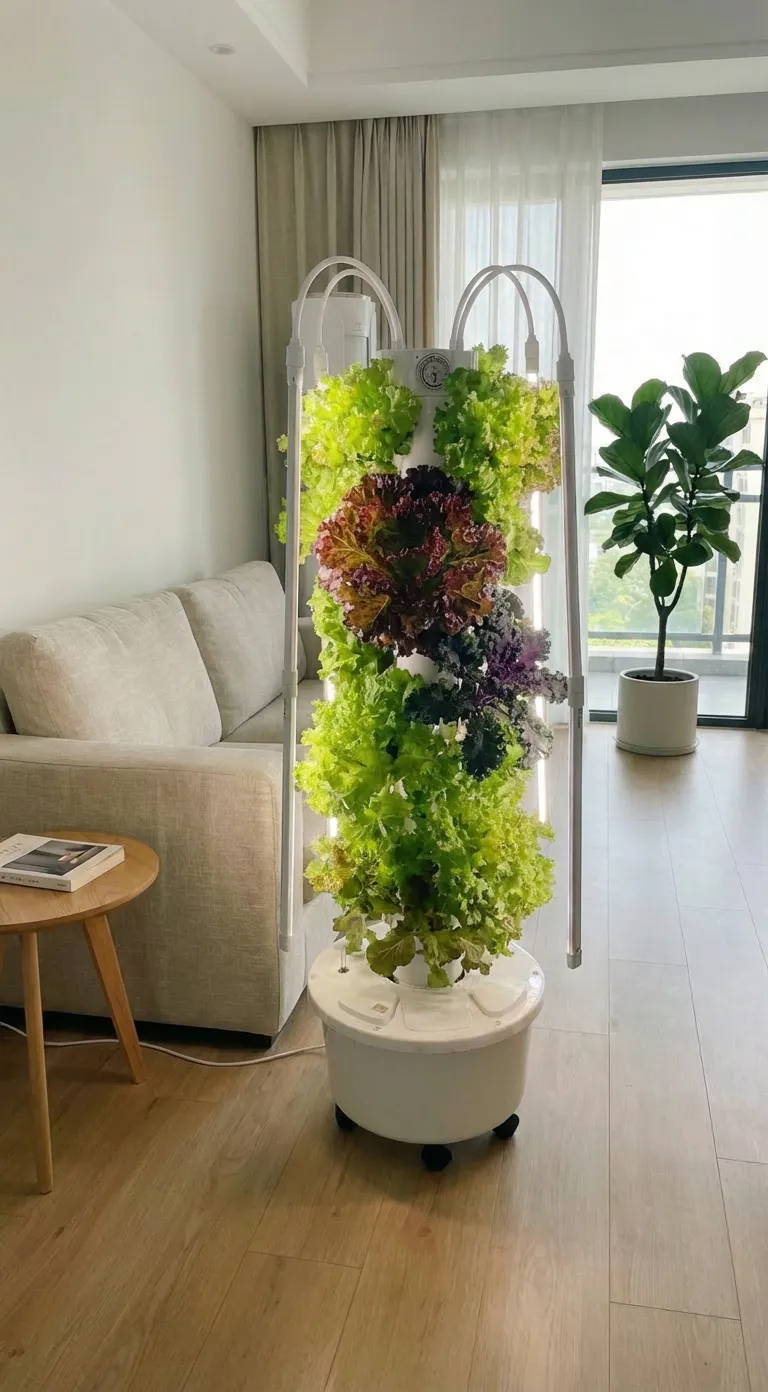
Short answer: change the reservoir water in your hydroponic tower every 7 to 14 days. Leafy greens in a full-size tank can go the full two weeks; fruiting crops — or any tank in a warm room — need fresh water closer to every 7 days. Between changes, top up with plain water, not more nutrients.
Here’s the thing nobody tells beginners: the pump can be running, the lights perfect, and your plants can still stall — because the water has quietly turned into something they can’t use. Plants don’t absorb nutrients evenly. They grab nitrogen fast, sip calcium slowly, and leave the rest behind. Within a couple of weeks, EC drifts, pH swings, and the leftovers start feeding algae instead of your lettuce.
A water change is the cheapest reset button in hydroponics: fifteen minutes, almost no cost, and it fixes more “mystery problems” than any additive on the shelf. Below: a schedule you can actually follow, the signs that mean “change it now,” and the fastest way to do it without stressing your plants.

For most home towers, every 7 to 14 days is the right window — UF/IFAS Extension recommends changing nutrient solution every 1–2 weeks to prevent buildup or deficiencies (UF/IFAS Extension, Hydroponic Production Methods). Where you land in that window depends on what’s growing and how hard the system is working:
| Situation | Change interval | Why | Limitation |
|---|---|---|---|
| Leafy greens only (lettuce, kale, chard), full-size tank | Every 14 days | Greens are light, steady feeders; a larger water volume buffers EC and pH drift | A small tank or a warm room can foul days earlier than this |
| Mixed herbs and greens, moderate plant load | Every 10–14 days | Herbs like basil drink more and feed unevenly, so ratios drift a little faster | Herb roots shed more debris — watch for smell, not just the calendar |
| Fruiting crops (cherry tomatoes, peppers, strawberries) | Every 7–10 days | Heavy, lopsided feeders — they pull potassium and calcium hard and leave the rest | See what not to grow in a hydroponic tower first — crop choice decides half your maintenance |
| Hot weather or tank water above ~75°F | Every 7 days, sooner if it smells | Heat speeds up microbes and algae and makes pH drift harder to predict | A thermometer beats a schedule — one heatwave can beat a 7-day interval |
| Vacation / low-use mode (few plants, lightly fed) | Up to 21 days | Low plant load means slow uptake; plain-water top-ups keep the level stable | Stagnant water still grows biofilm — slimy tank walls mean change it regardless of the day count |
What this table can’t tell you: it says nothing about how your plants look, what your EC meter reads, or how warm your room runs. Two identical towers can need changes a week apart. Use the table as your starting calendar, then let your meter and your nose overrule it. A fresh tank is not a harvest guarantee — it just removes one of the most common reasons crops stall.
It’s not that the water “expires.” Three things happen to it, all at once:
None of this is dramatic. It’s slow, quiet, and cumulative — which is why a calendar beats waiting for visible trouble.
Five signs, in the order I’d actually check them:
EC has drifted ~0.5 mS/cm or more from your target. Mixed at 1.4, reading 2.0 a week later? The composition has shifted — top up with plain water and move your next full change sooner. (Not sure of your target? Our nutrient EC, pH & PPM cheat sheet lists ranges by crop.)
pH swings wildly day to day. A slow upward drift is normal. But if you correct it every morning and it rockets back by evening, the buffering capacity is shot. Most crops want pH 5.5–6.5 — a window backed by UF/IFAS Extension and a 2026 HortScience lettuce study (HortScience 61(10)).
The water smells off. Fresh solution smells like almost nothing. A swampy or rotten-egg smell means anaerobic bacteria are winning — don’t fix that with additives. Change the water.
Slime on the tank walls or roots. Run a finger along the reservoir wall — slippery means biofilm. Light slime with healthy white roots: change soon. Brown, slimy roots plus a bad smell: change today.
The water level drops much faster than your plants could drink. A suddenly thirsty tank usually means evaporation is outpacing uptake — the remaining solution is getting saltier by the day. Top up with plain, pH-balanced water and move the full change earlier.
Fifteen minutes, no drama. Do the steps in this order — the first one is the one beginners skip, and it’s the one that matters most.
Between full changes, topping up isn’t just allowed — it’s required. Plants drink water faster than they absorb minerals. Top up with plain, pH-balanced water, not more nutrient solution. Topping up with nutrients steadily drives EC upward until leaf tips scorch — the single most common beginner mistake.
But topping up replaces volume, not balance. The lopsided uptake, salt concentration, and microbial buildup don’t get fixed by adding water — like topping up car oil between services, not skipping the oil change. Commercial lettuce operations replace full solution every several weeks to months, some doing daily 5–10% partial swaps instead (Agronomy (MDPI), 2026). Home tanks are smaller and less buffered — don’t assume a commercial interval applies to a 5-gallon home tank.
Usually yes — it’s about temperature, not the calendar. Warm water accelerates everything above: microbes, algae, pH drift. Keep the tank out of direct sun and check the temperature if your space runs hot. Aim for roughly 65–72°F; above the mid-70s, plan on the 7-day end of the schedule and let smell and slime be your early warning.
What actually helps: an opaque lid or dark towel over a translucent reservoir (light-blocking covers suppress algae, per the Wiley review above) and keeping the tank off hot floors. A chiller is overkill for a home tower; shade and a lid are not.
One honest note: those greens taste the way they do because they’re harvested minutes before eating at peak freshness — not because of some magic formula. Clean water on schedule keeps that coming.
We reviewed source material on 2026-10-05.
Research describes general methods; it does not verify any specific model, product claim or customer outcome.
Keep learning: browse all growing guides.
Not indefinitely. Topping up replaces the water plants drink, but not the lopsided ratios, salt buildup, or microbes accumulating over weeks. Eventually the solution is something your plants can’t use, no matter how full the tank is. A full change every 7–14 days resets all of it.
Yes. Different crops want different EC levels and ratios — lettuce at 1.0 mS/cm and fruiting tomatoes at 2.0 are completely different recipes. Fresh solution keeps the old crop’s leftovers out of the new grow.
Change it right away. A rotten-egg or swampy smell means anaerobic bacteria are thriving — usually low oxygen, warm water, or decaying root matter. Drain, wipe, refill with fresh solution, and check tank temperature and pump cycles.
Not for a routine change — wiping biofilm off the walls is enough. Save the full deep clean for between crop cycles or after algae or root problems. Sterilizing every two weeks is overkill you’ll eventually skip.
Don’t assume fresher means faster. Once the solution is in range, changing it every 3 days instead of 10 won’t speed anything up — plants absorb nutrients only so fast. More often than weekly mostly wastes fertilizer and water. Fix the schedule first; then check light and temperature.
Dilute it half-and-half with plain water and use it on outdoor soil plants or a lawn. Don’t pour full-strength solution on seedlings or into storm drains, and don’t reuse it in the tower — it has exactly the imbalances you’re trying to get rid of.

