Address
304 North Cardinal
St. Dorchester Center, MA 02124
Work Hours
Monday to Friday: 7AM - 7PM
Weekend: 10AM - 5PM
Address
304 North Cardinal
St. Dorchester Center, MA 02124
Work Hours
Monday to Friday: 7AM - 7PM
Weekend: 10AM - 5PM
Cherry tomatoes are among the most rewarding tower crops, but variety choice makes or breaks it. Pick a dwarf or compact type, train it early, keep EC near 2.0–3.0 mS/cm, and hand-pollinate indoors.
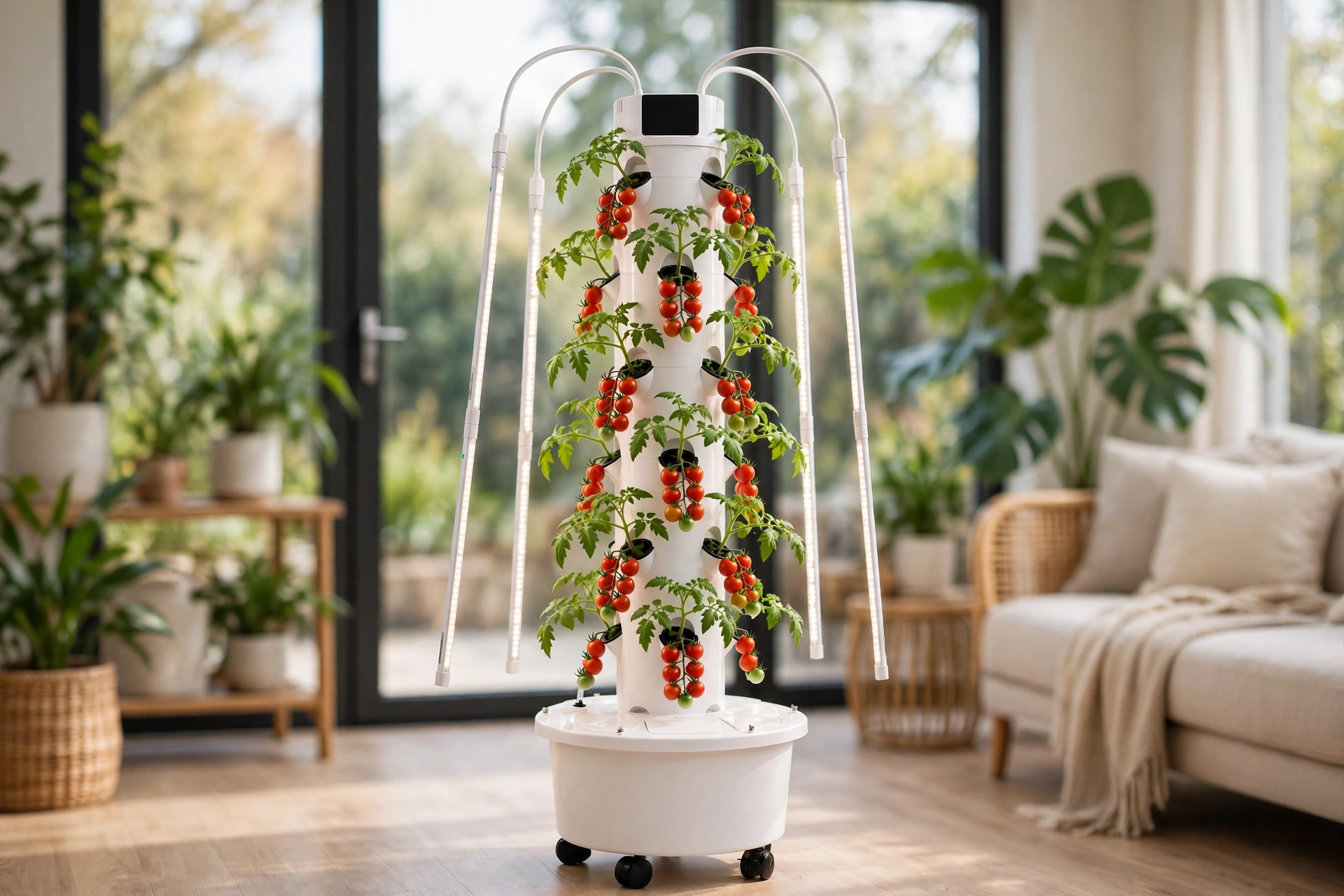
Yes — cherry tomatoes grow well in a hydroponic tower, but variety choice matters more than anything else. If you’re growing cherry tomatoes hydroponically, the most important decision is variety: most cherry tomato varieties are indeterminate vines that can reach 6–10 feet, far taller than most towers. The reliable path is a dwarf or compact cherry variety (like Tiny Tim or Husky Cherry Red), 2–4 upper pods per plant, EC held near 2.0–3.0 mS/cm at pH 5.5–6.0, strong light (20–30 mol/m²/day DLI if you can get it), and hand-pollination indoors. Expect first ripe fruit roughly 60–75 days after transplant.
This guide walks through the whole thing: which varieties actually fit a tower, exact nutrient targets by growth stage, how to support and prune without wrecking your harvest, indoor pollination, and the problems that show up most often. It assumes a vertical aeroponic/hydroponic tower with planting pods and a shared reservoir — the same setup behind our what-you-can-grow guide.

Short version: yes, with realistic expectations. Tomatoes are heavy feeders with big root and canopy demands, so they break more "rules" of tower growing than lettuce or basil. One tomato plant realistically occupies 2–4 pods — or effectively a whole section of the tower — because it needs the light, airflow, and root space around it. Planting a tomato in every pod, the way you’d plant lettuce, is the single most common mistake. On a compact model like the Ovelium 24-plant hydroponic tower, one tomato plant realistically claims a whole section of the tower. There are two honest ways to do it:
Plant count does not equal harvest guarantee — one well-lit, well-fed tomato plant will out-produce three crowded, shaded ones. That’s the mindset for the rest of this guide to growing cherry tomatoes hydroponically.
Cherry tomato varieties fall into three growth habits. Only the first two are realistic in a tower; the third is included so you know what to avoid — a 24-plant tower simply doesn’t have the headroom for 6-foot vines.
| Growth habit | Typical height | Pruning | Support needed | Tower fit | Example varieties |
|---|---|---|---|---|---|
| Dwarf / micro-dwarf (determinate) | 6–16 inches | None (pruning cuts the harvest) | Minimal — sometimes a small stake | Excellent — bred for containers | Tiny Tim, Micro Tom, Orange Hat |
| Compact / dwarf indeterminate | 2–4 feet | Light suckering, top at LED height | Yes — tie to trellis or stake | Good with training | Husky Cherry Red, Patio Cherry |
| Standard indeterminate cherry | 6–10+ feet | Season-long suckering | Substantial trellis | Poor — outgrows the tower | Sweet 100, Sungold (full-size vines) |
What this table doesn’t tell you: variety names are genetics, not guarantees. A "dwarf" grown in dim light with weak nutrients will stretch leggy and disappoint; a vigorous indeterminate kept under strong light and trained hard can behave. The table compares growth habits in typical conditions, not promises about any specific seed packet — your light and feeding matter at least as much as the label. A few specifics worth knowing:
Cherry tomatoes are heavier feeders than leafy greens, so they’ll want a stronger solution than whatever you’re running for lettuce — don’t mix them on the same reservoir setting without a compromise. Research on hydroponic cherry tomatoes gives a useful stage-by-stage picture:
| Growth stage | Target EC | Target pH | Notes |
|---|---|---|---|
| Seedling / transplant | 1.0–1.5 mS/cm | 5.5–6.0 | Start low; young roots burn easily |
| Vegetative growth | 1.5–2.5 mS/cm | 5.5–6.0 | Raise gradually as the plant sizes up |
| Flowering | 2.0–3.0 mS/cm | 5.5–6.0 | Watch for blossom drop if EC spikes |
| Fruiting / harvest | 2.5–3.5 mS/cm | 5.5–6.0 | Slightly higher EC can raise sugars — with a yield trade-off |
What this table doesn’t tell you: these ranges come from greenhouse and NFT research setups, not from anyone’s specific tower model. EC meters also read differently with temperature, and your tap water’s starting EC counts. Treat the table as a starting map, then adjust by watching the plant — pale new growth and slow fruiting usually mean feed up; leaf-tip burn and stalled growth usually mean back off. When growing cherry tomatoes hydroponically, the plant’s response matters more than any printed number.
The science behind the fruiting-stage bump is worth a sentence. A study in Horticulturae found that dropping EC to 1.5 mS/cm during seedling/flowering and raising it to 3.0–4.5 during fruiting and harvest improved cherry tomato fruit quality and fertilizer efficiency versus a constant 3.0. But there’s a trade-off: Buck et al. showed that pushing EC above about 2.3 dS/m raised total soluble solids (sweetness) while reducing total yield, because fruit got smaller. Translation: don’t chase high EC for flavor unless you’re willing to harvest less. Keep pH between 5.5 and 6.0 — the range used across the cited hydroponic tomato research — and check it at least twice a week, because tomato plants swing pH faster than greens as they feed. Our full walkthrough of meters, mixing, and troubleshooting lives in the hydroponic nutrients EC/pH/PPM guide.
It depends entirely on the growth habit — and this is where most tower growers go wrong in both directions. Dwarf determinate varieties (Tiny Tim, Micro Tom): do not prune. Extension guidance is consistent on this: pruning determinates removes the flowering branches that would have become fruit, cutting the harvest for no benefit. The only pruning a dwarf needs is removing leaves that touch surfaces or show disease. Indeterminate and compact-indeterminate varieties: yes, sucker them. A sucker is the shoot that grows in the leaf axil — the "armpit" between the main stem and a leaf branch. Left alone, each sucker becomes its own stem, and on a tower that means a tangled canopy that shades itself, blocks airflow, and outgrows your lights in weeks. Practical rules:
Pruned, staked plants produce fewer but larger fruit than unpruned ones — the same trade-off as the EC story. For growing cherry tomatoes hydroponically in a tower, where space and light are the limiting factors, fewer-but-bigger is usually the right trade. One more caution: don’t prune wet plants (disease spreads on wet tools and hands), and wash or wipe snips between plants.
A fruiting cherry tomato is heavy. A truss of ripening cherries plus a water-loaded stem will bend, snap, or pull a pod cup out of its hole if unsupported. Research greenhouses support hydroponic tomato plants on overhead wires with twine — in one NFT cherry tomato trial, plants were trained up linen threads attached to an overhead wire, with all lateral shoots removed. You can scale that down:
Set supports up before the plant needs them — driving a stake into a pod cup full of established roots damages exactly the roots doing the work.
Tomato flowers are self-pollinating — each flower contains both male and female parts — but the pollen still needs to move. Outdoors, wind and bumblebees do it by vibration ("buzz pollination"). Indoors, with still air and no bees, flowers can open, fail to set, and drop. The fix is mechanical and takes seconds:
If flowers are dropping despite vibration, suspect temperature, not technique. Tomato pollen loses viability in sustained heat — extension sources flag daytime temperatures above ~90°F and nights above ~75°F as blossom-drop territory. Indoors, the usual culprit is a tower parked next to a heat vent or in a sun-baked window — move it or add airflow before blaming the variety.
More than your tower’s built-in LEDs probably deliver alone. Fruiting tomatoes are among the most light-hungry crops you can grow indoors: research reviews suggest a daily light integral (DLI) of 20–30 mol/m²/day for good-tasting, high-yielding greenhouse tomatoes. A cherry-tomato-specific LED trial found supplemental lighting raised yield 18–41% over unsupplemented controls. Practical translation for a tower grower:
From seed, a dwarf cherry tomato like Tiny Tim runs about 60 days to maturity; from transplant, most compact cherries give you the first ripe fruit in roughly 60–75 days, then keep producing for weeks (indeterminate types) or in one concentrated flush (determinates). A realistic week-by-week plan:
Three problems cause most tower-tomato grief, and all three are environmental, not varietal:
The short version: growing cherry tomatoes hydroponically in a tower comes down to three things — a dwarf or compact variety, stable EC and pH through each growth stage, and as much light as you can provide. Get those right, and you’ll be picking ripe cherries minutes before eating them.
One or two. A fruiting tomato needs the light, airflow, and root space of 2–4 pods’ worth of tower real estate. When growing cherry tomatoes hydroponically, crowding more plants in gives you a jungle with little fruit. Fill the remaining pods with herbs or lettuce, which are far less demanding.
Technically yes, practically it’s a fight. Standard indeterminate cherries grow 6–10 feet and will outgrow any tower’s lights within weeks. If you try it, train to a single stem, top it at light height, and accept a sprawling project. Dwarf or compact varieties are the sane choice.
Yes — tomatoes are heavier feeders. If they share a reservoir with lettuce, you’ll compromise: run EC around 2.0–2.5 and accept that neither crop is at its personal optimum, or give the tomato its own reservoir/tower. Tomatoes also want relatively more potassium once fruiting starts.
Most likely causes indoors: no vibration for pollination, or temperatures too hot (above ~90°F days / ~75°F nights sterilizes pollen). Vibrate the flower clusters with an electric toothbrush around midday every few days, and check that the tower isn’t parked next to a heat source.
At least twice a week — growing cherry tomatoes hydroponically means plants that swing pH and drink down nutrients faster than leafy greens. Top up with plain pH-adjusted water between reservoir changes, and do a full reservoir refresh every 1–2 weeks during heavy fruiting.
Dwarf varieties can survive and fruit modestly, but yields and flavor improve dramatically with supplemental light — a cherry tomato trial showed 18–41% higher yields with added LEDs. For a serious harvest, give the tower your brightest window spot plus the LED bars on 14–16 hours.
Growing cherry tomatoes hydroponically can give excellent flavor, especially picked fully ripe — but light is the deciding factor, and most indoor setups deliver less light than a sunny garden. Don’t expect a sun-baked August tomato from a dim corner; do expect excellent flavor from a well-lit tower, harvested minutes before eating.
We reviewed source material on 2026-10-09.
Research describes general methods; it does not verify any specific model, product claim or customer outcome. More in Growing Guides

