Address
304 North Cardinal
St. Dorchester Center, MA 02124
Work Hours
Monday to Friday: 7AM - 7PM
Weekend: 10AM - 5PM
Address
304 North Cardinal
St. Dorchester Center, MA 02124
Work Hours
Monday to Friday: 7AM - 7PM
Weekend: 10AM - 5PM
Most hydroponic tower pumps run at 30–45 dB — about as loud as a refrigerator hum. Here's what actually makes a tower noisy, and the fixes that keep it whisper-quiet in a bedroom or living room.
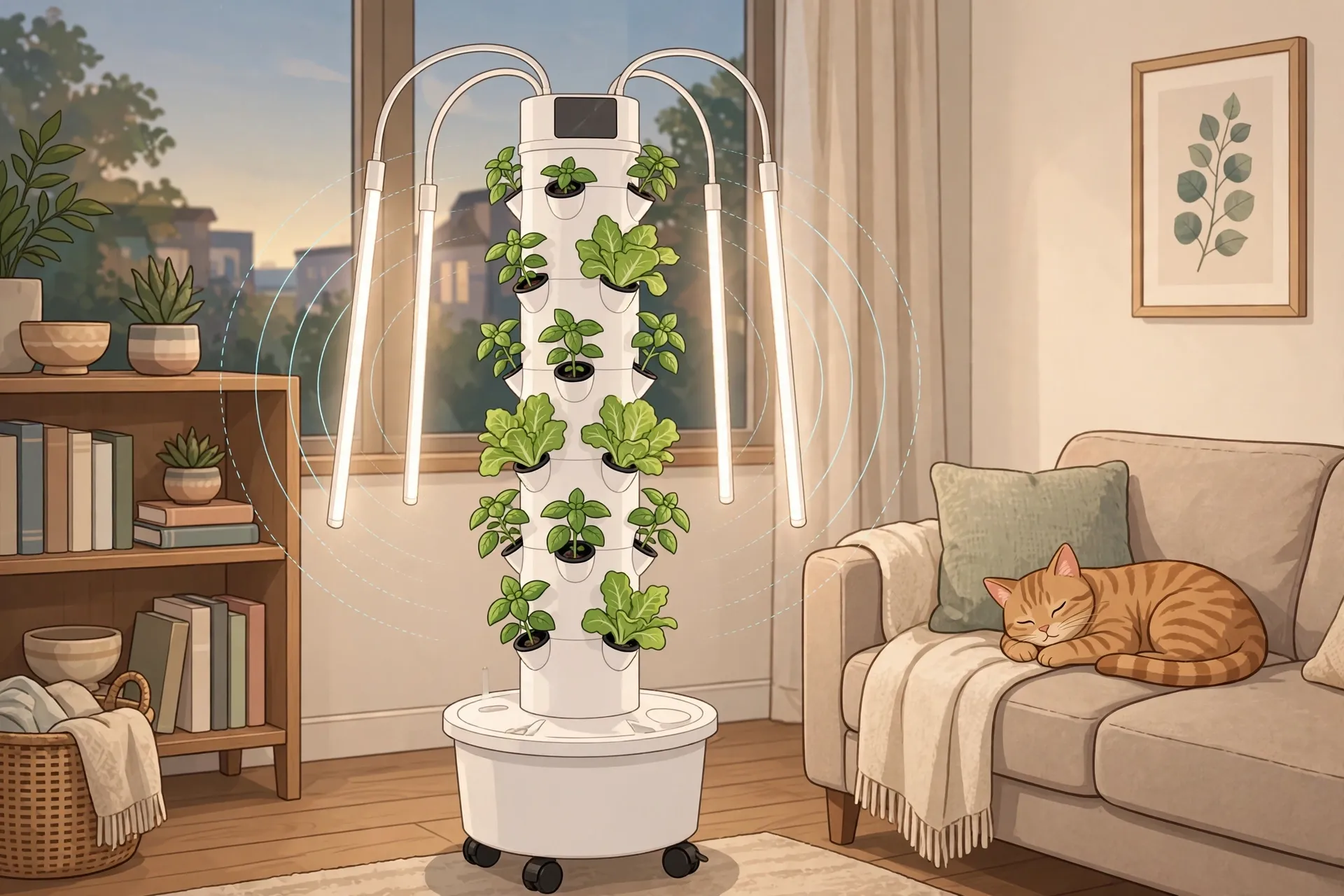
A hydroponic tower is quiet enough for a living room — and usually a bedroom, too. Most tower pumps are rated at 30 to 45 decibels, roughly the volume of a refrigerator hum or a quiet library. Real-world noise is a little higher when water levels drop or the pump needs cleaning, but with basic maintenance a tower stays in the background hum range, far below anything that would bother neighbors or damage hearing.
If you’ve been holding off on indoor growing because you picture a noisy pump grinding away next to your couch, you can relax. The water pump — the only moving part in most towers — is one of the quietest appliances you’ll own. A dishwasher runs at about 60 decibels; your tower will be nowhere near that. Below, we’ll put real numbers on tower noise and show you the simple fixes that keep it whisper-quiet year-round.

Decibels are confusing because the scale is logarithmic — every 10-point jump represents roughly ten times more sound energy, not just “a little louder.” So the gap between a 35 dB tower pump and a 60 dB dishwasher is enormous, even though the numbers look close.
Here’s how a hydroponic tower compares to sounds you already know:
| Sound source | Typical level | What it feels like |
|---|---|---|
| Breathing / pin drop | 10 dB | Barely audible |
| Soft whisper at 5 feet | 20 dB | Very quiet |
| Quiet library / bedroom at night | 30 dB | Background silence |
| Typical hydroponic tower pump | 30–45 dB | Quiet hum you notice only if you listen |
| Refrigerator hum | 40–50 dB | Familiar kitchen background |
| Moderate rainfall | 50 dB | Clearly audible, not annoying |
| Normal conversation | 60 dB | Everyday talking |
| Dishwasher in the next room | 60–63 dB | Noticeable appliance noise |
| Vacuum cleaner | 70 dB | Loud enough to raise your voice |
Reference levels drawn from published decibel comparison charts (Cearvol, Manta Sleep, Creative Field Recording). Figures are typical ranges; exact levels vary by distance and environment.
The takeaway: a well-running hydroponic tower sits in the same band as the fridge you already live with. If your refrigerator doesn’t keep you awake, a tower won’t either.
A hydroponic tower makes three kinds of sound. Knowing which is which matters, because each has a different fix.
1. The pump’s motor hum. Most towers use a small submersible pump — the same type of pump used in aquariums and tabletop fountains. The impeller spins inside a sealed housing, and because the whole pump sits underwater, the reservoir acts like a muffler. Manufacturers of these pumps typically rate them at 20 to 40 dB (POPOSOAP lists “less than 30 dB,” NFESOLAR and VIVOSUN both list 30–40 dB for their submersible models). These are manufacturer claims rather than independent lab measurements, so treat them as optimistic — but they establish the right ballpark.
2. Water movement. As water is lifted to the top of the tower and rains back down through the growing columns, you hear a gentle trickling or babbling-brook sound. Many people find this pleasant — it’s the same class of sound as a small indoor fountain, around 40 dB. It gets noticeably louder when the reservoir water level drops, because water then falls a longer distance and splashes harder.
3. Vibration against hard surfaces. A pump resting directly on the hard plastic floor of a dry reservoir, or a tower sitting on bare tile, can transmit a low buzz through the floor. This is usually the culprit when someone says their tower “suddenly got loud.” It’s not the motor — it’s contact vibration, and it’s the easiest of the three to fix.
What you won’t hear: fans (most towers don’t have any), clicks from timers (the mechanical timers some towers use produce one soft click per cycle — barely worth mentioning), or anything resembling a motor grinding. If your tower ever does sound like it’s grinding, something is wrong — usually debris in the impeller.
You may have noticed pump listings that claim everything from “less than 20 dB” to “40 dB.” Some of that variation is real; some is marketing. Three things move the number:
One honest caveat: I haven’t put a calibrated sound meter next to a tower in a lab. The 30–45 dB range comes from manufacturer specifications and the consensus of grower reviews, which consistently describe tower pumps as “quieter than the fridge.” Treat specific brand claims with healthy skepticism — but the overall picture is solid: these pumps are designed for aquariums, where silence is a selling point, and towers inherit that quietness.
If your tower is audible in a way that bothers you, work through these steps in order. In most cases, the first two solve it.
One thing not to do: don’t turn the pump off overnight as a routine noise fix unless your tower is designed for intermittent watering. Roots in a tower dry out faster than in soil, and a long dry stretch can stress plants. Use the timer settings instead.
For most people, yes. Here’s the math: the World Health Organization’s night-noise guideline sets 40 dB as the threshold for protecting sleep. A well-maintained tower running at 30–40 dB sits right at or below that line — comparable to the ambient sound of a quiet bedroom itself. Many growers keep towers in bedrooms and home offices without issue, and report that the gentle water sound becomes white noise they stop noticing within days.
Two exceptions worth being honest about. First, if you’re an extremely light sleeper who wakes at every sound, even 35 dB of intermittent trickling may bother you — put the tower in another room or run it on a timer with nighttime off-cycles. Second, a tower that’s neglected (low water, dirty impeller) can climb well above its rated noise, into the 50+ dB range where it genuinely disrupts sleep. Noise is a maintenance indicator as much as anything else: a suddenly louder tower is a tower asking to be cleaned.
For perspective on safety, the CDC notes that hearing damage begins around 85 dB with prolonged exposure — a tower will never get anywhere near that. And compared to the rest of your home, the tower is one of the quietest appliances you own: your refrigerator (40–50 dB), your dishwasher (60+ dB), and your HVAC system (often 50–60 dB when the blower runs) all out-noise it.
Many do run their pumps continuously, but plenty of towers use timers that cycle the pump — for example, 15 minutes on, 45 minutes off. Both approaches work; it depends on the tower’s design and what you’re growing. If yours runs continuously and you’d like nighttime quiet, check whether the manufacturer supports a timer cycle before changing anything.
Almost always one of three things: the water level dropped, the pump impeller picked up debris, or the pump shifted and is now vibrating against the reservoir wall. Top off the water first — that fixes it most of the time. If not, clean the impeller.
Not necessarily. A taller tower needs a pump with more lift height, which can mean slightly more wattage, but tower pumps stay small across the board — typically 8 to 20 watts. The difference between a 24-plant and a 96-plant tower’s pump noise is small compared to the effect of water level and maintenance.
No. At 30–45 dB inside your home, tower noise doesn’t travel through walls in any meaningful way. It’s quieter than a normal conversation (60 dB), and sound drops off quickly with distance. Apartment dwellers can grow without worrying about complaints.
Noise, no — a clean, full tower is already quiet enough to sleep near. Electricity is a separate question, and the answer is still modest: tower pumps are low-wattage, so the running cost is small either way. If you do use nighttime off-cycles, make sure your tower’s design supports intermittent watering so roots don’t dry out.
A living room or home office corner, on a rug or mat, away from shared bedroom walls. Kitchens work too — the ambient fridge and HVAC noise will completely mask the tower. The only spot I’d avoid is right next to a light sleeper’s bed, and even that works fine with a timer.
Yes, roughly. Free sound-meter apps (like NIOSH SLM on iOS) give ballpark readings — hold the phone about 3 feet from the tower in a quiet room. Expect phone readings to run a few decibels higher than manufacturer specs, which are measured under ideal conditions. If your reading is dramatically higher (say, 55+ dB), that’s your cue to check the water level and clean the pump.
Bottom line: noise is one of the least of your worries with a hydroponic tower. Buy a quality submersible pump, keep the water topped up, clean the impeller now and then, and your tower will hum along in the background — noticed only when you lean in to check on your plants. If you’re still planning your setup, browse our Growing Guides for more on nutrients, lighting, and crop-by-crop settings.
We reviewed source material on 2026-10-04.
Research describes general methods; it does not verify any specific model, product claim or customer outcome.

