Address
304 North Cardinal
St. Dorchester Center, MA 02124
Work Hours
Monday to Friday: 7AM - 7PM
Weekend: 10AM - 5PM
Address
304 North Cardinal
St. Dorchester Center, MA 02124
Work Hours
Monday to Friday: 7AM - 7PM
Weekend: 10AM - 5PM
A hydroponic tower keeps the harvest going through winter: here's the setup — light targets, best cold-season crops, temperature ranges, and a weekly maintenance routine.
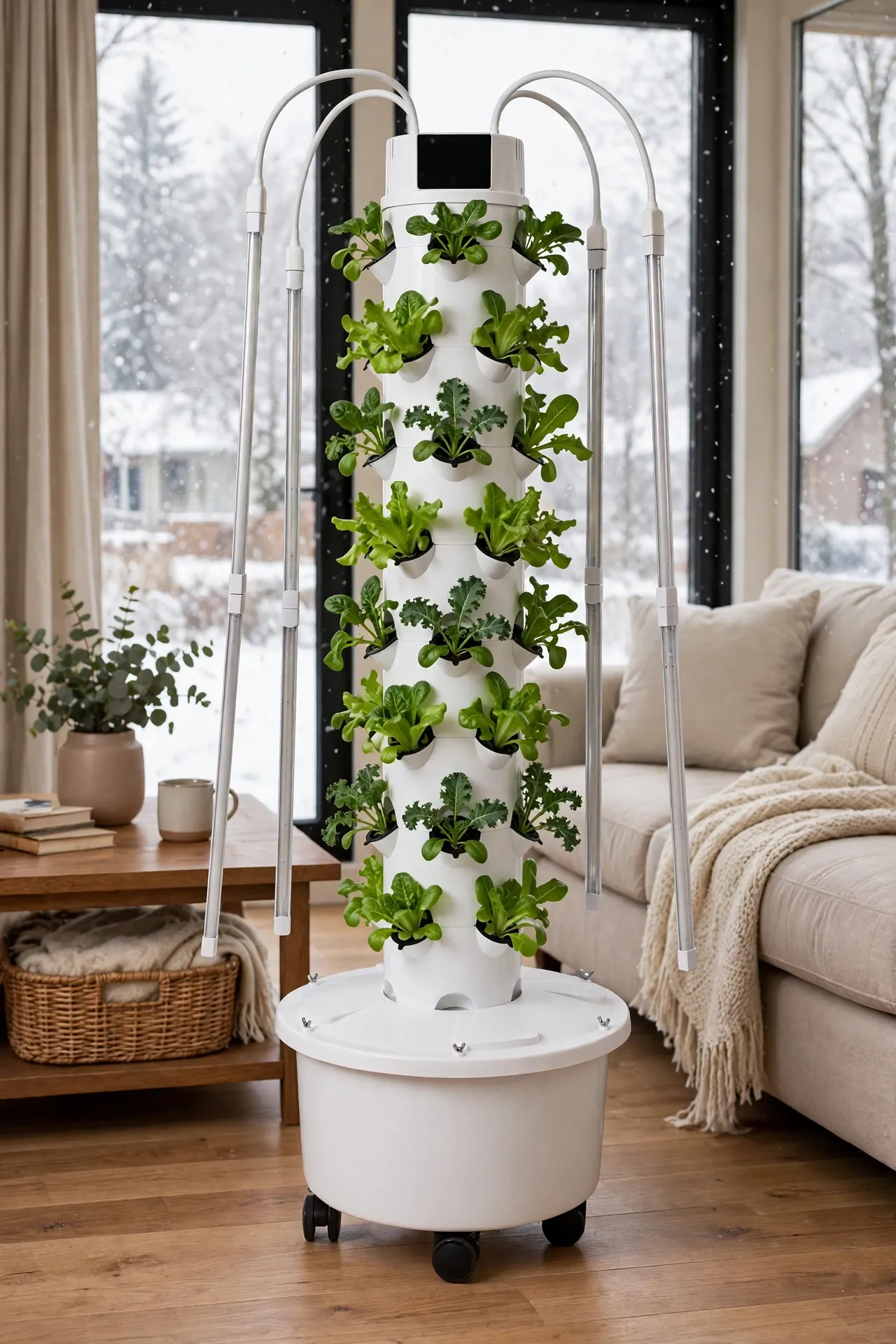
Yes — growing vegetables indoors in winter works, and a hydroponic tower is one of the few setups that does it well. Shorter days, cold windowsills, and dry indoor air stop outdoor growing in November — but inside your home, the tower’s grow lights, recirculating nutrients, and stable reservoir replace what winter takes away. Expect greens and herbs, not summer fruit: leafy crops thrive
under 12–16 hours of LED light, while tomatoes and peppers demand more light and heat than most homes can reasonably supply.
Winter’s three killers for indoor plants are weak light, cold root zones, and dry air. A hydroponic tower is built to answer all three — as long as you actually use the equipment it comes with.
None of this is automatic. More planting spots is not a harvest guarantee — a 40-plant tower running on dim light and cold water grows forty sad seedlings. Winter growing succeeds on three controlled inputs: enough light, stable temperatures, and the right crops.
Location is a winter decision in a way it isn’t in summer. Four rules:
A garage or unheated sunroom sounds tempting, but night temperatures in the 40s–50s°F slow cool-season greens to a crawl. The tower belongs inside the heated living space.
Winter rewards cool-season crops that ask for moderate light and tolerate the drier indoor air. These are the reliable performers in a home tower:
| Crop | Typical harvest | Why it works in winter | What this won’t tell you |
|---|---|---|---|
| Leaf lettuce / salad mixes | 25–35 days from transplant | Germinates and grows in cool rooms (65–70°F); needs only 12–14 mol/m²/day | Heat or excess light makes it bitter — a winter problem in reverse |
| Spinach | 30–40 days | Loves cool conditions; compact, so many pods per tower | Slower than lettuce; give it the cooler end of the room |
| Kale | 30 days for baby leaves, cut-and-come-again | Tolerates dry air and temperature swings well; keeps producing for months | Big plants shade lower pods — our kale guide covers spacing |
| Swiss chard | 30–45 days for baby leaves | Same cut-and-come-again habit as kale; colorful and forgiving | Needs more light than lettuce; put it on the top tiers |
| Bok choy | 30–40 days | Fast, compact, cool-loving; excellent winter staple | Bolts in warm rooms — keep it away from heat sources |
| Herbs (basil, cilantro, mint, parsley) | 21–35 days, ongoing | Small, fast, and you harvest a little at a time all winter | Basil wants warmer air (70°F+) than the cool-season greens; it is the fussiest herb on this list |
| Green onions | Regrow from scraps in ~2 weeks | Nearly indestructible; a good first crop for beginners | Yields are garnish-scale, not meal-scale |
What this table can’t tell you: variety matters as much as species. A heat-tolerant lettuce bred for summer will still bolt under your LEDs if the room runs warm — read the seed packet’s “bolt resistance” notes; the tower can’t fix a wrong variety choice. And this list deliberately excludes fruiting crops: tomatoes and peppers need 20–30 mol/m²/day and warm nights, which means more fixtures and more electricity — a different project from a winter greens tower.
Light is the single input that decides whether winter growing works. The target is DLI — daily light integral, the total light a plant receives in a day, measured in mol/m²/day. In winter you cannot borrow it from the sun, so the tower’s LEDs have to supply all of it.
| Crop group | Target DLI | Typical timer setting |
|---|---|---|
| Lettuce, spinach, bok choy, salad mixes | 12–17 mol/m²/day | 14–16 hours of LED light |
| Kale, chard, arugula | 14–17 mol/m²/day | 14–16 hours of LED light |
| Herbs (basil, cilantro, mint, parsley) | 14–20 mol/m²/day | 14–16 hours; basil at the higher end |
| Seedlings (first 1–2 weeks) | 6–12 mol/m²/day | Shorter hours or raised lights, then ramp up |
Most home tower LEDs run a fixed intensity, so the timer is your control dial: DLI ≈ light intensity (PPFD) × hours × 0.0036. If your bars deliver roughly 250 µmol/m²/s at pod height, 14 hours gives about 12.6 mol/m²/day — right in the leafy-green band. Most greens want a dark period too, so don’t run LEDs around the clock; 14–16 hours on is the standard.
What this table can’t tell you: DLI targets describe mature plants under research conditions, not your exact tower. Bar height, pod position, and plants shading each other all change the real number at the leaf. If lower-tier plants stretch tall and pale, they are asking for more light or a better position, whatever the math says. These ranges come from controlled-environment research on general crop groups — what lettuce-type plants respond to, not what any specific tower model delivers.
Winter growing runs cooler than summer growing, and that’s fine — these crops prefer it. Two temperatures matter:
Humidity is winter’s quiet problem: heated indoor air often sits at 25–35% RH, while leafy greens prefer 40–60%. Two cheap fixes: a small room humidifier near (not on) the tower, or keeping the tower out of the direct path of forced-air heating. A $10 thermometer/hygrometer next to the tower tells you whether you actually have a problem.
The chemistry doesn’t change with the season, but the rates do. Slower winter growth means plants drink relatively more water than nutrients compared with summer — the solution concentrates between top-ups, so EC creeps upward. Check EC weekly and top up with plain pH-adjusted water (not fresh nutrient mix) when the level drops; do a full reservoir change every 2–3 weeks as usual.
pH drifts the same way it always does — typically upward as plants take up nitrate — so the weekly pH check stays on the schedule. Cold top-up water straight from the tap can shock roots; let it sit until it reaches room temperature first. Keep a simple log: EC, pH, and water temperature once a week takes two minutes and spots trends before they become deficiencies.
| Symptom | Likely winter cause | Fix |
|---|---|---|
| Seedlings tall, pale, floppy | Not enough light — classic winter DLI shortfall | Increase timer hours; move plants to top tiers; start the next batch under stronger light from day one |
| Slow growth despite good light | Reservoir or room too cold (below ~60°F) | Move tower into the heated space; verify water is 65–68°F |
| Leaf edges browning | Dry heated air + transpiration stress, or tip burn from excess light | Move away from vents; raise humidity toward 40–50%; check DLI isn’t overshooting 17+ for lettuce |
| Brown, slimy roots / sour smell | Warm reservoir (above ~72°F) with low dissolved oxygen | Cool the tank, improve air circulation around it, change the reservoir; see our root-rot diagnosis guide |
| EC rising between checks | Heated-room evaporation outpacing plant uptake | Top up with plain water more often; don’t add nutrients to compensate for a dropping level |
| White crust on pods or tank rim | Salt buildup from concentrated solution | Wipe down during the reservoir change; rinse pods |
What this table can’t tell you: symptoms overlap. Leggy seedlings in a cold room can be both under-lit and too cold — fixing only the light gives stockier plants that still grow slowly. Work the cheapest, easiest change first and re-check after each fix.
| When | Task | Time |
|---|---|---|
| Daily (glance) | Lights on as scheduled? Pump running? Any leaks or wilted plants? | 1 minute |
| Weekly | Check EC, pH, water temperature; top up with room-temperature water | 10 minutes |
| Every 2–3 weeks | Full reservoir change; wipe tank and rinse pump intake | 30 minutes |
| Monthly | Harvest outer leaves (cut-and-come-again); inspect roots; start next seedling batch | 20 minutes |
The monthly seedling batch is what makes growing vegetables indoors in winter feel abundant instead of sparse: with a small tray of starts always coming along, harvested pods get replanted the same day. For more troubleshooting walkthroughs, browse our Growing Guides.
We reviewed source material on 2026-10-19.
Research describes general methods; it does not verify any specific model, product claim or customer outcome.
Not really — not vegetables worth eating. A bright south-facing window in December delivers far too little total light (DLI) for leafy greens to grow properly; plants survive but stretch pale and stall. A hydroponic tower’s LED bars on a 14–16 hour timer replace that missing light, which is what makes winter growing work.
Leaf lettuce or a salad mix. It germinates easily, tolerates normal room temperatures, needs only moderate light (12–14 mol/m²/day), and you can start harvesting outer leaves in about a month. Green onions regrown from kitchen scraps are even easier if you want a near-zero-effort first crop.
Plan on 14–16 hours of LED light per day for leafy greens and herbs. That timer setting, not the sun, is what delivers the 12–17 mol/m²/day these crops need. Seedlings need less (6–12), and fruiting crops like tomatoes need more (20–30) — which is why winter towers focus on greens.
The pump is tiny (around 10W) and the LED bars are the main draw — typically well under 100W total for a home tower. At average US residential rates, running lights 14–16 hours a day usually costs on the order of a few dollars a month, not tens. Time-of-use customers can shift the light window to off-peak hours.
Keep room air at 65–75°F for leafy greens and herbs, and the reservoir water at 65–68°F. Below about 60°F air temperature, growth slows sharply; above about 72°F water temperature, dissolved oxygen drops and root problems become more likely. Keep the tower inside the heated living space, not in a garage or unheated sunroom.
It’s possible but it’s a different project: tomatoes need 20–30 mol/m²/day of light, warm nights, and hand pollination indoors. Most home tower LED setups and timers are sized for greens, so winter tomatoes usually mean added fixtures, higher electricity use, and often a grow tent. Start with greens; add fruiting crops once the basics are routine.
Every 2–3 weeks for a full reservoir change, same as other seasons, with weekly EC, pH, and water-temperature checks in between. Winter’s twist is faster evaporation in heated rooms, which concentrates nutrients — top up with plain room-temperature water between changes rather than adding more nutrient mix.

