Address
304 North Cardinal
St. Dorchester Center, MA 02124
Work Hours
Monday to Friday: 7AM - 7PM
Weekend: 10AM - 5PM
Address
304 North Cardinal
St. Dorchester Center, MA 02124
Work Hours
Monday to Friday: 7AM - 7PM
Weekend: 10AM - 5PM
Peppers are heavier feeders than lettuce: run EC 2.0–2.5 for bells (up to 3.0 for hot types) at pH 5.8–6.2, give each plant 2–3 pods, and keep calcium steady to dodge blossom-end rot.
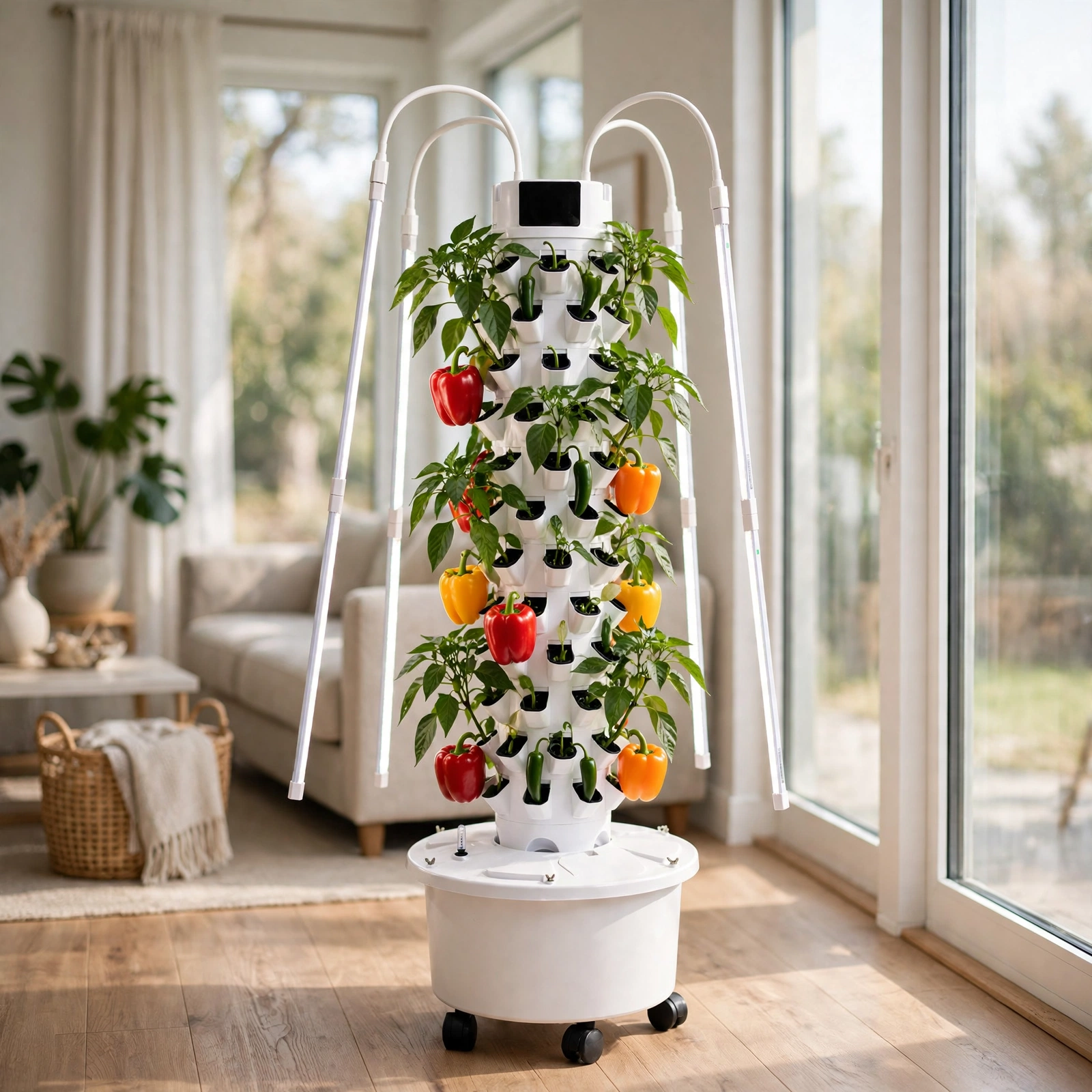
Peppers fruit best in a hydroponic tower at EC 2.0–2.5 mS/cm (bell types) or up to 3.0 for hot types, pH 5.8–6.2, 14–16 hours of light, and day/night temperatures near 72/64°F. Give each plant 2–3 pods’ worth of space, vibrate the flowers for pollination, and keep calcium and potassium in a roughly 1.5:1 ratio to stop blossom-end rot.
Growing peppers in hydroponic tower gardens is a step up from leafy greens — and the payoff is real. Nothing beats slicing a bell pepper you picked ten seconds ago. But peppers are long-cycle, heavy-feeding fruiting plants, and they punish sloppy nutrient management the way lettuce never will. Run the reservoir like you would for basil and you’ll get a tall, handsome, flowerless bush.
This guide gives you stage-by-stage EC and pH targets, the temperature and light numbers that matter, how to handle pollination indoors, and how to keep blossom-end rot off your fruit — with the honest caveat that your plants, not the meter, get the final vote.

Lettuce is a sprint; peppers are a marathon. A head of lettuce goes from transplant to harvest in about a month and sips nutrients at EC 0.8–1.2. A bell pepper needs 60–90 days from transplant to its first ripe fruit, eats at roughly double that EC, and spends weeks in a flowering phase where every stress event — heat spike, EC swing, missed pollination — can dump its blossoms on the floor.
| Parameter | Lettuce (typical) | Peppers (typical) | What this table can’t tell you |
|---|---|---|---|
| EC | 0.8–1.2 mS/cm | 2.0–2.5 mS/cm (bells); up to 3.0–3.5 (hot types) | Starting points from reference charts, not your tower’s measurements; cultivar, light, and temperature all shift the ideal. |
| pH | 5.5–6.5 | 5.8–6.2 (acceptable 5.5–6.5) | The “ideal” matters less than stability — peppers drift pH faster because they feed harder. |
| Cycle | ~30 days from transplant | ~60–90 days from transplant for bells | Estimates, not promises; variety and light shift these widely. |
| Light | 12–14 h, modest intensity | 14–16 h, high intensity (DLI 20–30) | Home light meters are approximate; compact growth and thick stems are the real gauge. |
| Spacing | 1 pod per plant | 2–3 pods’ worth of space per plant | Slot count is not a harvest guarantee — crowding buys foliage, not fruit. |
| Pollination | Not needed | Needs vibration indoors | Self-pollinating; indoor “pollination problems” are usually heat or nutrition in disguise. |
Bottom line: don’t run peppers on lettuce reservoir settings. If peppers must share a reservoir with lettuce, both get a compromise — more on that in the FAQ.
EC is your best single proxy for nutrient strength. Peppers are heavier feeders than almost anything else grown on a tower, and their appetite grows as they shift from leaves to fruit.
| Growth stage | Target EC (mS/cm) | What this stage needs, and what the number doesn’t prove |
|---|---|---|
| Seedlings (after first true leaves) | 1.0–1.5 | Gentle feeding while roots establish — light matters as much as EC here. |
| Vegetative growth | 1.5–2.0 | Enough nitrogen to build the frame that will carry fruit; higher EC here grows leaves, not future peppers. |
| Flowering | 2.0–2.5 | The transition zone. A widely used hydroponic reference chart puts bell peppers at 2.0–2.5 and hot peppers up to 3.5 — starting points, not lab-verified tower targets. |
| Heavy fruiting | 2.0–2.5 (bells); up to 3.0 (hot types) | Hold, don’t chase. One greenhouse trial on the ‘Sirocco’ bell cultivar held 2.6–3.0 successfully — commercial greenhouse, one cultivar, not your tower. Raise EC by 0.2 at a time and watch for a week. |
Three habits matter more than the exact number:
For a deeper dive on reading EC, pH, and PPM meters and converting between the scales, see our hydroponic tower nutrients guide (EC, pH & PPM).
Aim for 5.8–6.2; anything in the 5.5–6.5 band is fine. pH decides which nutrients roots can absorb: much above 6.5 and calcium, magnesium, and iron start locking out — which is exactly how blossom-end rot appears in a reservoir that technically contains enough calcium.
Peppers swing pH faster than lettuce because they feed harder, so check at least twice a week during fruiting. Adjust with small doses of pH down or pH up, then re-check the next day — big single corrections cause bigger swings than the drift you were fixing.
Light first: peppers are sun plants. Run the LED bars 14–16 hours a day during fruiting and park the tower at your brightest window, aiming for a daily light integral (DLI) of roughly 20–30 mol/m²/day — a level most tower LEDs alone struggle to hit without daylight help. Leggy stems with wide gaps between leaf nodes mean “more light, please.” Compact, deep-green growth with thick stems means you’re there.
Temperature is where indoor pepper growing is quietly won or lost. Horticulturist Christopher Currey’s greenhouse pepper guidance puts the sweet spot at roughly 72–73°F days and 64–65°F nights — about a 70°F daily average. The flip side: sustained nights above ~70–75°F or days above ~90–95°F sterilize pollen and trigger flower drop. If your flowers open, then fall off untouched, check the thermometer before you blame pollination — and don’t park the tower against a heat vent or radiator.
Good news: peppers are self-pollinating, so you don’t need bees. Each flower contains everything required — what indoor flowers sometimes lack is the vibration (a breeze, a visiting bee) that shakes pollen loose onto the stigma.
The fix is almost comically low-tech: around midday, when flowers are open, press the back of an electric toothbrush against the stem just behind each flower cluster for a few seconds, or give the plant a gentle daily shake. A small fan blowing softly across the tower helps too. Do this every few days as new flowers open — but remember the hierarchy: if flowers keep dropping despite vibration, the cause is usually heat, EC stress, or a calcium issue. Fix the environment first.
A tower pod is a small home for a big plant, so variety choice is really a size decision. The standard advice among indoor growers: pick compact, bushy types and skip the giants.
Spacing: give each pepper plant 2–3 pods’ worth of tower real estate — on a 40-plant tower, roughly 8–12 pepper plants with the rest in herbs or lettuce. Train each plant to one or two main stems, and pinch the earliest flower buds on young transplants so the plant builds its frame before spending energy on fruit. It feels wrong to remove flowers. Do it anyway; the later harvest is heavier.
Blossom-end rot (BER) — the dark, sunken, leathery spot on the bottom of a pepper — looks like a disease but isn’t. New Mexico State University’s extension guide calls it a physiological disorder: calcium deficiency in the developing fruit, compounded by water and nutrient imbalances. No fungus, no bacteria, nothing to spray.
The cruel part: your reservoir can contain plenty of calcium while fruit still rots. Calcium moves with water through the plant, so anything interrupting steady water flow — irregular pump cycles, EC spikes, high humidity with no airflow — starves the fast-growing fruit tip first. University of Delaware extension specialist Gordon Johnson’s guidance: keep irrigation even and adequate, keep pH in range, don’t over-fertilize with potassium or magnesium (they antagonize calcium uptake), and prefer nitrate nitrogen over ammonium or urea.
That last point deserves emphasis, because “more potassium for fruiting” is common advice. Fruits do need potassium — one study found pepper fruit weight and yield responding positively to higher potassium — but calcium and potassium compete for uptake. Currey’s guidance suggests keeping the K:Ca ratio around 1.5:1 to avoid the antagonism. Practical translation: use a fruiting-stage formula designed for peppers or tomatoes rather than stacking extra potassium on a grow formula, and resist the urge to “fix” BER by dumping in more calcium. Stabilize EC, pH, and watering first; the disorder usually fades on new fruit within a couple of weeks.
From transplant, expect the first ripe bell peppers in roughly 60–90 days, with many hot types a bit earlier. Pick bells green at full size for a crisp, grassy pepper, or leave them to ripen to red, yellow, or orange for sweeter, thicker-walled fruit — ripening on the plant takes weeks longer and slows the next wave, so it’s a flavor-versus-volume tradeoff, not a right answer.
Harvest often: a pepper left to fully ripen signals the plant to slow down, while steady picking keeps new flowers coming. Use scissors rather than twisting — pepper stems snap easily. And the quiet reward of the whole project: peppers harvested minutes before eating, at peak freshness, are the one thing a grocery store simply cannot sell you.
We reviewed source material on 2026-10-10.
Research describes general methods; it does not verify any specific model, product claim or customer outcome.
Growing fruiting crops is where a tower earns its keep — peppers today, cherry tomatoes next. For the full fundamentals, start with our hydroponic tower gardening guide, and browse the Growing Guides section for the rest of the crop series.
You can, but both crops compromise. Peppers want EC 2.0–2.5 while lettuce is happiest at 0.8–1.2; a shared reservoir around 1.8–2.0 keeps both alive but neither at its best. If you want heavy fruiting, give peppers their own tower or reservoir.
Usually heat or stress, not pollination. Sustained nights above ~70–75°F or days above ~90°F sterilize pollen; EC spikes and calcium issues cause drops too. Peppers are self-pollinating — vibrate the flower clusters with an electric toothbrush around midday every few days, then check temperature and EC.
Yes — peppers are much heavier feeders. Once fruiting starts, shift to a fruiting-stage formula with relatively more potassium, and keep the potassium-to-calcium ratio near 1.5:1 so the two don’t block each other’s uptake.
Roughly 60–90 days from transplant for bell peppers, with many hot types a bit earlier. Pick bells green at full size or wait for color — ripening on the plant takes weeks longer but gives sweeter, thicker-walled fruit.
Compact varieties can fruit modestly under LEDs alone, but yields and fruit quality improve dramatically with supplemental daylight — park the tower at your brightest window and run the bars 14–16 hours a day.
No. Blossom-end rot is a physiological disorder — a calcium-uptake failure in the developing fruit, not a pathogen. Stabilize your pump schedule, EC, and pH rather than adding more calcium; new fruit usually comes in clean within a couple of weeks.
Give each plant 2–3 pods’ worth of space — on a 40-plant tower that’s roughly 8–12 pepper plants. Fill the remaining pods with herbs or lettuce. Planting slots aren’t a harvest guarantee; crowding peppers buys foliage, not fruit.

