Address
304 North Cardinal
St. Dorchester Center, MA 02124
Work Hours
Monday to Friday: 7AM - 7PM
Weekend: 10AM - 5PM
Address
304 North Cardinal
St. Dorchester Center, MA 02124
Work Hours
Monday to Friday: 7AM - 7PM
Weekend: 10AM - 5PM
Basil is one of the easiest crops for a hydroponic tower. This guide covers EC and pH targets, light schedules, a week-by-week harvest timeline, and the pinch-above-a-node technique for months of cut-and-come-again harvests.
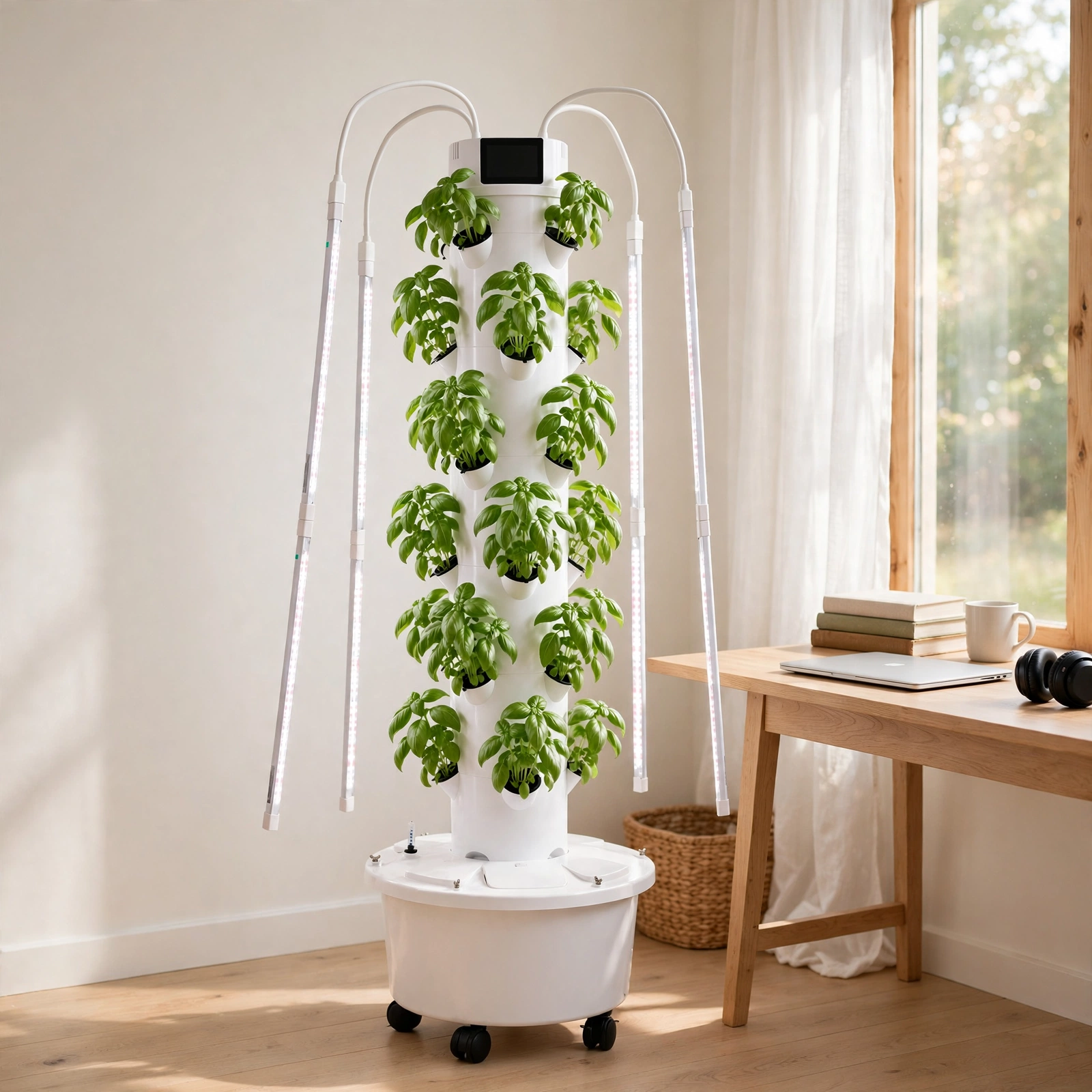
Basil is one of the easiest crops for a hydroponic tower. Keep your nutrient solution at an EC of 1.0–1.6 mS/cm and a pH of 5.5–6.5, give the plants 14–18 hours of light daily, and harvest the top leaves starting about 3–4 weeks after transplant. Pinch stems above a leaf pair and the plant branches out, giving you cut-and-come-again harvests for months.

Basil is a moderate feeder — hungrier than lettuce but far less demanding than fruiting crops like tomatoes. The table below collects the ranges most commonly recommended in extension publications and grower guides. Treat them as starting points, not guarantees: different nutrient brands, water sources, and basil varieties shift the ideal window slightly.
| Parameter | Recommended range for basil | Notes |
|---|---|---|
| EC | 1.0–1.6 mS/cm | Start at ~1.0 for seedlings; raise to 1.2–1.6 once plants are established |
| pH | 5.5–6.5 | Drift is normal — adjust back toward 6.0 when it creeps above 6.5 |
| Water temperature | 65–75°F (18–24°C) | Warm reservoirs invite root-zone disease faster |
| Air temperature | 70–85°F (21–29°C) | Basil stalls below ~60°F; leaf damage appears near 50°F |
| Relative humidity | 40–60% | High humidity + poor airflow favors downy mildew |
What this table can’t tell you: these ranges describe general hydroponic basil, not your tower or your water. Tap water with high alkalinity can push pH upward faster than the table implies, and a reservoir shared with heavy-feeding fruiting crops will drift differently than a basil-only system. Measure with your own meter and adjust — the numbers above are a compass, not a cruise control.
For the full mechanics of EC and pH — how to measure, how often to check, and what drift patterns mean — see our nutrient guide (EC, pH & PPM cheat sheet).
Basil wants strong light but doesn’t demand the intensity of fruiting plants. Aim for a daily light integral (DLI) of roughly 12–18 mol/m²/day, delivered over a 14–18 hour photoperiod. If your tower has built-in LED bars, running them 16 hours a day at a moderate distance is a solid default; many growers find basil thrives around the same schedule they already use for leafy greens.
Signs of too little light are easy to spot: leggy stems, pale leaves, and slow growth. Signs of too much (or lights placed too close) include leaf bleaching or crispy edges. When in doubt, start conservative and watch the plants for a week — basil tells you quickly.
Our lighting guide (PPFD, DLI & schedules) walks through how to translate “hours of light” into what your eyes — and your timer — can actually manage.
From seed to first serious harvest, expect roughly 6–8 weeks. Here’s a realistic timeline:
This timeline assumes warm temperatures and adequate light. Cool rooms or weak light can add a week or two; don’t interpret a slow start as failure.
The “cut-and-come-again” method works because basil branches at every leaf node. Follow these steps and a single plant becomes a basil factory:
If your basil is destined for pesto, harvest in the morning when essential-oil concentration is highest — the flavor difference is noticeable, and it’s one of the quiet advantages of growing herbs at home: harvest minutes before eating, at peak freshness.
Basil is forgiving, but towers concentrate a few classic failure modes. Here’s a quick diagnosis chart:
| Symptom | Likely cause | Fix |
|---|---|---|
| Leggy, pale stems | Not enough light | Increase photoperiod or lower light distance; check our lighting guide |
| Yellow lower leaves | Nitrogen deficiency or old reservoir | Refresh the nutrient solution; see our water-change schedule |
| Brown/black leaf edges | Nutrient burn (EC too high) or tip burn | Dilute the reservoir; bring EC back into the 1.0–1.6 range |
| Wilting despite wet roots | Root-zone disease (Pythium) from warm water | Cool the reservoir below 75°F; sanitize at next cleaning (cleaning schedule) |
| White/gray fuzz under leaves | Downy mildew | Improve airflow, lower humidity; remove affected leaves; avoid overhead wetting |
| Premature flowering | Heat stress or irregular harvest | Pinch buds; harvest regularly; keep temps under 85°F |
Limitation of this chart: symptoms overlap. Yellow leaves can mean nitrogen deficiency, an old reservoir, root damage, or simply the plant’s oldest leaves aging out. If two rows seem to match, fix the cheapest, most reversible problem first (usually a reservoir refresh) and re-observe for a few days before reaching for harsher measures.
Genovese basil is the default for a reason: vigorous, compact enough for tower spacing, and the classic pesto flavor. Good alternatives:
Avoid giant or tree-like varieties bred for field production — they’ll crowd neighbors and shade lower pods. If you’re still choosing what to plant, our “what NOT to grow” guide covers the space hogs to skip.
Yes — basil’s EC (1.0–1.6) and pH (5.5–6.5) needs overlap well with lettuce and most culinary herbs, so a mixed leafy tower works. Keep fruiting crops like tomatoes on a separate nutrient schedule or a separate tower; their higher EC demands don’t suit basil.
Plan on one plant per two planting holes, or space plants 6–8 inches apart. Basil bushes out aggressively once you start pinching, and crowded plants compete for light and airflow — which invites mildew.
No. You harvest basil for its leaves, not its fruit, so pollination is irrelevant. Flowering is actually the enemy — pinch buds to keep leaves sweet.
The usual culprits: the plant is flowering, temperatures are too high, or it’s overdue for harvest. Pinch flowers, keep temps under 85°F, and harvest regularly. Old, woody stems also taste harsher — restart the plant when it gets leggy.
Indoors, yes — with 14–18 hours of light and temperatures above 65°F, basil doesn’t care what month it is. Winter windowsills alone are usually too dim and drafty; a tower with built-in LEDs solves both problems.
Follow a 1–2 week refresh cycle in a shared reservoir; top off with plain water between changes. Our detailed water-change schedule explains why the calendar matters more than the plant species.
Flavor depends mostly on variety, light intensity, and harvest timing — not the growing medium. Hydroponic basil harvested minutes before eating is typically more aromatic than store-bought bunches that spent days in transit, regardless of how they were grown.
We reviewed source material on 2026-10-06.
Research describes general methods; it does not verify any specific model, product claim or customer outcome.

