Address
304 North Cardinal
St. Dorchester Center, MA 02124
Work Hours
Monday to Friday: 7AM - 7PM
Weekend: 10AM - 5PM
Address
304 North Cardinal
St. Dorchester Center, MA 02124
Work Hours
Monday to Friday: 7AM - 7PM
Weekend: 10AM - 5PM
Cilantro bolts when heat and long days convince it summer is ending. Here's how to keep a hydroponic tower harvest leafy for weeks — with EC, pH, light, and harvest targets that actually delay flowering.
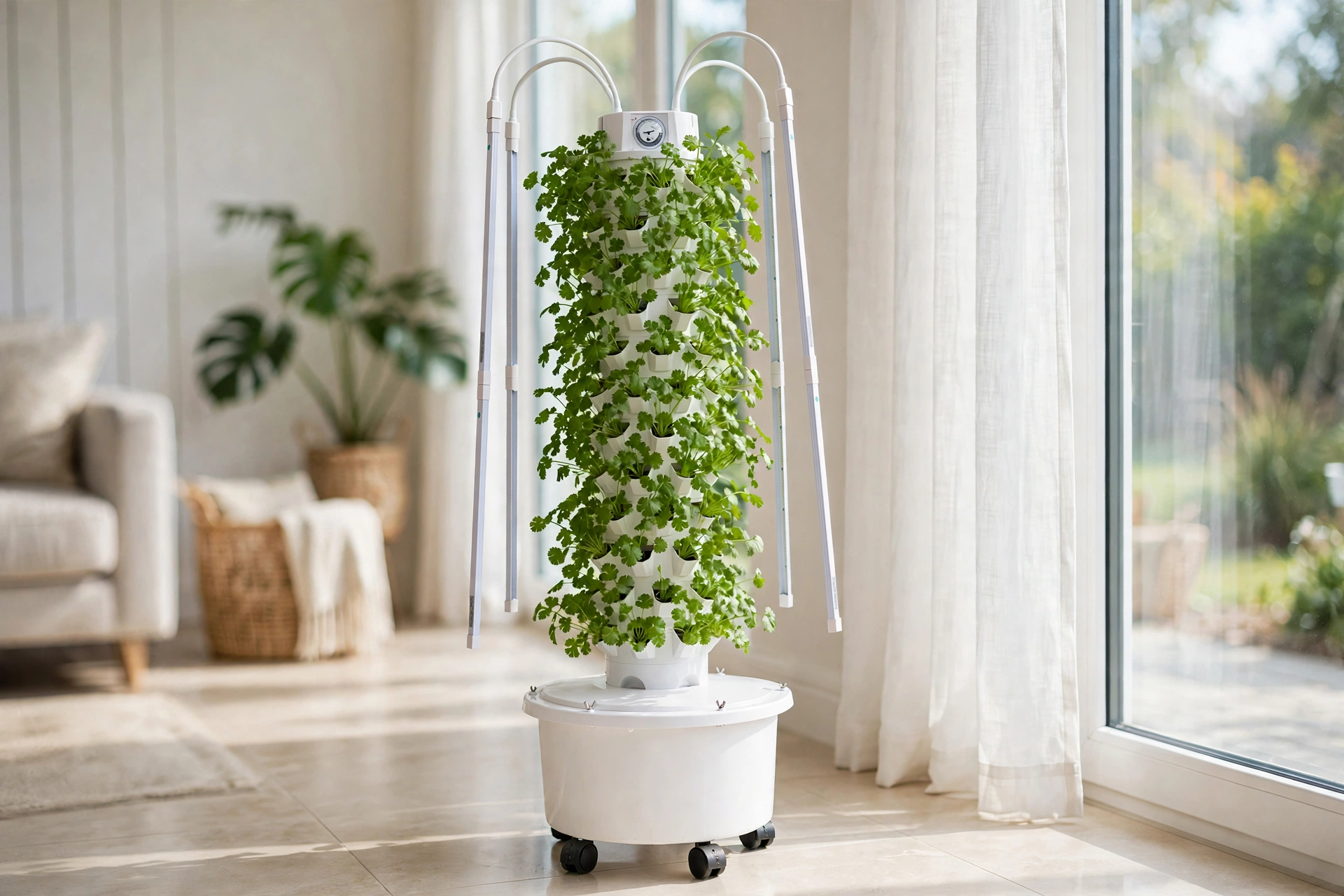
Cilantro bolts when heat or long days signal the end of its season — tall stem, white flowers, bitter leaves. A hydroponic tower lets you override both triggers: keep the room below 75°F, run 12–14 hours of light, feed EC 1.2–2.0 at pH 5.5–6.5, harvest outer leaves weekly, and sow slow-bolt varieties like ‘Calypso’ or ‘Slo-Bolt’.
That’s the whole strategy in one paragraph.

Bolting is cilantro’s survival plan. It’s a cool-season annual — its natural script is to sprout in cool spring weather, grow leaves fast, then flower and set seed before the heat arrives. When conditions get warm or days get long, the plant switches its energy from leaves to reproduction. The leaves that remain turn thin, feathery, and bitter, and the plant is done.
Four triggers drive that switch, and they can gang up on you:
Here’s the part that matters for your tower: indoors, you control the two big ones — temperature and light. That’s the entire advantage of growing cilantro in a hydroponic tower instead of a sunny windowsill. You’re not at the mercy of a heat wave or a 15-hour summer day.
Cilantro is a light feeder compared to fruiting crops. It wants a gentler nutrient solution than tomatoes or peppers — and interestingly, research suggests it doesn’t care much about the exact EC within a wide range. A 2019 Iowa State University study on hydroponic cilantro found that daily light integral (DLI) drove growth far more than EC: fresh mass jumped 154% under high light, while EC across 0.5–4.0 mS/cm barely changed the outcome. Translation: don’t obsess over the perfect EC number; get the light and temperature right first.
| Parameter | Cilantro target | What this number can’t tell you |
|---|---|---|
| pH | 5.5–6.5 | Stability matters more than a magic number — wild pH swings stress the plant more than a slightly high reading. |
| EC | 1.2–2.0 mS/cm (600–1000 ppm) | Higher EC won’t delay bolting. Cilantro grew fine across 0.5–4.0 in research; EC is not your anti-bolting lever. |
| Water temperature | 65–72°F (18–22°C) | Warm reservoir water heats the roots directly. A reservoir above 75°F can stress the plant even if the air is cool. |
| Air temperature | 60–70°F, never sustained above 75°F | No indoor number overrides genetics — even slow-bolt varieties quit under sustained heat plus long days. |
| Light schedule | 12–14 hours daily | More hours are not better. 16–18 hours mimics long summer days and may nudge bolting sooner. |
If you run your tower’s lights and pump on the same timer, you’re fine — cilantro doesn’t need a special schedule. The one schedule decision that actually matters is capping light at 12–14 hours. Every extra hour is a little more “summer” your plants can sense.
A practical note on sharing a tower: cilantro’s targets (cool, moderate EC, 12–14h light) overlap comfortably with other leafy herbs — see our best herbs for a hydroponic tower roundup. Don’t plant it on the same tower as fruiting crops like cherry tomatoes or peppers, which want stronger nutrients, warmer air, and longer days — the opposite of what keeps cilantro leafy.
Cilantro wants 12–14 hours of decent light per day. In a tower with built-in LED bars, that usually means the plants sit a foot or so from the light tubes, which is plenty bright for a leafy herb. You don’t need to blast it — the research cited above showed growth improved with more total daily light, but bolting risk rises with day length, so the sweet spot is bright-but-short days.
Watch the leaves and they’ll tell you what’s off:
Variety choice is the single easiest anti-bolting upgrade you can make — it costs the same as any other seed packet. “Bolt-resistant” doesn’t mean a plant will never bolt (nothing does), but these cultivars were bred to hold their leafy stage weeks longer under warm or long-day conditions:
Whatever variety you choose, sow densely — cilantro seeds are cheap, and a full net cup of 5–8 seeds gives you a lush bunch that shades its own crown. A shaded crown stays cooler, and cooler means slower bolting.
Harvest like the plant owes you money. Frequent cutting is one of the most effective bolting-delay tactics, and it costs nothing:
Think of it as a rotation, not a single crop. Net cups make this easy: when one plant bolts, pull it, drop in a fresh grow sponge with new seeds, and the tower never has a gap.
It happens. Heat waves, a forgotten timer, a variety that wasn’t as slow-bolt as the packet promised. When you see the central stalk shoot up with feathery leaves and tiny white flowers, you have three honest options:
What you shouldn’t do: keep a bolted plant in a prime net cup hoping it reverts. It won’t. That cup is your future cilantro supply — give it to a fresh seedling.
Yes — that’s the whole point of growing it indoors. A tower with a 12–14 hour light timer and room temps below 75°F removes the two triggers (heat and long days) that kill outdoor cilantro in summer. Sow fresh net cups every 2–3 weeks for a continuous supply.
Usually too little light, or bolting has started. Check that the light tubes reach the lower tiers and that neighbor plants aren’t shading the cilantro. If the center stem is shooting up with feathery leaves, it’s bolting — pinch the stalk immediately or replant.
Expect sprouts in 7–14 days and first harvestable leaves at about 6 inches tall, roughly 3–4 weeks after sprouting. Most plants stay productive for 6–10 weeks with weekly harvesting and succession sowing.
Direct-sow seeds in the tower’s net cups. Cilantro grows a long taproot and dislikes transplanting, so moving seedlings can trigger early bolting. Sow 5–8 seeds per cup for a full bunch.
The leaves turn tougher and more bitter once flowering starts, but they’re safe to eat. Use them in cooked dishes where the edge disappears, or let the plant finish and harvest the seeds as homegrown coriander.
Parsley is more forgiving — it tolerates heat better and rarely bolts. But cilantro is faster: you’ll harvest cilantro weeks before parsley’s slow seedlings catch up. Grow both, and run cilantro as a short-rotation crop.
We reviewed source material on 2026-10-11.
Research describes general methods; it does not verify any specific model, product claim or customer outcome. Planting-slot counts are not a harvest guarantee.

