Address
304 North Cardinal
St. Dorchester Center, MA 02124
Work Hours
Monday to Friday: 7AM - 7PM
Weekend: 10AM - 5PM
Address
304 North Cardinal
St. Dorchester Center, MA 02124
Work Hours
Monday to Friday: 7AM - 7PM
Weekend: 10AM - 5PM
How much light does a hydroponic tower really need? Plain-English PPFD and DLI targets for leafy greens and fruiting crops, light schedules by growth stage, and how to tell when your plants want more — or less — light.
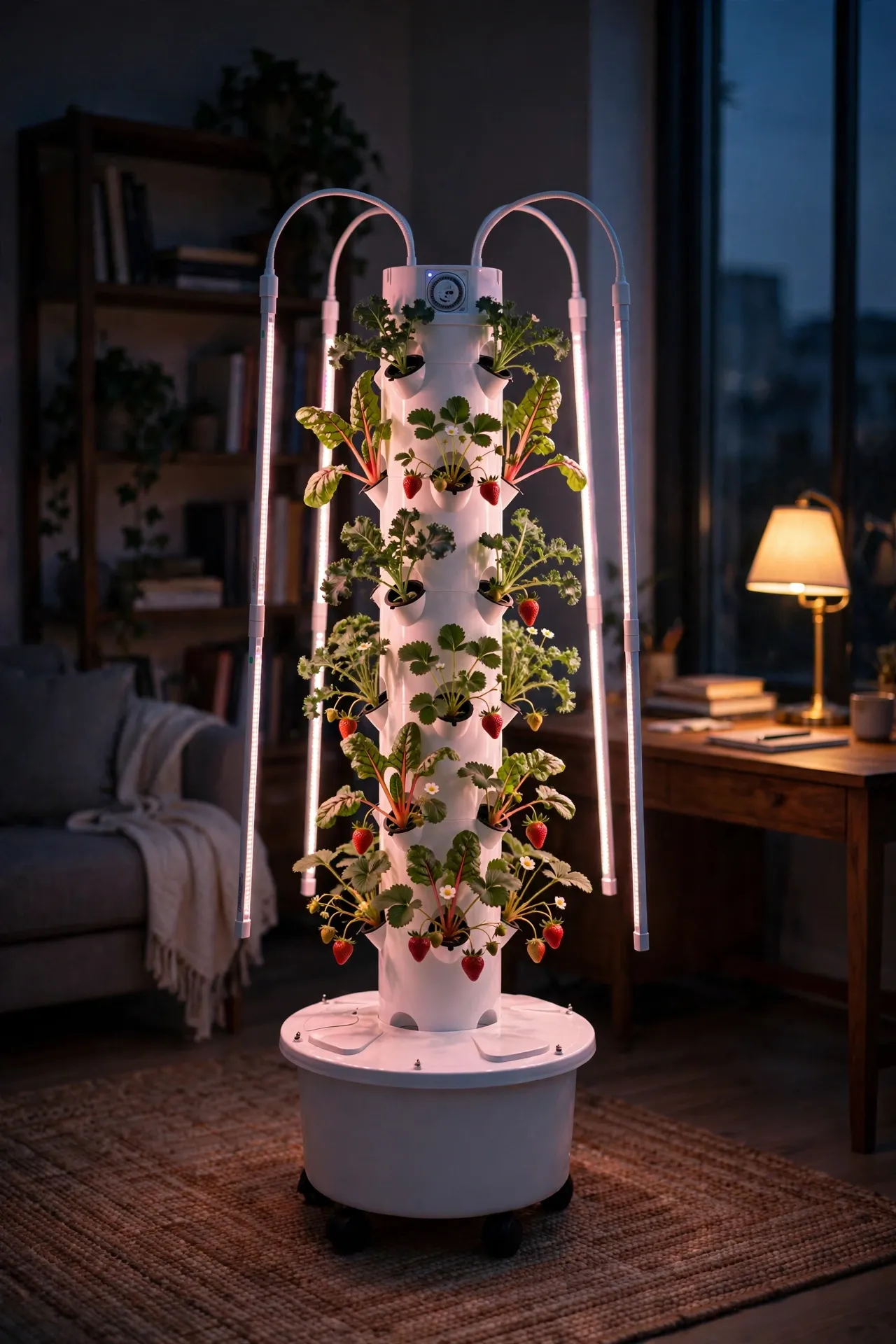
The short answer: Most leafy greens and herbs thrive on a daily light integral (DLI) of 12–17 mol/m²/day, which a typical LED tower setup delivers in about 14–16 hours a day. Fruiting crops like tomatoes, peppers, and strawberries want roughly double that, around 20–30. Get the daily total right first; the schedule is just how you slice it.

Growers throw around a lot of acronyms. Only two really matter for you.
PPFD (photosynthetic photon flux density) measures how much usable light hits a given spot right now. The unit is micromoles per square meter per second (µmol/m²/s). Think of it as the brightness of the moment. A spot reading of 300 µmol/m²/s right now tells you intensity, nothing about the day as a whole.
DLI (daily light integral) is the total amount of usable light a plant receives over a full day, in moles per square meter per day (mol/m²/day). Think of it as the day’s calorie budget. This is the number that actually decides whether your basil grows thick or leggy.
The two connect with simple math:
DLI = PPFD × hours of light × 3,600 ÷ 1,000,000
Example: lights delivering 300 µmol/m²/s for 14 hours give a DLI of about 15. The same 300 µmol/m²/s for only 10 hours gives about 11 — often not enough for vigorous growth. That is why the schedule question and the brightness question are really one question.
Different crops evolved under different skies, and their light appetites still show it. Leafy greens are the easy tenants; fruiting crops are the demanding ones. These are the DLI ranges most extension guides and horticulture researchers converge on:
| Crop group | Target DLI (mol/m²/day) | Typical PPFD range (µmol/m²/s) | What this range can’t tell you |
|---|---|---|---|
| Seedlings (all crops) | 8–12 | 150–250 | Start low; young plants scorch easily even when mature plants would be fine |
| Leafy greens: lettuce, spinach, kale, chard | 12–17 | 200–400 | At the top of this range with warm air, lettuce and cilantro bolt faster — see the schedule section |
| Herbs: basil, mint, cilantro, parsley | 14–18 | 250–400 | Basil asks for more than mint; treating “herbs” as one crop is already an approximation |
| Strawberries (day-neutral varieties) | 18–25 | 350–500 | Light is only one variable — pollination and temperature limit berries before light does in many setups |
| Fruiting crops: cherry tomatoes, peppers | 20–30 | 400–600+ | Hitting 30 DLI with weak tower bars is often unrealistic; honest expectations beat optimistic numbers |
One more piece of hedging discipline, because it matters more here than in most topics: planting-slot count is not a harvest guarantee. A tower marketed with 40 planting holes does not promise 40 harvestable plants — light is the first reason why. On a vertical tower, the top ports can easily receive twice the light of the bottom ones, so a single DLI target is really a target for the middle of the tower, with a gradient above and below.
Once you pick a DLI target, the schedule is mostly arithmetic. But plant biology adds two wrinkles worth knowing before you set the timer.
First, plants need a real dark period. Do not run lights 24 hours a day. Photosynthesis happens in the light, but respiration, nutrient transport, and a lot of repair happen in the dark. Horticulture research has repeatedly found injury and stunted growth when tomatoes and some other crops get continuous light with no dark break. Most home growers land in the 14–16 hour window; it is a good default for almost everything a tower can hold.
Second, day length can trigger flowering. Lettuce and cilantro are long-day plants: very long photoperiods combined with warm air push them to bolt (flower early), which turns leaves bitter. If your lettuce keeps bolting indoors, try 12–14 hours instead of 16, keep the air under about 75°F, and harvest outer leaves early. Day length is rarely the only cause — heat and stress usually share the blame — but it is the lever a light timer actually controls.
| Stage / crop | Suggested photoperiod | Why | What this doesn’t cover |
|---|---|---|---|
| Seedlings (first 2–3 weeks) | 14–16 hours | Gentle, long days build compact, sturdy transplants | Start them dimmer; a seedling schedule at full PPFD fries young leaves |
| Leafy greens & most herbs | 14–16 hours | Reliably reaches a 12–17 DLI with typical LED bars | If bolting appears, shorten to 12–14 hours rather than dimming — DLI still matters |
| Fruiting crops (tomato, pepper) | 16–18 hours | The only realistic way to approach a 20+ DLI on modest hardware | More hours can’t fully substitute for low PPFD; weak lights stay weak |
| Strawberries (day-neutral) | 14–16 hours | Enough for decent DLI without heat buildup from marathon sessions | Fruiting still depends on pollination and variety choice, not the timer |
A practical note on consistency: plants are more bothered by irregular light than by a slightly imperfect schedule. A steady 14 hours every day beats 18 hours on weekdays and 10 on weekends. Put the lights on a timer from day one and stop thinking about it.
For the LED bars built into or clipped onto most hydroponic towers, 6–12 inches (15–30 cm) above the leaf canopy is the standard starting point, closer for seedlings and lower-light crops, farther for anything fruiting.
Why does a few inches matter so much? Because light intensity falls off fast with distance — roughly following the inverse-square law for point-like sources, meaning twice the distance gives roughly a quarter of the intensity. LED bars are long and diffuse rather than perfect point sources, so the falloff is softer in practice, but the direction is always the same: every inch of extra gap costs you light you are paying for in electricity. If your tower lights are fixed, ignore this section — that is what the manufacturer already decided for you, and it is one argument in favor of adjustable designs.
Towers add one geometry problem that flat trays don’t have: vertical light gradient. The top tier of a tower lives inches from the light source while the bottom tier sits in its shadow. Three honest workarounds, in order of effort:
Your plants file a daily report. You just have to read it:
| Symptom | Usually means | What to do | What this sign can’t prove |
|---|---|---|---|
| Stems stretch tall and thin, leaves small and pale (“legginess”) | Too little light | Lengthen the photoperiod or move lights closer | Stretching also follows warm air and crowding — check those before blaming the lights |
| Slow growth, oversized thin leaves reaching sideways | Too little light | Same as above; often the bottom tier of a tower | Nutrient weakness looks similar, so check EC and pH too |
| Leaf edges turn white, papery, or bleached; crispy tips | Too much light (or heat) | Raise lights or shorten the day; add airflow | Bleaching and fertilizer burn look alike — light burn usually faces the light source |
| Leaves cup downward or curl inward under bright light | Light/heat stress | Move lights up a few inches and watch for 3–4 days | Curling has many causes (pests, viruses); light is only one suspect |
| Reddish-purple tint on leaf undersides or stems | Mild stress — often light intensity the plant is adapting to | Usually fine if growth stays vigorous; back off only if growth stalls | Some varieties color up genetically; purple is not always a complaint |
Change one variable at a time and give it several days. Plants respond on a days-to-weeks timescale, and adjusting both distance and schedule at once teaches you nothing about which one helped.
For a home tower grower, less than the marketing suggests. Here is the honest breakdown:
One more thing the schedule does that nobody buys it for: it fights algae. Algae needs light, water, and nutrients — your tower provides all three. A light-blocking tank cover and capped empty ports matter more than any schedule tweak, but there is no reason to give algae a 24-hour buffet either. Our cleaning guide covers the light-denial side of the war.
This is the easiest win in the whole article. Pick one:
The cost question comes up every time: LED bars on a home tower typically draw a few dozen watts — a fraction of what the pump adds up to over a month. Our electricity cost breakdown runs the real kWh numbers so you can price your own schedule.
And if you are still deciding what belongs in the tower in the first place, what you can grow in a hydroponic tower pairs crop choice with difficulty level — light needs included. Browse more setups and fixes in Growing Guides.
We reviewed source material on 2026-10-04.
Research describes general methods; it does not verify any specific model, product claim or customer outcome.
Most home towers run their lights 14–16 hours a day. Leafy greens and herbs do well in that range; fruiting crops like tomatoes and peppers usually want 16–18 hours to reach the higher daily light totals they need.
Around 12–17 mol/m²/day. That is a moderate target most LED tower setups can hit with a 14–16 hour photoperiod. At the top of that range with warm air, lettuce bolts faster — keep it cool and harvest outer leaves early.
No — plants need a dark period. Photosynthesis runs in the light, but respiration and repair run in the dark, and research shows crops like tomatoes develop leaf injury under continuous light. Give them at least 6–8 hours of darkness.
About 6–12 inches (15–30 cm) above the leaf canopy is the standard starting point for LED bars. Keep them closer for seedlings, farther for fruiting crops, and raise them as plants grow into the light.
Almost certainly light. On a vertical tower the bottom ports sit in the shadow of the canopy above and can receive far less light than the top. Match low-light crops (lettuce, mint, parsley) to the bottom ports and light-hungry ones (basil, tomatoes) to the top, or rotate plants weekly.
For home towers, yes — full-spectrum white LEDs grow leafy greens and herbs just as well in practice, and they look like normal light in your home. Spectrum tuning matters more in commercial research than in a living-room setup.
Not usually. The LED bars on a typical home tower draw a few dozen watts — often less than an old incandescent bulb. Our electricity cost guide runs the real monthly numbers for pump plus lights.

