Address
304 North Cardinal
St. Dorchester Center, MA 02124
Work Hours
Monday to Friday: 7AM - 7PM
Weekend: 10AM - 5PM
Address
304 North Cardinal
St. Dorchester Center, MA 02124
Work Hours
Monday to Friday: 7AM - 7PM
Weekend: 10AM - 5PM
A home hydroponic tower uses 0.05–2.5 kWh per day depending on pump and lights: under $1 a month outdoors without grow lights, roughly $8–$13 a month indoors with LED bars running 14 hours daily at US average rates. The pump is the small part — typically 10W on a 15-minutes-on/45-minutes-off timer. Lighting dominates the bill.
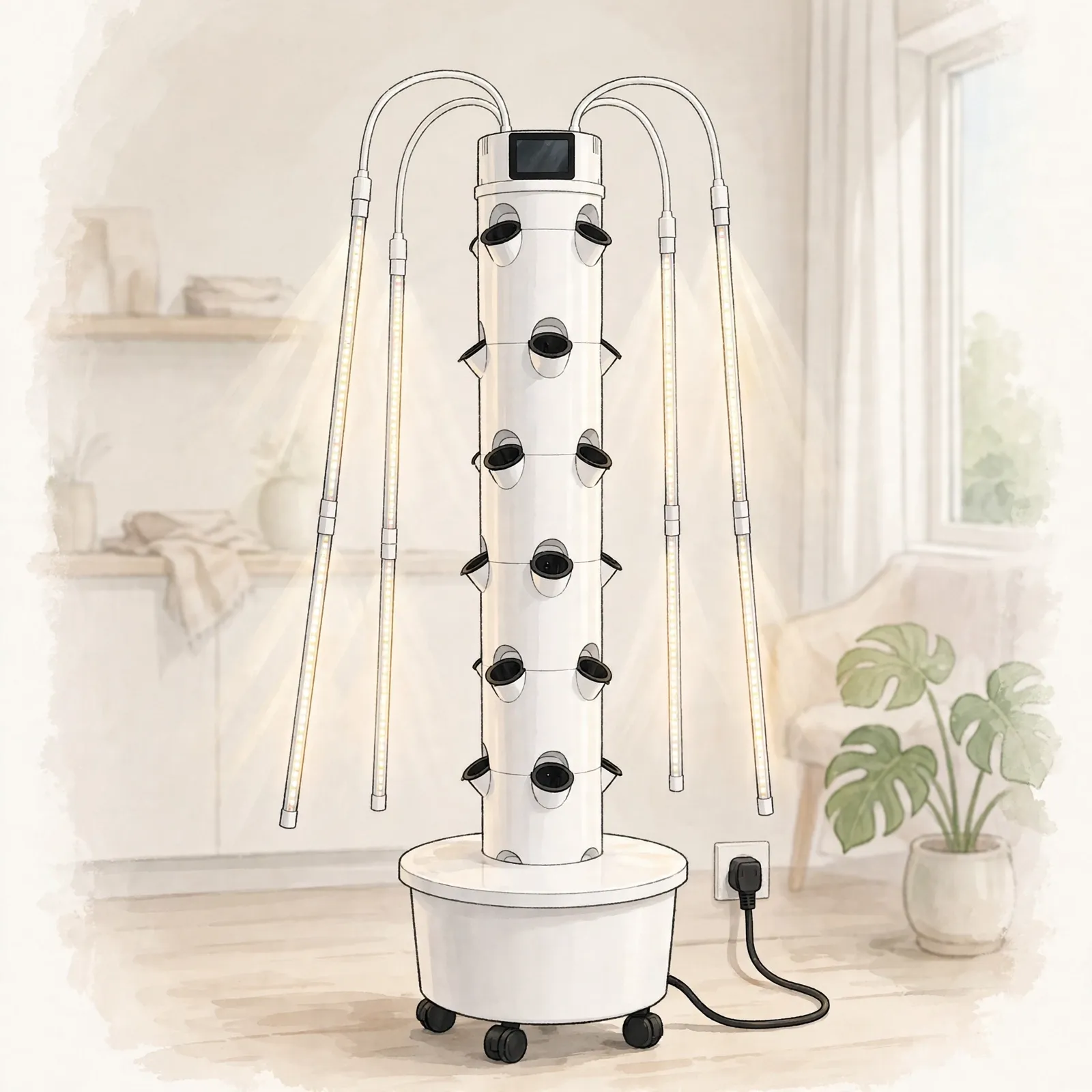
The short answer: A typical home hydroponic tower uses 0.05–2.5 kWh per day, which costs roughly $0.30–$13 per month at the 2026 U.S. average electricity rate of about 18¢/kWh. An outdoor tower running only a small pump on a timer costs under a dollar a month — and nearly all of the power in an indoor setup goes to the LED grow lights, not the pump.
It’s one of the most common questions people ask before buying a hydroponic tower: is this thing going to run up my electric bill? It’s a fair question. The pump runs every day, and the grow lights stay on for hours at a stretch. But the real numbers are reassuringly small.
Electricity is the second-biggest running cost of a hydroponic tower after nutrients, and it’s the easiest one to calculate precisely. Every component has a wattage printed on its label, and the math from watts to dollars is simple. Below are the typical wattages for pumps and lights, a cost formula with worked examples, and what the same tower costs in different U.S. states.
Just two components draw meaningful power:
A control board or timer draws under 2 watts — too little to matter. There are no heaters, air pumps, or cooling fans on a typical home tower. If you’re new to the mechanics, our guide to how hydroponic towers work explains the pump cycle in detail.
| Setup | Typical pump wattage | Typical light wattage | Total draw |
|---|---|---|---|
| Compact 5-tier tower, no lights | 10–16 W | — | 10–16 W |
| Mid-size tower with indoor LED kit | 16–25 W | 64–80 W | 80–105 W |
| Large tower with full LED kit | 20–25 W | 96–120 W | 116–145 W |
| Aeroponic-style tower (larger pump) | ~45 W | — | ~45 W |
These ranges reflect published specs from tower manufacturers and retailers — for example, common tower listings rate their pumps at 10, 16, or 25 watts with 64–96 watts of LED bars, Nutraponics lists its NutraTower at roughly 120 watts total draw, and one tower maker (Yunzy) publishes 120 watts for LEDs plus 20 watts for the pump on its V8 model. Aeroponic-style towers like Tower Garden use a beefier 45-watt pump, per grower documentation published by Agrotonomy.
For most home towers: 10 to 25 watts — about the same as an LED light bulb. That’s the pump’s draw while it’s actually running, which brings up the more important number: how long it runs.
Pump schedule matters more than pump wattage. Most towers don’t run the pump around the clock. The common approach is an intermittent cycle — for example, 15 minutes of pumping per hour, or a 3-minutes-on / 12-minutes-off cycle (the schedule Tower Farms uses on its commercial towers, according to Agrotonomy). Cycling cuts pump energy use by 50–80% compared with continuous operation, and most home towers are designed for it. Check your tower’s manual for the recommended cycle.
Bottom line for the pump alone: a 20-watt pump on a 6-hours-a-day cycle uses 0.12 kWh per day. That’s roughly $0.65 a month at the national average rate.
LED bar kits that ship with towers typically draw 60–120 watts in total. Lights are the part of the bill you can actually feel: a 120-watt set of bars running 14 hours a day uses about 1.7 kWh per day — many times more than everything else on the tower combined.
This is also why outdoor and bright-sunroom towers are so cheap to run. Skip the lights entirely and the pump is the whole electricity bill. One tower maker’s published example lines up with this math: Yunzy estimates about $8–10 per month at $0.18/kWh for a setup with 12–14 hours of LED light and a pump on a 6-hour daily cycle.
Four steps, no special tools needed:
Three worked examples at the 2026 U.S. average rate of about 18¢/kWh:
| Setup | Daily kWh | Monthly kWh | Monthly cost |
|---|---|---|---|
| Outdoor tower, 20 W pump cycled 6 h/day, no lights | 0.12 | 3.6 | $0.65 |
| Indoor tower, 25 W pump 24 h + 100 W lights 14 h/day | 2.00 | 60.0 | $10.80 |
| Large indoor tower, 25 W pump 12 h + 120 W lights 16 h/day | 2.22 | 66.6 | $11.99 |
A plug-in power meter (about $15–25) removes all guesswork if you want your exact number — just plug the tower through it for a week.
Barely. Even the hungriest home setup in the table above uses around 60 kWh a month, which is a small slice of a typical household’s usage. The variable that actually moves the number is where you live, not which tower you buy.
The U.S. Energy Information Administration’s September 2026 Short-Term Energy Outlook projects a 2026 national average residential price of 18.20¢/kWh (June 2026 data showed 18.34¢). But state rates spread roughly three-to-one:
| Location | June 2026 avg. residential rate | Cost of 60 kWh (typical indoor tower month) |
|---|---|---|
| U.S. average | 18.34¢ | $11.00 |
| California | 34.74¢ | $20.84 |
| New York | 29.49¢ | $17.69 |
| Texas | 15.94¢ | $9.56 |
| Louisiana | 12.72¢ | $7.63 |
| Hawaii | 52.72¢ | $31.63 |
State figures from EIA data via the CPUC Public Advocates Office (California), the Empire Center (New York), and EIA state datasets. In California or Hawaii, an indoor tower costs roughly two to three times the national average to run — still modest, but worth knowing before you size your light setup.
| Appliance | Typical draw | Typical daily use |
|---|---|---|
| Hydroponic tower, indoor with lights | 100–145 W | 1.5–2.2 kWh |
| Hydroponic tower, outdoor (pump only) | 10–45 W | 0.05–0.2 kWh |
| LED bulb | 10 W | 0.06 kWh (6 h) |
| Laptop | 30–60 W | ~0.24 kWh (6 h) |
| Large TV | 100–150 W | ~0.5 kWh (4 h) |
| Refrigerator | 100–200 W (cycling) | 1–2 kWh |
| Space heater | 1,500 W | 6 kWh (4 h) |
The takeaway: a lit indoor tower draws about as much as a TV while the lights are on; an outdoor tower draws about as much as an LED bulb while the pump runs. Either way, it’s nowhere near the appliances that actually drive a power bill.
No. A home tower uses 0.05–2.5 kWh per day depending on whether it has grow lights. That works out to under $1 a month outdoors and roughly $8–13 a month for a full indoor setup at the U.S. average electricity rate.
Usually not necessary. Most home towers are designed for intermittent pump cycles — 15 minutes per hour is a common starting point — which keeps roots fed while cutting energy use. Follow your tower’s manual for the recommended schedule.
Sometimes not. Herbs and leafy greens want 12–16 hours of strong light daily; a bright south-facing window can cover that in summer, but most growers add supplemental LEDs in winter or in north-facing rooms. If you’re just starting out, see our beginner’s guide to hydroponic towers for setup basics.
Under $1/month for an outdoor pump-only tower, $8–13/month for a typical indoor tower with LED lights, at the 2026 U.S. average rate of about 18¢/kWh. Check your state’s rate — California and Hawaii run two to three times higher.
A pump-only outdoor tower is very solar-friendly — a small panel and battery can cover 10–25 watts. LED grow lights are the hard part: 100+ watts for 14 hours a day needs a serious panel and battery bank, which usually costs more than the grid electricity it replaces.
It depends on what you grow and what you pay for produce. Electricity for a lit tower runs $8–13 a month at average U.S. rates; add nutrients, seeds, and growing media, then compare against your grocery spending on the same herbs and greens. Fast-growing leafy crops usually make the math work best.
Only slightly. Taller towers ship with slightly stronger pumps (for example, 25 W instead of 16 W), but the difference is a few watts — a dollar or two per year. Light wattage is the number that actually moves the bill.
Related reading: our complete hydroponic tower gardening guide covers nutrients, planting, and harvest timing.
We reviewed source material on 2026-10-04.
Research describes general methods; it does not verify any specific model, product claim or customer outcome.
Last updated: September 30, 2026.

