Address
304 North Cardinal
St. Dorchester Center, MA 02124
Work Hours
Monday to Friday: 7AM - 7PM
Weekend: 10AM - 5PM
Address
304 North Cardinal
St. Dorchester Center, MA 02124
Work Hours
Monday to Friday: 7AM - 7PM
Weekend: 10AM - 5PM
The best herbs for a hydroponic tower are compact, cut-and-come-again varieties: basil, parsley, cilantro, chives, and dill — plus mint, which deserves its own pocket because it spreads aggressively. They share similar light and nutrient needs, germinate quickly, and tolerate regular harvesting, giving you fresh cooking herbs steps from the kitchen all year.
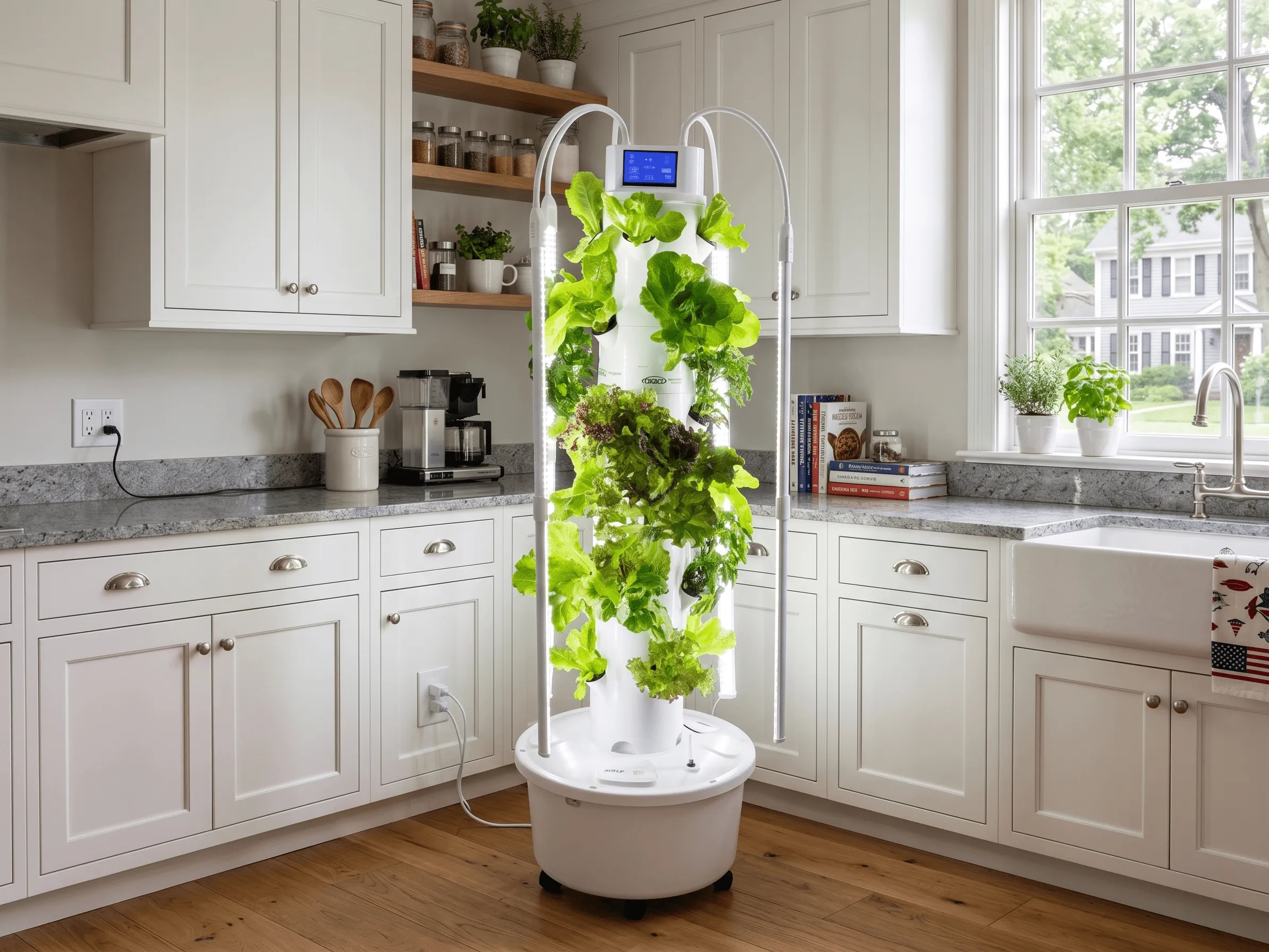
The best herbs for a hydroponic tower are basil, mint, parsley, cilantro, chives, oregano, and thyme. They stay compact, tolerate the pH 5.5–6.5 range most towers run at, and give you cut-and-come-again harvests starting in as little as three to four weeks. Start with three or four varieties you actually cook with — not the full spice rack.
Herbs are the ideal first crop for a tower for one simple reason: the payoff is fast and obvious. You are not waiting three months for a tomato. You are snipping basil into pasta within a month, and that quick win is what turns a gadget into a habit.
Not every herb is equally happy in a vertical system. The winners share three traits: compact growth, tolerance for steady moisture at the roots, and a habit of regrowing after you cut them. Here is how the seven most reliable choices compare.
| Herb | First harvest (from transplant) | pH | EC (mS/cm) | Light | Beginner rating |
|---|---|---|---|---|---|
| Basil | 3–4 weeks | 5.5–6.5 | 1.0–1.6 | 14–16 hrs/day | ★★★★★ |
| Mint | 3–4 weeks | 5.5–6.5 | 1.0–1.4 | 12–14 hrs/day | ★★★★★ |
| Parsley | 4–6 weeks | 5.8–6.5 | 1.0–1.6 | 12–14 hrs/day | ★★★★☆ |
| Chives | 4–6 weeks | 5.5–6.5 | 1.0–1.6 | 12–14 hrs/day | ★★★★★ |
| Cilantro | 3–4 weeks | 5.8–6.5 | 1.0–1.4 | 12–14 hrs/day | ★★★☆☆ |
| Oregano | 5–7 weeks | 5.5–6.5 | 1.0–1.6 | 14–16 hrs/day | ★★★★☆ |
| Thyme | 6–8 weeks | 5.5–6.5 | 0.8–1.4 | 14–16 hrs/day | ★★★☆☆ |
The pH and EC ranges above are starting points, not gospel. The pH 5.5–6.5 window comes from Missouri Extension’s hydroponic nutrient guide (G6984), and the EC ranges are cross-checked against the IGWorks hydroponic nutrient and pH chart — the same references behind our nutrients cheat sheet. A peer-reviewed vertical-farming study in Horticulturae (MDPI) similarly notes extension services recommend EC 0.5–1.6 for basil. Watch your plants and adjust; they will tell you when something is off.
Good news: nearly all culinary herbs are comfortable in the same reservoir. Keep pH between 5.5 and 6.5 and EC between 1.0 and 1.6 mS/cm, and basil through thyme will all do fine together. That is the whole appeal of an herb tower — one reservoir, one set of numbers, seven flavors.
Two practical notes. First, start seedlings at the low end of the EC range (around 1.0) and creep up as plants establish; young roots burn more easily than mature ones. Second, if you are growing on the 500-scale PPM meter common in the US, 1.0–1.6 mS/cm reads roughly 500–800 PPM. Check which scale your meter uses before following any feeding chart — mixing up the 500 and 700 scales underfeeds everything by about 40%.
Most culinary herbs want 12–16 hours of good light a day. Basil, oregano, and thyme sit at the hungry end (14–16 hours); mint, parsley, and chives are fine with 12–14. A tower with built-in full-spectrum LED grow lights handles this on a timer — set it once and forget it.
If your tower sits near a bright window, you might get away with supplementing rather than replacing daylight. But be honest with yourself: a north-facing kitchen in winter is not “bright light.” When herbs stretch tall and pale with big gaps between leaves, that is legginess, and it means one thing — not enough light. Move the tower closer to the LEDs or lengthen the photoperiod before you blame nutrients.
This is where beginners either build a perennial supply or slowly murder their plants. The rule is simple: never take more than a third of the plant at once, and always cut in a way that encourages branching.
Harvest in the morning if you can. That is when essential oils are most concentrated, and you will taste the difference — this is one of those small things that separates homegrown herbs from the plastic clamshell at the store.
My honest opinion: basil, mint, chives, and parsley. That is the starter pack. Basil gives you the fast visible win, mint is nearly unkillable, chives are the lowest-effort flavor in the lineup, and parsley covers everything else. Cilantro is delicious but bolts if you look at it wrong in warm conditions — add it second, once you have the routine down.
Build the tower in this order:
Related reading: what you can grow in a hydroponic tower, fresh herbs and everyday living, hydroponic tower gardening guide
We reviewed source material on 2026-10-04.
Basil, parsley, cilantro, chives, and mint are the m
ost forgiving starters. They germinate quickly, tol
erate the wet-dry cycling of tower systems, and share similar light and nutrient needs, so they grow happily side by side in the same tower.
Either works, but seedlings get you harvesting weeks sooner. If starting from seed, germinate in a damp paper towel or starter plug first, then move the sprouted seedling into a net pot once it has true leaves — tiny seeds wash out of tower pockets easily.
Fast growers like basil and cilantro are ready for light harvesting about 3–4 weeks after transplanting; parsley and chives take closer to 5–6 weeks. Start by snipping the outer leaves and never take more than a third of the plant at once.
No — leafy herbs and lettuce thrive on the same general-purpose hydroponic nutrient mix at EC 1.0–2.0 and pH 5.5–6.0. Keep it simple: one reservoir, one mix. Only fruiting crops like tomatoes and peppers justify a separate, stronger feed.
Check water first: a clogged pocket or a pump timer set too sparse leaves roots dry between cycles. If watering is fine, look at pH — above 6.5, basil can’t take up nutrients and wilts despite wet roots. Also confirm the roots aren’t sitting in light; algae-covered roots struggle.
It can, but give mint its own pocket and harvest it aggressively — its runners spread through shared water channels and crowd neighboring plants. Many growers keep mint in a separate small pot next to the tower to avoid the battle entirely.
Pinch or snip just above a leaf node, which signals the plant to branch into two new stems. Harvest in the morning when oils are strongest, rotate which plants you cut, and never strip a plant bare — steady, light harvesting keeps a tower productive for months.
Almost always insufficient light. Basil stretches toward whatever light exists, producing long stems with sparse leaves. Increase the photoperiod to 16 hours or move the plant closer to the LED array. Pinching the top also forces side branching, which makes the plant bushier even in imperfect light.
A bright south-facing window can work for mint, parsley, and chives. Basil, oregano, and thyme usually want more than a window delivers, especially in winter. LED grow lights on a timer remove the guesswork entirely — and they cost very little to run. See our breakdown of how much electricity a hydroponic tower uses.
Every one to two weeks for a full reservoir change, topping up with plain pH-balanced water in between. Herbs are light feeders compared to fruiting crops, so EC drift is slower — but stale solution still accumulates imbalances. Our nutrients cheat sheet covers the full routine.
Heat and long days trigger flowering, after which the leaves turn bitter. Keep the growing area below about 75°F (24°C) if you can, harvest outer leaves young and aggressively, and sow a fresh plant every two to three weeks for continuous supply. Bolting is a when, not an if — plan for succession.
Freeze them. Chop basil, cilantro, or parsley with a little water or olive oil in ice cube trays — they keep their flavor far better than dried. Oregano and thyme dry well hung in small bundles. Chives freeze fine chopped. Drying basil is the one method I’d skip; it loses most of what makes it good.
Research describes general methods; it does not verify any specific model, product claim or customer outcome.

