Address
304 North Cardinal
St. Dorchester Center, MA 02124
Work Hours
Monday to Friday: 7AM - 7PM
Weekend: 10AM - 5PM
Address
304 North Cardinal
St. Dorchester Center, MA 02124
Work Hours
Monday to Friday: 7AM - 7PM
Weekend: 10AM - 5PM
If your hydroponic tower's pH keeps climbing no matter how often you adjust it, your source water's alkalinity is probably the culprit — not your meter. This guide covers the main causes of pH drift and fixes that hold the reservoir steady between 5.5 and 6.5.
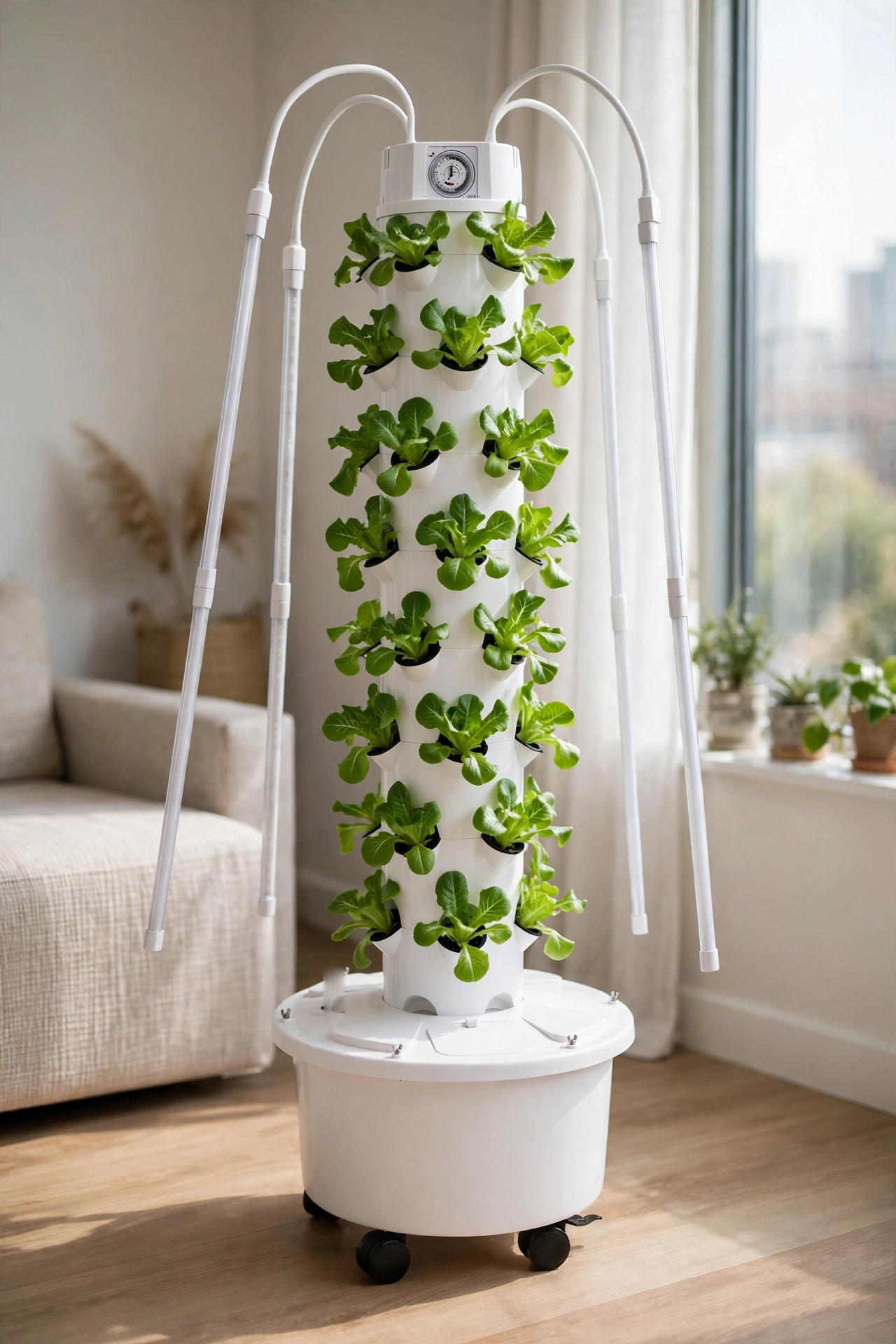

Hydroponic tower pH drift is normal — the real question is how much and in which direction. Most towers drift upward because tap water’s carbonate alkalinity buffers the solution back up after every adjustment. The fix isn’t adjusting more often; it’s removing the cause: test the source water, tame the alkalinity, adjust small and rarely.
Because a tower’s reservoir is a small, busy chemical system with three forces pulling on it at once: your source water’s buffering capacity, your plants’ feeding habits, and the biology growing on every wet surface. Penn State Extension puts the chemistry plainly: alkalinity — measured as bicarbonates, typically reported as ppm CaCO3 — is water’s resistance to pH change, and it is not the same thing as pH. A water sample can test at a reasonable pH of 7.2 and still drag your reservoir upward for days, because its alkalinity is quietly neutralizing every drop of acid you add.
Then the plants join in. Most hydroponic nutrients deliver nitrogen mainly as nitrate (NO3⁻). As roots absorb nitrate, they release hydroxide (OH⁻) ions to keep their internal charge balanced — and hydroxides raise pH. It’s biology, not a product flaw. Nitrate-dominant formulas push pH up by default; that’s why upward drift is the classic hydroponic pattern, and downward drift is the exception.
One honest caveat before the fixes: a perfectly steady pH is not a harvest guarantee. pH management keeps nutrients available — it doesn’t replace light, temperature, or sanitation. Think of it as unlocking the door, not growing the plant.
First, the target: most leafy greens and herbs grown in towers do best when the reservoir sits between 5.5 and 6.5. Fruiting crops like tomatoes and peppers tolerate the same window. Outside it, nutrient availability starts to skew — iron and manganese lock out first at high pH, which is why the classic symptom of chronic upward drift is yellowing between the leaf veins while the veins stay green.
Some movement is ordinary. In a small recirculating tank (a tower reservoir is typically 20–35 liters), a drift of a few tenths of a point per day is par for the course — the small water volume means each plant’s ion exchange moves the needle more than it would in a big pond. What counts as a problem is the pattern: you set 5.8 in the morning and find 6.8 by evening, day after day, with adjustments that never seem to stick. That rebound — the pH snapping back hours after you corrected it — is the fingerprint of alkalinity. The acid you added got consumed by the buffer, not by the plants.
Downward drift happens too, just less often. If your pH keeps sliding toward 5.0 instead of climbing, the likely drivers are ammonium-heavy nutrients (ammonium uptake releases H⁺, the mirror image of nitrate) or nitrifying bacteria colonizing the system and converting ammonium to nitrate — a process that also releases acid. Same advice in reverse: find the driver, don’t just chase the number.
Match your symptom to the likely cause before reaching for the pH Down bottle. Correcting the wrong one wastes acid and stresses the plants.
| What you see | Likely cause | What to try first | What this table can’t tell you |
|---|---|---|---|
| pH rebounds within hours of every adjustment | High-alkalinity source water. Penn State flags anything above 100 ppm CaCO3 as worth managing; growers often report rebound problems starting around 150 ppm. | Test alkalinity (not just pH). Dilute with RO or distilled water, or pre-treat the source. | These are the most common patterns, synthesized from extension publications and grower guides — not a diagnosis of your water. Two towers on the same street can drift differently because municipal water chemistry varies by district and season. The only definitive answer comes from testing your own source water. |
| Slow, steady climb over days; adjustments hold briefly then fade | Nitrate-dominant nutrients doing their normal thing. Plants absorb NO3⁻ and excrete OH⁻. | Keep the nutrient formula; manage the range instead of fighting the biology (see the steps below). | |
| Drift started right after a reservoir change or new media | Fresh growing media (expanded clay, rockwool) or mineral scale leaching alkaline residue. | Rinse and pre-soak new media before it goes in the tower; descale the reservoir on the cleaning schedule. | |
| Green film on tank walls or around net cups | Algae. Photosynthesis strips dissolved CO2 from the water during the light cycle, which raises pH; the swing reverses partially at night. | Make the reservoir light-proof, scrub the film off, and keep the lid hatch closed. See our tower cleaning schedule. | |
| pH spikes after every top-off | Topping off with raw tap water re-injects alkalinity and dilutes the acid you already added. | Top off with pH-adjusted water, or a half-strength nutrient mix adjusted to your target pH. | |
| Readings jump around with no pattern | An uncalibrated meter, a dying probe, or readings taken at wildly different water temperatures. | Calibrate with pH 4.0 and 7.0 buffers; store the probe wet; measure at a consistent time of day. |
If you want the one-paragraph version: alkalinity sets the floor, nitrate uptake provides the steady push, and everything else adds noise. Here’s each piece.
Alkalinity is the main event. Penn State’s water-quality toolkit states the recommended upper limit for greenhouse production at 100 mg/L (100 ppm) alkalinity — above that, expect pH management headaches. In limestone-aquifer regions (much of the US Midwest and Mid-Atlantic), tap water routinely tests at 200–400 ppm. That water will consume your pH Down before the pH even moves, then keep nudging the reservoir upward for days. This is also why “my tap water tests at pH 7.0, so it should be fine” is a trap: pH is a snapshot, alkalinity is the momentum. Test both.
Nitrate feeding is the slow push. Fertilizer chemistry explains the rest. When roots take up nitrate (an anion), they release hydroxide to stay electrically neutral, and pH climbs. When they take up ammonium (a cation), they release H⁺, and pH falls. Most hydroponic formulas are nitrate-dominant — often 90%+ of nitrogen as nitrate — so the net biological pressure is upward. Some growers add a small ammonium fraction specifically to create a counterbalancing “absorption buffer,” but that’s formula design, not something to DIY by dumping ammonium into your tank.
Algae and biofilms add swing. Light reaching the reservoir grows algae; algae photosynthesizes; photosynthesis consumes dissolved CO2; less CO2 means higher pH. At night the reverse happens. The result is a daily sawtooth on top of the slow upward trend. A separate, subtler effect comes from biofilms on tank walls and pump housings, whose microbial metabolism can shift local pH independent of what your probe reads in the bulk solution — one more reason the cleaning schedule matters for chemistry, not just hygiene.
Evaporation concentrates everything. Warm reservoir water evaporates; pure water leaves, minerals stay, and the remaining solution gets more concentrated — which typically nudges both EC and pH upward. If your tower runs warm, keeping the reservoir cool matters here too; temperature, pH, and EC are a triangle, and diagnosing one side in isolation misleads.
Work this list in order. Most towers stabilize by step 3 — don’t skip ahead to chemical fixes before you’ve checked the water and the meter.
A note on “natural” pH Down alternatives: citric acid (lemon juice) and vinegar do lower pH, and Penn State notes citric acid is the standard organic option — roughly 7–9 ounces of powdered citric acid per 100 gallons to drop typical well water one point. But they’re weak acids that microbes happily eat, so the pH often rebounds within a day or two in a living reservoir. Fine in a pinch; phosphoric-acid pH Down is the set-and-hold choice for most tower growers.
Probably not — and the instinct to do so causes more harm than the drift itself. Daily dosing teaches you to react to noise: probe error, temperature differences between morning and evening readings, and the normal post-feeding wobble as plants take up a fresh batch of ions. Each adjustment adds counter-ions (phosphate from pH Down, potassium from pH Up) that accumulate in the small reservoir and slowly skew your nutrient balance.
Don’t default to “more control is better.” Check pH two or three times a week once the system is stable, log the numbers, and act on the trend, not the reading. A reservoir that climbs from 5.8 to 6.4 over five days and gets nudged back monthly is healthier than one yanked back to 5.8 every morning. Plant growth rate is the real report card — if the greens are growing and the pH is in band, leave it alone.
Slightly, and mostly through the meter rather than the water. pH probes are temperature-sensitive; good meters include automatic temperature compensation (ATC), cheap ones don’t. The practical rule: take readings at a consistent time and a consistent tank temperature, and don’t compare a 68°F morning reading against an 80°F afternoon one and call the difference “drift.” If your reservoir swings widely in temperature, fix that first — because warm water accelerates every drift mechanism on this page: evaporation, microbial activity, and nutrient uptake all run faster when hot.
For the broader feeding picture — EC targets, nutrient mixing order, and how pH interacts with nutrient strength — see our nutrient EC and pH guide, and browse the Growing Guides archive for crop-specific settings.
We reviewed source material on 2026-10-23.
Research describes general methods; it does not verify any specific model, product claim or customer outcome.
Usually two forces: your tap water’s carbonate alkalinity buffering the solution back up after each adjustment, and nitrate-dominant nutrients — as plants absorb nitrate they release hydroxide ions, which raise pH. Test your source water’s alkalinity first; it’s the most common root cause.
Between 5.5 and 6.5 for most leafy greens, herbs, and fruiting crops. Anywhere inside that band is fine — adjust only when readings leave the range, not because they moved within it.
Daily for the first week with a new reservoir or new water source, then two to three times a week once it’s stable. Log the numbers and act on the trend, not on any single reading.
They work briefly — both are acids — but microbes in a living reservoir consume them quickly, so the pH often rebounds within a day or two. Phosphoric-acid pH Down is the standard set-and-hold option for tower growers.
Downward drift usually means ammonium-heavy nutrients (ammonium uptake releases acid) or nitrifying bacteria converting ammonium to nitrate in the system. Check your nutrient formula’s nitrogen breakdown and keep the system clean.
Yes. Topping off with raw tap water re-injects the alkalinity you just fought and dilutes your previous adjustments. Keep a jug of pH-adjusted water or adjusted half-strength nutrient solution for top-offs.
It slows it — a larger water volume dilutes each plant’s ion exchange — but it doesn’t remove the cause. High-alkalinity source water will still push pH up; it will just take longer. Fix the water, not just the tank size.

