Address
304 North Cardinal
St. Dorchester Center, MA 02124
Work Hours
Monday to Friday: 7AM - 7PM
Weekend: 10AM - 5PM
A hydroponic tower grow tent setup beats an open room only when your home is dry, drafty, or light-leaky — otherwise, an open room is simpler and less likely to trap moisture.
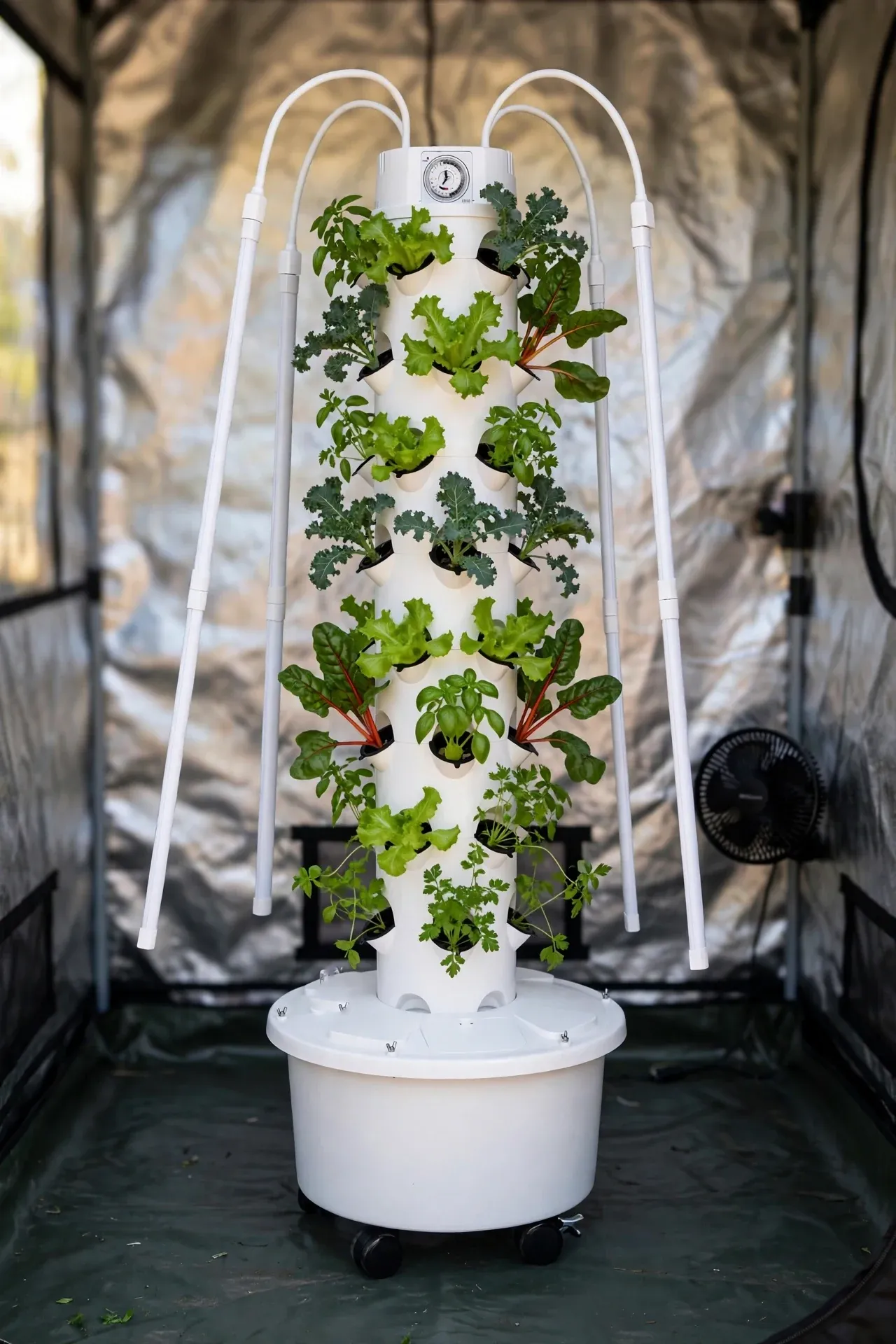
So, hydroponic tower grow tent or open room — which should you choose? A tent wins only when the room is dry, drafty, or leaks light at night. An open room wins when the air is humid or space is warm. A tent gives more control, not better plants, and it can trap moisture if airflow is poor.
A tower changes the air around it: water evaporates from the tank, leaves release moisture, and lights add a little heat. In an open room that moisture drifts away. Inside a zipped tent it stays put. That one difference drives almost every tent-versus-room argument, from humidity and mold to light and pests.
This guide is general growing guidance, not a verified setting for any one tower model. Filling every pod does not guarantee a harvest, and a tent does not guarantee healthier plants.
A grow tent is a light-proof fabric box with reflective inner walls, vents, and ports for fans and cables. It adds no nutrients or water. It changes four things, and each one can help or hurt depending on your home.
| Factor | Inside a grow tent | In an open room | Limitation |
|---|---|---|---|
| Humidity | Rises fast, often to 60–80% unless vented | Tracks the house, often 30–50% in a heated winter home | One reading is a snapshot, not a trend |
| Temperature | A few degrees warmer than the room, more with lights on | Tracks the room, with drafts and sun patches | A wall thermostat can read cooler than air at plant height |
| Light | Reflective walls bounce light back and block spill at night | Light escapes, and daylight or lamps can disturb a schedule | A tent cannot fix weak lights |
| Airflow | Must be created with a fan; still air is the default sealed | Comes free from the house, but drafts are uneven | Leaf-level air movement matters most |
In short, a tent concentrates everything, good and bad. Leafy greens like moderate humidity and gentle, constant air movement. Very dry air wilts edges; very still, damp air invites mold, algae, and weak stems. The choice is really about which problem your home already has.
Not by itself. Do not assume a tent means faster growth, or an open room means slower growth. Plants grow from light, water, nutrients, temperature, and air. A tent only reshapes how those factors behave in a small space. If your room is already steady, moving the tower into a tent may change little except your cleaning routine.
Where a tent can help is consistency. In a dry, heated apartment in winter, it can hold humidity where lettuce and herbs stop crisping at the edges. It also keeps leaves away from pets and cold drafts, and keeps night-time lights out of the bedroom. Where it hurts is just as clear: a sealed tent with no exhaust fan becomes a damp box, and pods stay wet, tank water warms, and mold finds the dampest corners first.
Consider a tent when one or more of these sound familiar:
If you are new to hydroponics, start in an open room and add a tent later, once you know how your home behaves across a season.
Size and airflow matter more than brand or accessories. Work through these steps in order, and do not seal the tent and walk away on day one.
Do not run a tent fully sealed with no fan and no exhaust: still, damp air is the fastest route to moldy pods and sour tank water.
An open room needs less equipment, but the goal is the same: moderate humidity and gentle air movement, achieved with placement and small habits.
| Symptom | More likely in | First fix | Limitation |
|---|---|---|---|
| White or gray mold on pods | Sealed tent, still damp air | Increase exhaust and circulation, remove affected medium, let pods dry slightly | Check airflow, humidity, and tank together |
| Brown leaf edges (tip burn) | Either setup, often with fast growth | Improve gentle airflow, avoid overfeeding, refresh stale tank water | Tip burn has several causes |
| Wilting or crisp edges | Dry open room | Move the tower away from vents, add gentle circulation, check tank level and roots | Wilting can also mean root problems |
| Leggy, pale plants | Either setup with weak light | Move lights closer if the design allows, thin crowded pods, check light hours | A tent cannot fix weak or distant lights |
| Fungus gnats | Damp tent or damp room | Let medium tops dry between cycles, remove dead leaves, improve airflow | Killing adults alone does not break the cycle |
| Algae or smell in the tank | Warm tent, light in the tank | Keep the tank covered and out of direct light, refresh water on schedule | Algae control is ongoing maintenance |
Most tent problems are airflow problems; most open-room problems are placement problems. Fix the environment first.
A tent is a one-time purchase, and prices vary widely by size and quality. Running cost is usually small: a clip fan and a small exhaust fan draw far less power than grow lights, though the exact figure depends on the wattage on each device and your local electricity rate. The hidden cost is attention: zippers, vents, a fan filter, and humidity to watch. If you want the lowest-maintenance setup, an open room with a small fan is usually the cheaper choice in time, if not in watts.
For help choosing what to grow once the setup is settled, see what you can grow in a hydroponic tower, and for a cut-and-come-again leafy crop that suits either setup, see our guide to growing kale in a hydroponic tower. More setup and crop guides live in our Growing Guides collection.
Only if your room gives you a reason to: very dry air, light spill at night, drafts, or pets. If your room is steady and humid, an open room is simpler and less likely to trap moisture.
It can. A zipped tent traps moisture from tank and leaves, often reaching 60–80% without ventilation. A fan and regular exhaust keep it moderate, not the fabric itself.
Measure your tower first, then add working room. Most tall towers are around 5 feet high, so a tent at least 6 feet tall, with space to reach every pod, is a sensible start.
Yes, in practice. Still air is the default sealed, and still, damp air invites mold and weak stems. Use gentle circulation plus exhaust near the top.
Yes; partly open is a useful middle ground while you learn the tent. It vents moisture and heat, but gives up some light control and pest protection.
Usually, yes. It has fewer settings to get wrong and easier access for daily checks. Learn your home’s humidity pattern first, then add a tent if a specific problem calls for it.
No, not on its own. It can reduce exposure to pets and flying insects, but mold and gnats thrive in damp, still air inside a tent too. Airflow and cleanliness matter more than the walls.
We reviewed source material on 2026-10-30.
Research describes general methods; it does not verify any specific model, product claim or customer outcome.

