Address
304 North Cardinal
St. Dorchester Center, MA 02124
Work Hours
Monday to Friday: 7AM - 7PM
Weekend: 10AM - 5PM
Address
304 North Cardinal
St. Dorchester Center, MA 02124
Work Hours
Monday to Friday: 7AM - 7PM
Weekend: 10AM - 5PM
Are hydroponic towers worth it? Usually yes — if you grow high-markup crops like fresh herbs and leafy greens, buy during a sale, and keep the tower running year-round. Our 2026 math puts break-even at roughly 2–5 years for a mid-size tower.
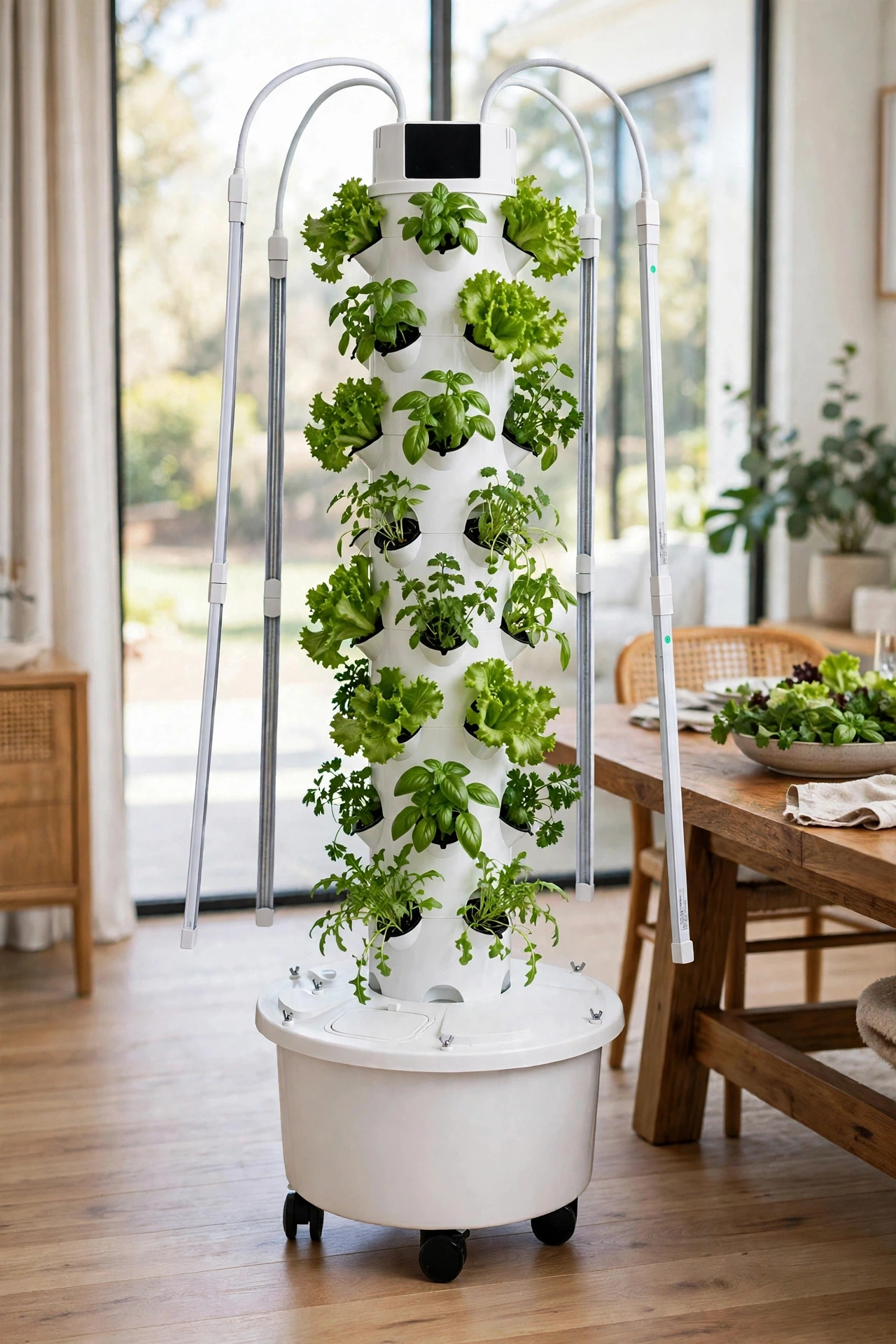

Short answer: Are hydroponic towers worth it? Usually yes — if you grow high-markup crops like fresh herbs and leafy greens, buy during a sale, and keep the tower running year-round. Our 2026 math puts break-even at roughly 2–5 years for a mid-size tower. If you only want an occasional head of lettuce, a tower is an expensive hobby. The honest answer depends on what you grow and how often you harvest.
Nobody should spend $600–900 on a hydroponic tower based on vibes. So let’s do the math properly: real hardware prices, real electricity rates, real grocery prices, and the harvest numbers a home grower can reasonably expect. No inflated promises — planting slots are not a harvest guarantee, and what follows assumes you actually tend the plants.
A tower has two kinds of cost: the one-time hardware bill, and the running costs that keep showing up every year. People who call towers “expensive” usually only look at the first one; people who call them “cheap” usually forget the second.
| Cost item | Typical 2026 range | What this number can’t tell you |
|---|---|---|
| Hardware (40-plant tower, on sale) | $679–$807 | Sale prices change; list prices run $799–$949. Budget towers exist, but build quality varies widely. |
| Electricity (LED + pump) | $90–$150/yr | Depends on your tower’s wattage, light hours, and your state’s rate. California can be 2× the national average. |
| Nutrients (A+B concentrate) | $40–$70/yr | Powdered nutrients cost less per gallon than liquid; heavy feeders like tomatoes drink more. |
| pH adjusters + test kit | $25–$45/yr | Test strips are cheap; a decent pH pen costs $30–50 once and lasts a couple of years. |
| Seeds / seedlings | $20–$60/yr | Buying nursery seedlings is convenient but 5–10× the cost of starting seeds yourself. |
| Replacement parts | $0–$40/yr (averaged) | Pumps and light tubes eventually wear out. A $40 pump every 3–4 years is a realistic expectation. |
Add it up and a 40-plant tower at sale pricing costs roughly $679–$807 up front plus $180–$365 per year to run. The electricity line deserves a look: at the EIA’s national average residential rate of about $0.18/kWh, a tower drawing ~120 W with lights on 15 hours a day uses roughly 54 kWh a month — about $9.70. In Hawaii or California that same tower can cost double. Nutrient costs stay modest because hydroponic solutions are used at low concentrations — a liter of two-part concentrate typically stretches to hundreds of gallons of feed water.
This is where most marketing goes sideways, so let’s stay conservative. A 40-plant tower does not hand you 40 harvests a week. Crops rotate: leaf lettuce takes roughly 30–45 days from transplant to harvest, basil gives repeated cuttings for months, and fruiting crops like cherry tomatoes occupy pods for an entire season.
At steady state, with staggered planting and most pods filled with leafy greens and herbs, a home grower can reasonably expect about 4–8 pounds of greens and herbs per month from a 40-plant tower — call it 50–95 pounds a year. That assumes decent light (14–16 hours daily), the right nutrient strength, and plants that are actually suited to vertical towers. Grow heat-loving fruiting crops through winter without enough light and you’ll get less; grow microgreens-style cut-and-come-again lettuce and you may get more. Nobody can promise your exact harvest — your light, your seeds, and your consistency decide it.
Compare that against what the harvest replaces. USDA retail data (2026) puts organic head lettuce around $3–4, organic basil near $3 per small clamshell, and organic cherry tomatoes near $5 a pint. Fresh herbs carry the most absurd retail markup in the produce aisle — often $30–40+ per pound equivalent. That is the whole economic story of the tower: it isn’t a bulk-calorie machine; it’s a fresh-herb and greens machine.
Break-even math only works if we fix the assumptions. Here are three, all using a 40-plant tower at the $679 sale price, $0.18/kWh electricity, and organic grocery prices. Your numbers will differ — the point is the method, not the exact month.
| Scenario A: greens-heavy | Scenario B: herb-heavy | Scenario C: mixed + fruiting | |
|---|---|---|---|
| What’s planted | ~30 pods leaf lettuce, 10 pods basil | ~25 pods basil/mint/dill, 15 pods greens | 20 pods greens, 12 pods herbs, 8 pods cherry tomatoes/peppers |
| Estimated annual harvest value (organic retail) | $400–$550 | $550–$800 | $450–$700 |
| Annual running costs | $220–$320 | $220–$320 | $280–$400 (more nutrients, more light hours) |
| Net grocery savings / year | $80–$330 | $230–$580 | $50–$420 |
| Hardware payback (at $679) | ~3–8 years | ~1.5–3 years | ~2–10 years (most variable) |
Herbs win because the grocery markup on fresh herbs is enormous and the yield per pod is steady. Fruiting crops have the highest potential value, but also the widest spread — tomatoes that set poorly in weak winter light can land you near the low end. And none of this counts the produce you currently buy and throw away: Americans waste roughly a third of the food they buy, and salad greens are among the worst offenders. Harvesting exactly tonight’s salad from the tower instead of watching a $4 clamshell wilt is a savings category most spreadsheets miss.
Four costs surprise first-time owners:
None of these are deal-breakers. They are just the difference between the brochure’s payback and your payback.
Honesty requires the other side. A tower is probably not worth it if:
There’s also a non-money test: if maintaining the tower feels like a chore by month two, the financial case is moot. The people who get the best return are the ones who enjoy the ritual — checking the tank, snipping basil, watching seedlings take off. Hobby value is real value; it’s just not in the table.
The clearest winners: people who buy organic herbs and greens weekly (the markup you’re replacing is the biggest), apartment dwellers with no garden option, cooks who want produce harvested minutes before eating at peak freshness, and households that currently throw away wilted greens every week. If you recognize yourself in two or more of those, the math tilts strongly in your favor.
If you’re still deciding what to grow, start with the crops that pay back fastest: basil, mint, dill, and leaf lettuce are the forgiving, high-value workhorses of indoor tower growing. Save the cherry tomatoes and strawberries for your second season, once your nutrient and pH routine is solid — see our how hydroponic towers work primer if the plumbing and pumps are still new to you.
We reviewed source material on 2026-10-21.
Research describes general methods; it does not verify any specific model, product claim or customer outcome.
Want the full beginner playbook? Browse the Growing Guides archive.
Roughly 2–5 years for a mid-size tower, based on our 2026 math — faster if you grow lots of fresh herbs, slower if you grow mostly lettuce on expensive electricity. Year-round operation and sale pricing shorten it the most.
They can, mainly on high-markup items like fresh herbs and organic greens. A 40-plant tower can offset roughly $400–$700 a year in organic produce value, against $180–$365 in running costs. Savings assume you harvest and eat what you grow.
Families often get the best return because more people eat more greens — less waste, more harvests consumed. A family that buys organic salad and herbs weekly will break even noticeably faster than a single person who cooks occasionally.
Usually yes on a per-plant basis — a 96-plant tower costs less per planting slot than a 24-plant one. But a bigger tower only pays if you keep it filled and harvest it. A half-empty big tower loses to a full small one.
Modest amounts: a typical tower with LED bars and a pump draws around 100–150 W, running roughly $90–$150 a year at the national average $0.18/kWh. That’s the largest running cost, and it’s worth checking your state’s rate before buying.
They can be, if you start with forgiving crops like basil and leaf lettuce and accept one learning season. Beginners who jump straight to tomatoes or strawberries often get thin harvests and a longer payback.
Buy during a sale, grow at least half your pods with herbs, start seeds yourself, and keep the tower running through winter. Those four moves cut payback time more than any other choice.

